Executive Briefing: The ‘Matri Van’ Urban Forest Initiative
1. Strategic Overview and Ecological Intent
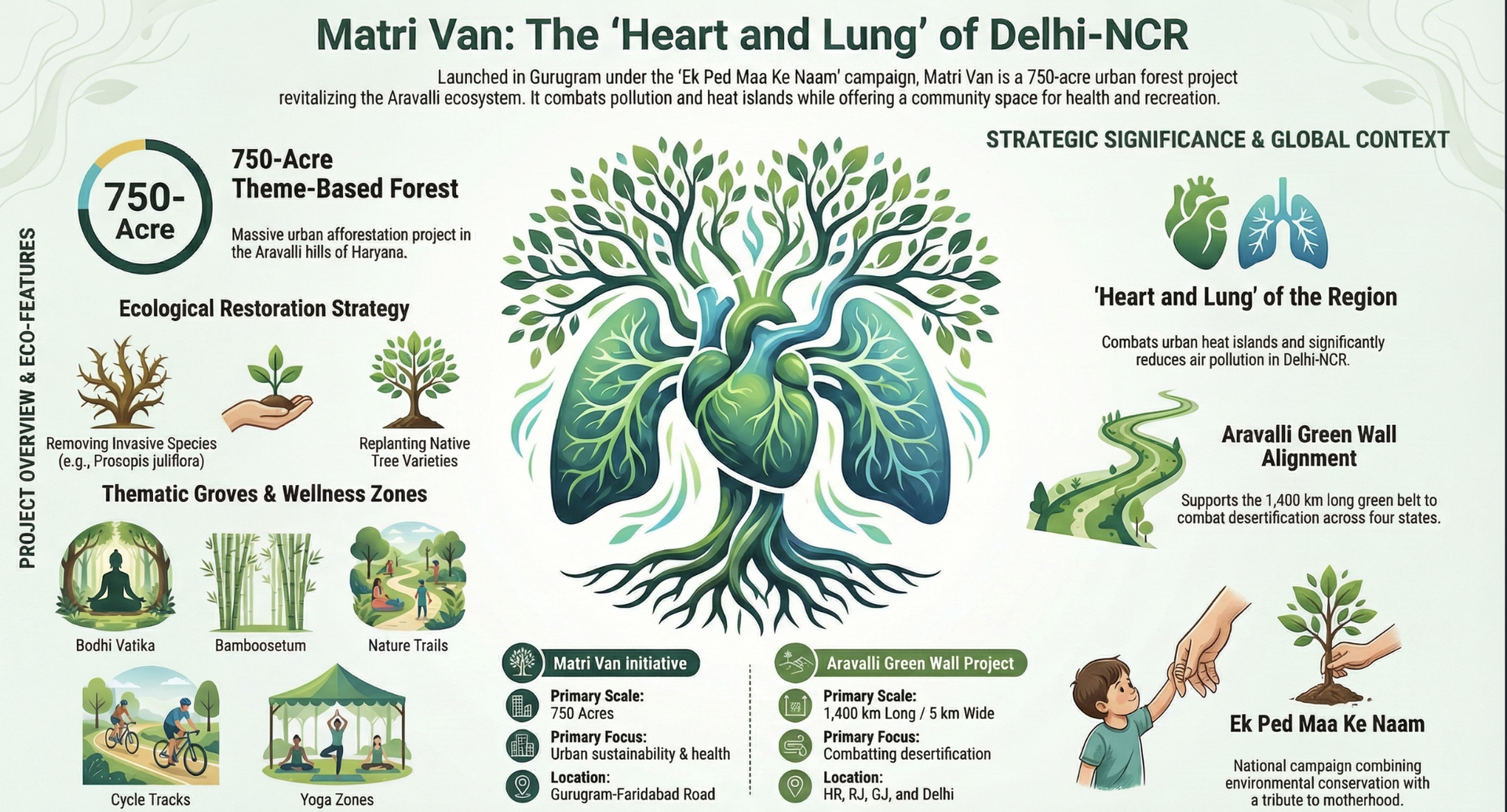
The ‘Matri Van’ initiative represents a pivotal strategic intervention in the National Capital Region’s environmental landscape, transforming 750 acres within the Aravalli Hills into a resilient ecological asset. By reclaiming this degraded terrain for large-scale conservation, the project serves as a critical bridge between modern urban sustainability requirements and India’s profound cultural heritage. This project is not merely an exercise in afforestation; it is a calculated effort to weave ecological stability into the socio-economic fabric of one of India's most rapidly developing urban corridors.
The name ‘Matri Van’ translates to “Mother’s Forest,” a nomenclature that underscores its vision as a unique ecological and cultural sanctuary dedicated to biodiversity, public well-being, and climate-positive development. The initiative is designed to function as a multifunctional space where traditional conservation values intersect with contemporary urban planning. The project’s formal inception signals a high-level administrative commitment to deploying nature-based solutions within the ecologically sensitive Aravalli range.
2. Official Launch and Governance Framework
The successful execution of large-scale environmental infrastructure requires rigorous inter-ministerial coordination to align ecological goals with urban development standards. The collaborative oversight of the Ministry of Environment, Forest, and Climate Change (MoEFCC) and the Ministry of Housing and Urban Affairs (MoHUA) is essential for integrating such a massive green corridor into the complex logistical framework of Gurugram. This dual-ministerial approach ensures that the project benefits from both environmental expertise and urban developmental resources.
Launch Metadata
Key Attribute | Detail |
Date of Launch | August 2, 2025 |
Presiding Union Ministers | Bhupender Yadav (MoEFCC; MP Alwar, Rajasthan) and Manohar Lal Khattar (MoHUA & Ministry of Power) |
Location | Aravalli Hills Region, Gurugram, Haryana |
Organizing Body | Haryana Forest Department |
Affiliated National Programs | Van Mahotsav 2025 and ‘Ek Ped Maa Ke Naam’ |
This official launch provides the necessary regulatory and political momentum to transition the ‘Matri Van’ from a conceptual vision into a practical, partnership-driven execution phase.
3. The Collaborative Development Model and Ecological Strategy
Modern urban development is increasingly adopting the Government-Public Partnership (GPP) model to ensure the long-term viability of green infrastructure. From a strategic perspective, this model is essential for de-risking long-term maintenance costs by sharing the fiscal and operational burden across a broad spectrum of stakeholders. By fostering community ownership, the ‘Matri Van’ project transitions from a static government asset into a shared, self-sustaining public resource.
The project engages a diverse stakeholder landscape:
- Corporate Sector: Integration of CSR partners and Multinational Corporations (MNCs) for funding and long-term stewardship.
- Civil Society: Collaboration with Non-Governmental Organizations (NGOs) and Resident Welfare Associations (RWAs) to drive local engagement.
- Educational Institutions: Involvement of school students to cultivate environmental literacy and intergenerational responsibility.
- Governmental Agencies: Cross-departmental coordination to ensure alignment with regional planning.
The primary ecological restoration strategy involves the systematic replacement of the invasive Prosopis juliflora(locally known as Kabuli Kikar) with indigenous species such as Dhak and Amaltash. This is a critical move; Prosopis juliflora often creates a monoculture that depletes groundwater and suppresses local flora. By reintroducing native trees, the project restores the natural biodiversity balance, allowing indigenous wildlife and vegetation to thrive. This restorative work provides the foundation for the forest's specialized aesthetic and functional zones.
4. Categorized Thematic Zones: The Ten Ecological Pillars
Utilizing "theme-based" forestry is a strategic method to maximize public engagement and maximize the educational value of urban green spaces. By categorizing the forest into distinct botanical and cultural pillars, the project offers a structured narrative of India’s ecological diversity and traditional botanical knowledge.
The forest is organized into ten thematic zones:
- Bodhi Vatika: A sacred grove featuring species such as Bargad (Banyan), Peepal, Gullar, and Pilkhan.
- Bamboosetum: A dedicated collection focused on a diverse group of bamboo species.
- Aravalli Species Arboretum: A specialized repository for the indigenous trees of the Aravalli range.
- Pushp Vatika: A vibrant zone curated as a group of species of flowering plants.
- Sugandh Vatika: An olfactory landscape featuring a group of species known for their natural fragrance.
- Medicinal Plants Vatika: A collection of flora used in traditional and pharmaceutical applications.
- Nakshtra Vatika: A botanical garden aligned with traditional astrological plant associations.
- Rashi Vatika: A thematic space centered on plants associated with the twelve zodiac signs.
- Cactus Garden: A specialized habitat for succulent and desert-adapted flora.
- Butterfly Garden: A pollinator-friendly ecosystem designed to support local butterfly populations.
Specialized Biodiversity Hubs
The Arboretum, Cactus Garden, and Butterfly Garden serve as the initiative's core biodiversity hubs. These areas act as living laboratories for conservation, providing protected habitats for rare local species and vital pollinators. These specialized zones are seamlessly integrated with the physical infrastructure provided for public use.
5. Infrastructure, Amenities, and Resource Conservation
For an urban forest to effectively enhance the well-being of a metropolitan population, it must integrate accessible amenities while strictly maintaining ecological integrity. The infrastructure at ‘Matri Van’ is designed to facilitate a "Lifestyle for Environment" by encouraging low-impact human interaction with the natural world.
Amenity Category | Specific Features |
Active Recreation | Nature trails and dedicated cycle tracks |
Wellness & Leisure | Dedicated yoga spots, sitting places, and gazebos |
Logistics & Access | General public facilities and parking at four distinct corners |
Sustainable Resource Management | Treated water irrigation system |
The implementation of a treated water irrigation system is a hallmark of resource efficiency and aligns the project with circular economy principles. In the semi-arid climate of the Aravallis, utilizing treated wastewater rather than depleting groundwater reserves serves as a scalable model for water conservation in urban development. This commitment to sustainable resource management shifts the project’s significance from a local greening initiative to a landmark of national environmental policy.
6. Policy Alignment and Historical Contextualization
The ‘Matri Van’ initiative is a practical manifestation of India’s broader climate commitments. It serves as a physical touchpoint for Mission LiFE (Lifestyle for Environment), where amenities like nature trails and yoga spots translate abstract sustainability goals into daily public habits. Furthermore, the expansion of this 750-acre green corridor contributes directly to India’s non-fossil fuel energy targets by increasing the nation's capacity for carbon sequestration.
Historical Context: Van Mahotsav The ‘Matri Van’ launch was conducted as part of Van Mahotsav 2025, a flagship national tree-planting festival. Originating in 1950, Van Mahotsav was launched by KM Munshi, the then Union Minister for Agriculture. For over seven decades, this campaign has functioned as India's primary platform for promoting forest conservation and fostering a national culture of environmental responsibility.
The long-term impact of the 'Matri Van' initiative lies in its dual capacity to mitigate carbon emissions through massive green cover expansion and to serve as a blueprint for future urban ecological restoration. By integrating historical conservation traditions with modern circular economy strategies, the project secures a vital green corridor for the future of the National Capital Region.