
Renaming Kerala to "Keralam"
Introduction
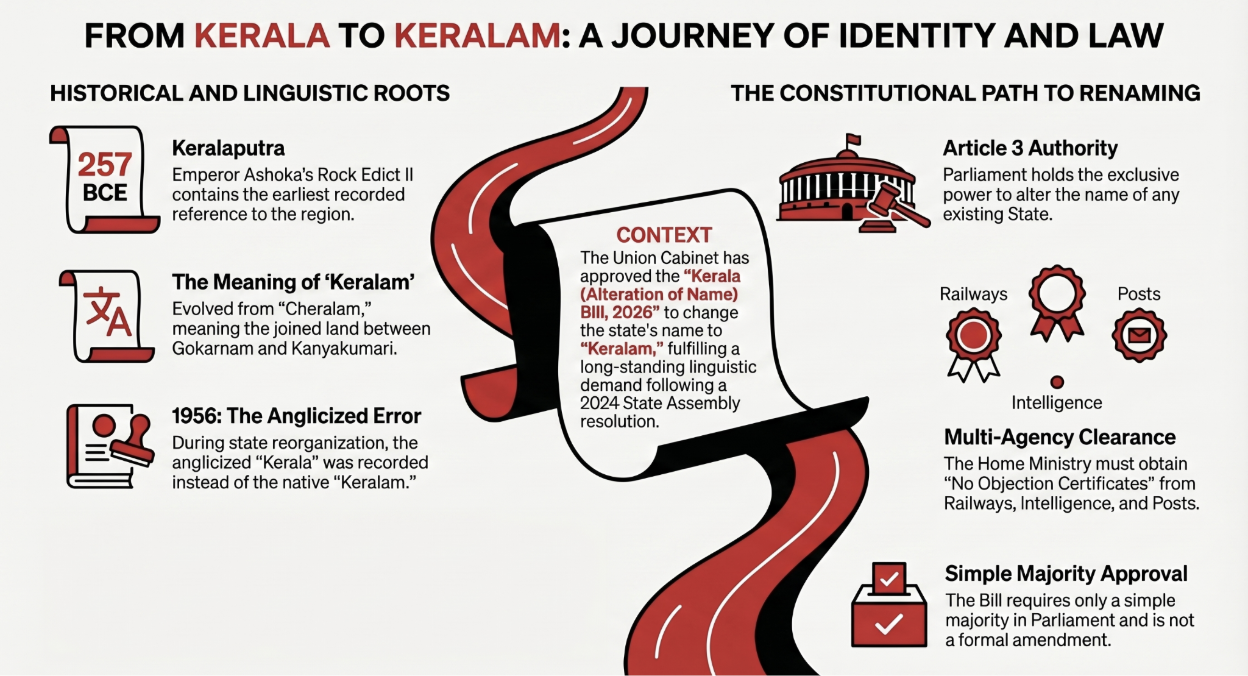
The Union Cabinet has recently approved a proposal to rename the State of Kerala to "Keralam." This administrative shift is being formalised through the Kerala (Alteration of Name) Bill, 2026, which is being processed under the authority of Article 3 of the Indian Constitution. The decision follows a 2024 resolution by the Kerala Legislative Assembly aimed at aligning the state’s official designation with its native Malayalam nomenclature and ensuring linguistic consistency across all languages recognised in the Eighth Schedule of the Constitution.
The renaming process involves a rigorous constitutional procedure requiring clearances from multiple federal ministries and agencies before receiving parliamentary approval and presidential assent. This change addresses a historical discrepancy dating back to the 1956 State Reorganisation, where the anglicised version "Kerala" was recorded in the Constitution instead of the native "Keralam."
Legislative and Constitutional Framework
The renaming of a state in India is a centralised process governed by specific constitutional provisions and administrative protocols.
Article 3 of the Constitution
Under Article 3, the Indian Parliament holds the exclusive authority to alter the name, area, or boundaries of any existing state. The process for renaming a state follows these steps:
State Initiation: The process generally begins with a resolution passed by the State Legislative Assembly, which is then forwarded to the Ministry of Home Affairs (MHA).
Agency Clearances: The MHA seeks "No Objection Certificates" (NOCs) from various stakeholders to ensure the name change does not disrupt administrative or security records. Key agencies involved include:
Ministry of Railways
Intelligence Bureau (IB)
Department of Posts
Survey of India
Registrar General of India
Legal Concurrence: The Department of Legal Affairs and the Legislative Department within the Ministry of Law and Justice must concur with the proposal.
Presidential Recommendation: The Bill can only be introduced in Parliament after receiving the prior recommendation of the President of India.
State Consultation: The President refers the draft Bill to the affected State Legislature for its views within a specified timeframe. Notably, Parliament is not legally bound by these views and may accept or reject them.
Parliamentary Passage: The Bill requires a simple majority in both houses of Parliament. It is not classified as a constitutional amendment under Article 368.
Presidential Assent: Upon receiving the President's signature, the Bill becomes law.
Constitutional Impact
The renaming necessitates an amendment to the First Schedule of the Constitution, which serves as the legal list of all States and Union Territories and their territorial boundaries. The Kerala Assembly has specifically requested that the name "Keralam" be adopted across all official languages in the Eighth Schedule to ensure total linguistic uniformity.
Historical and Etymological Context
The transition from "Kerala" to "Keralam" is rooted in deep historical, linguistic, and political foundations.
Epigraphic Origins
The earliest recorded evidence of the region appears in Rock Edict II of Emperor Ashoka (257 BCE). The edict refers to the region as "Keralaputra," which is widely interpreted by historians as a reference to the ruling Chera dynasty.
Etymological Evolution
Linguistic analysis suggests that "Keralam" evolved from native roots:
Scholarly Research: Herman Gundert, the compiler of the first Malayalam-English dictionary, posited that "Keralam" derived from "Cheram" or "Cheralam."
Root Meanings: The word is composed of the root "cher" (meaning "to join") and "alam" (meaning "land or region").
Historical Definition: Traditionally, "Keralam" denoted the integrated territory situated between Gokarnam and Kanyakumari.
The Aikya Kerala Movement
The demand for a unified state for Malayalam speakers, the Aikya Kerala Movement, gained significant traction in the 1920s. This political movement sought to integrate the regions of Malabar, Kochi, and Travancore.
State Reorganisation (1956)
Following the recommendations of the State Reorganisation Commission (SRC), led by Syed Fazl Ali, the modern state was formed on November 1, 1956 (observed annually as Kerala Piravi Day). While the state was formed on linguistic lines, the Constitution officially recorded the anglicised "Kerala" rather than the native "Keralam."
Comparative Analysis of State Renaming
The proposed change of Kerala to "Keralam" follows an established precedent of states seeking to align their official names with local history and language.
Former Name | New Name | Year of Change |
Uttaranchal | Uttarakhand | 2007 |
Orissa | Odisha | 2011 |
Kerala | Keralam | 2026 (Proposed) |
Conclusion
The renaming of Kerala to "Keralam" represents a movement toward linguistic decolonisation and the restoration of a native identity within the Indian federal structure. By utilising the Article 3 mechanism, the Union government is facilitating a change that aligns the First Schedule of the Constitution with the phonetic and cultural reality of the Malayalam-speaking population.