
Introduction
The 14th Ministerial Conference (MC14) of the World Trade Organization (WTO), held in Yaoundé, Cameroon, concluded without reaching a consensus on several pivotal global trade issues. The conference was marked by a profound "North-South divide," characterized by diverging priorities between developed and developing nations.
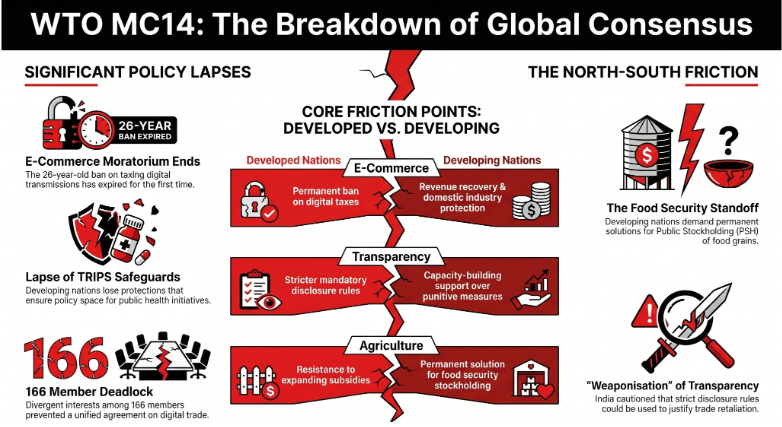
Key outcomes include the expiration of the 26-year-old e-commerce moratorium on customs duties and the lapse of the TRIPS safeguard against non-violation complaints. India emerged as a prominent voice for developing nations, specifically cautioning against the "weaponisation" of transparency norms and demanding a permanent solution for Public Stockholding (PSH) for food security. The failure to reach agreement has resulted in the postponement of critical agenda items to the next General Council meeting in Geneva, underscoring a deepening institutional crisis within the WTO.
Analysis of Key Conference Outcomes
The lack of consensus at MC14 led to the expiration of long-standing agreements and the stalling of several negotiations. The following table summarizes the primary outcomes:
Issue | Status/Outcome | Implications |
E-commerce Moratorium | Expired | Members are theoretically no longer legally barred from taxing electronic transmissions. |
TRIPS Safeguard | Lapsed | Removes protection against non-violation complaints; potentially impacts policy space for public health. |
Fisheries Subsidies | Negotiations ongoing | Aim to provide concrete recommendations for the 15th Ministerial Conference (MC15). |
Investment Facilitation (IFD) | Blocked | India opposed incorporating the China-led agreement into the WTO framework. |
Agriculture (PSH) | Postponed | No permanent solution reached for food security stockholding. |
Dispute Settlement | Stalled | The Appellate Body remains non-functional due to judge appointment blocks. |
Central Themes and Strategic Points of Contention
1. The E-Commerce Moratorium and Digital Trade
Since 1998, WTO members had agreed to a moratorium on imposing customs duties on electronic transmissions, such as software downloads, digital music, and e-books.
The Developed Nation Perspective (US, EU): Advocate for a permanent ban to encourage digital innovation, reduce trade costs, and provide certainty for global technology firms.
The Developing Nation Perspective (India, South Africa): Argue that the moratorium results in billions of dollars in lost customs revenue. As physical goods are replaced by digital versions, these nations lose the policy space necessary to support domestic digital industries and compete with multinational giants.
Plurilateral Progress: While the multilateral moratorium lapsed, a smaller coalition of 66 members (representing 70% of global trade) continued progress on a plurilateral WTO Agreement on Electronic Commerce to establish rules for data flows and consumer protection.
2. The Weaponisation of Transparency Norms
Transparency is a fundamental pillar of the WTO's Technical Barriers to Trade (TBT) agreement, requiring nations to share information regarding trade policies and subsidies.
Proposed Reforms: Developed nations, led by the US, proposed stricter mandatory disclosure rules, including penalties for nations that fail to notify the WTO of domestic policy changes or subsidies in a timely manner.
India’s Cautionary Stance: India argued that transparency should not be used as a tool for trade retaliation or to challenge domestic welfare policies.
Capacity Constraints: Developing nations and Least Developed Countries (LDCs) often lack the institutional and technical capacity to meet complex notification requirements. India maintains that these obligations should be supported by capacity-building rather than punitive measures.
3. Agriculture and Food Security
A significant point of friction remains the issue of Public Stockholding (PSH). India and various African nations have demanded a permanent solution that allows for greater flexibility in domestic food subsidies without the risk of WTO penalties.
Developing World Demands: Flexibility to procure and stock food grains is essential for national food security in the face of market access barriers and climate shocks.
Developed World Resistance: Developed nations have shown little support for expanding PSH flexibilities, leading to a continued deadlock.
4. TRIPS and Public Health
The lapse of the safeguard against "non-violation complaints" under the Trade-Related Aspects of Intellectual Property Rights (TRIPS) agreement is a critical development for public health. Developing countries have historically used this safeguard to ensure that WTO-compliant measures, such as compulsory licensing for medicines, cannot be easily challenged by other members.
Challenges and Requirements for WTO Relevance
The source context identifies several critical areas that must be addressed to restore the WTO’s credibility and functionality:
Restoration of the Dispute Settlement System: The Appellate Body has been non-functional since 2019 because the US has blocked the appointment of new judges. Reviving this body is essential for enforcing trade rules.
Preserving Special and Differential Treatment (S&DT): S&DT must remain a treaty-based right. Reforms should make eligibility more precise and operational so that it benefits genuine developing nations rather than economically powerful ones.
Addressing the Agriculture Deadlock: A permanent solution for PSH must be prioritized to allow poorer nations to manage food security while developed nations reduce their own trade-distorting subsidies.
Inclusive Digital Frameworks: Before making e-commerce rules permanent, the long-term revenue implications for developing nations must be assessed, and technology transfer must be facilitated.
Political Will over National Interests: Member nations are cautioned against viewing shared global problems through narrow national lenses. A fragmented trade system is viewed as detrimental to the long-term interests of both developed and developing economies.
Conclusion
The 14th Ministerial Conference exposed a "crisis of vision" within the WTO. While developed nations prioritize digital-first trade and stricter transparency, developing nations remain focused on foundational issues such as food security and the right to autonomous development. Without equitable compromise and a shift away from punitive transparency, the WTO risks failing to address the very global inequalities it was established to manage.