
Introduction
The Ministry of Health and Family Welfare has implemented a landmark regulatory reform concerning the Food Safety and Standards Authority of India (FSSAI) licensing and registration framework. Following recommendations from NITI Aayog, the government has transitioned from a periodic renewal system to a model of perpetual validity for FSSAI licenses. Key components of this reform include the elimination of dual licensing for over 10 lakh street food vendors, a significant upward revision of turnover thresholds for different licensing tiers effective April 1, 2026, and the introduction of a technology-enabled, risk-based inspection system. These measures are designed to enhance the ease of doing business by reducing administrative burdens, lowering compliance costs, and allowing regulatory bodies to shift their focus from routine paperwork to active food safety enforcement.
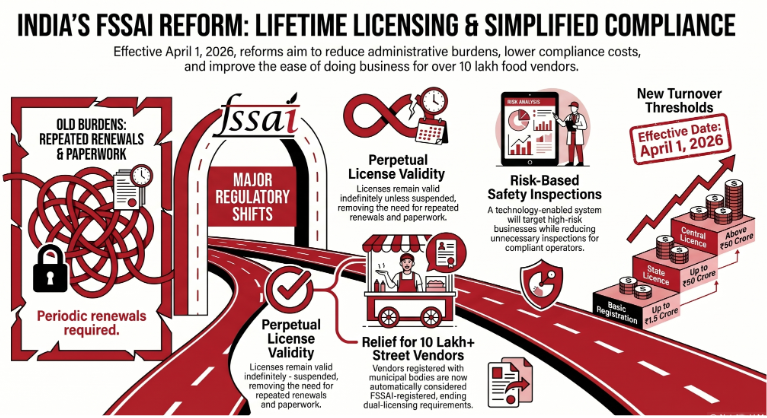
Perpetual Validity for FSSAI Licenses and Registrations
A central pillar of the Health Ministry's reform is the granting of indefinite validity to FSSAI registrations and licenses. This move addresses long-standing challenges associated with the previous periodic renewal system.
Shift in Licensing Lifecycle
Indefinite Duration: Once obtained, a license or registration remains valid indefinitely, provided the business is not found in violation of food safety standards.
Conditions of Validity: Licenses stay active unless they are specifically cancelled or suspended by authorities due to non-compliance.
Reduction in Bureaucracy: The move eliminates the recurring need for food business operators (FBOs) to interact with authorities for routine renewals, which previously required significant paperwork and fees.
Strategic Benefits
Operational Continuity: Businesses no longer face potential interruptions caused by renewal delays.
Cost Efficiency: Reduction in recurring compliance fees and administrative costs associated with managing multiple renewals.
Regulatory Focus: By automating the licensing lifecycle, regulators can redirect resources toward monitoring, surveillance, and the enforcement of food safety standards.
Rationalized Turnover Thresholds
Effective April 1, 2026, the government will implement revised turnover limits to categorize food businesses. This restructuring aims to strengthen the oversight of State authorities and simplify the regulatory pathway for smaller operators.
Category | Previous Turnover Limit | New Turnover Limit (Effective April 1, 2026) |
Basic Registration | Up to ₹12 lakh | Up to ₹1.5 crore |
State Licence | N/A | Up to ₹50 crore |
Central Licence | N/A | Above ₹50 crore |
This rationalization is intended to streamline regulatory oversight and reduce the number of businesses required to seek more complex licensing tiers.
Relief for Street Food Vendors
The reform specifically targets the "dual licensing" burden previously faced by street food vendors, who were often required to register with multiple government departments.
Elimination of Dual Registration
Automatic FSSAI Status: Street vendors already registered with Municipal Corporations or Town Vending Committees under the Street Vendors (Protection of Livelihood and Regulation of Street Vending) Act, 2014, are now automatically considered registered under FSSAI.
Scale of Impact: This decision is estimated to benefit more than 10 lakh street food vendors across India.
Compliance Reduction: By removing the requirement to seek separate registrations from different departments, the government aims to allow vendors to focus on hygiene and business growth rather than administrative compliance.
Modernized Compliance and Inspection Framework
The Ministry is shifting toward a more agile, technology-driven approach to food safety to ensure that the reduction in paperwork does not lead to a decrease in safety standards.
Simplified Business Operations
To facilitate easier market entry and operation for small and medium enterprises, several simplification measures have been introduced:
Instant Registration: Available for many business categories to speed up the commencement of operations.
Pre-inspection Removal: Certain categories of food businesses no longer require a pre-inspection before a license is granted.
Minimal Documentation: Overall paperwork requirements have been significantly reduced.
Risk-Based Inspection System
A new technology-enabled framework will dictate how and when inspections occur, moving away from routine checks toward a more targeted approach. Inspections will now be prioritized based on:
Product Risk: The inherent nature and safety risk level of the food product being handled.
Compliance History: The past record of the business regarding safety standards.
External Audits: Results and data from third-party audits.
Enforcement Data: Insights gathered from ongoing surveillance and enforcement activities.
This system ensures that high-risk entities receive appropriate scrutiny while compliant, low-risk businesses face fewer unnecessary regulatory interventions.