
Introduction
The Transgender Persons (Protection of Rights) Amendment Bill, 2026, introduced by the Ministry of Social Justice and Empowerment, represents a significant shift in the legal framework governing transgender rights in India. The Bill proposes to amend the Transgender Persons (Protection of Rights) Act, 2019, by replacing the principle of self-identification with a mandatory medical certification process. While the government advocates for these changes to prevent the misuse of "vague" definitions and to ensure benefits reach "genuinely oppressed" individuals, transgender activists argue that the Bill contradicts the landmark Supreme Court judgment in National Legal Services Authority (NALSA) v. Union of India (2014). Key highlights include narrower definitions of transgender identity, the introduction of a Medical Board for identity verification, and substantially increased criminal penalties for offenses against transgender persons.
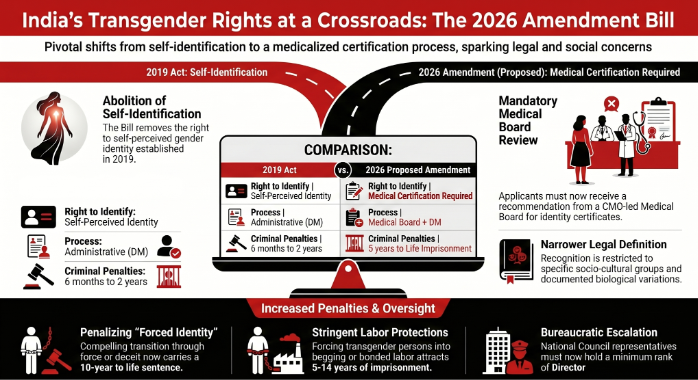
Analysis of Key Legislative Changes
1. The Transition from Self-Identification to Medical Certification
The most controversial aspect of the 2026 Bill is the fundamental change in how a person’s gender identity is legally recognized.
Abolition of Self-Identification: The Bill removes Section 4(2) of the 2019 Act, which granted individuals the right to self-perceive their gender identity. The government contends the original definition was "vague" and rendered various personal and civil laws "unworkable."
Mandatory Medical Board: The administrative process for obtaining identity cards is replaced by a requirement for a recommendation from a Medical Board. This board, headed by a Chief Medical Officer, must evaluate an individual before the District Magistrate can issue a certificate of identity.
Clinical Gatekeeping: Activists fear this returns to a medicalized model of identity, where transgender status is treated as a medical condition rather than a social or personal reality.
2. Narrowing the Definition of "Transgender Person"
The Bill seeks to refine who qualifies for protection under the law, moving away from broad gender fluidity toward specific biological and socio-cultural categories.
Recognition of Specific Groups: The definition now primarily recognizes those within traditional socio-cultural identities, such as kinner, hijra, aravani, and jogta.
Medicalized Biological Criteria: Recognition is extended to those with a specific list of "congenital biological variations," including chromosomal patterns and gonadal development.
Exclusion of Gender Fluidity: The legislation explicitly states it is not intended to protect "every class of persons" with diverse self-perceived sex identities or gender fluidities.
3. Stringent Penalties and New Criminal Categories
The 2026 Bill introduces a new category of crime related to "coerced" identity and significantly increases the severity of punishments for existing offenses.
Offense Category | Targeted Demographic | Proposed Punishment |
Kidnapping for forced identity | Adult | Minimum 10 years Rigorous Imprisonment (RI); extendable to life. |
Kidnapping for forced identity | Child | RI for life and a minimum fine of Rs 5 lakh. |
Forced begging or bonded labor | Adult | 5 to 10 years Rigorous Imprisonment. |
Forced begging or bonded labor | Child | 10 to 14 years Rigorous Imprisonment. |
Coerced Medical Procedures | N/A | Penalizes compelling a person through force, deceit, or allurement to undergo emasculation or hormonal changes. |
Critical Concerns and Institutional Impact
Reversal of Legal Progress
Critics argue the Bill directly undermines the NALSA (2014) verdict, which held that the Right to Self-Determination is a fundamental right that does not require medical proof. There is a fear that the 32,424 individuals who have already received certificates under the 2019 Act may be forced to "re-prove" their identity under the new, stricter criteria.
Impact on Non-Traditional Identities
By focusing on traditional groups like Hijras, the Bill may delegitimize transgender persons who live outside these systems (such as the guru-chela system), potentially leaving them without legal standing.
Administrative and Bureaucratic Oversight
The Bill proposes that representatives on the National Council for Transgender Persons from States/UTs must hold a minimum rank of Director. This indicates a move toward higher-level bureaucratic control over the implementation of transgender welfare policies.
Statistical and Historical Context
Population Data: According to Census 2011, India’s transgender population is approximately 4.88 lakh. The highest populations are found in Uttar Pradesh, Andhra Pradesh, and Maharashtra.
Legal Precedent: The NALSA v. Union of India (2014) judgment recognized transgender persons as the "third gender" and affirmed self-identification as a fundamental right.
Current Framework: The 2019 Act forbids discrimination in education, employment, and healthcare, but the 2026 Amendment seeks to tighten the eligibility for these protections.
Recommendations for Future Empowerment
To ensure the dignity and inclusion of transgender persons, the following measures are identified as critical:
Restoring Autonomy: Aligning laws with the NALSA judgment to ensure gender identity remains a matter of personal autonomy rather than medical certification.
Healthcare Access: Standardizing Gender Reassignment Surgery (GRS) and hormone therapy in government hospitals to ensure they are affordable and safe. This includes integrating transition-related care into schemes like Ayushman Bharat.
Economic Integration: Scaling models like Karnataka's 1% job reservation and corporate diversity hiring. A 2021 World Bank report suggests that fully integrating transgender persons into the workforce could boost India's GDP by 1.7%.
Sensitization: Training police, medical boards, and District Magistrates to interact with the community without prejudice or "gatekeeping" behavior.
Cultural Advocacy: Supporting inclusive platforms such as the Koovagam Festival in Tamil Nadu and community-led sports initiatives like the Ya_All Sports Club in Manipur.