
Introduction
In the judgment of Rachana Gangu vs Union of India (March 10, 2026), the Supreme Court of India addressed the constitutional necessity of providing a structured redressal mechanism for individuals who suffered serious Adverse Events Following Immunization (AEFI) during the COVID-19 pandemic. While the Court reaffirmed the legality of the vaccine regulatory approval process and the safety of the immunization program, it ruled that the absence of a uniform compensation policy violates the Right to Life and Health protected under Article 21 of the Constitution.
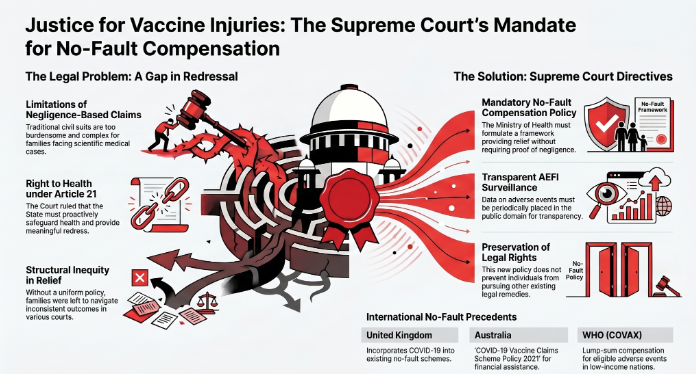
The Court concluded that in the context of a mass, State-led public health intervention, the burden of proving negligence in civil or consumer courts is an "onerous" and "ill-suited" remedy for affected families. Consequently, the Court directed the Union of India to formulate a "no-fault compensation framework" for serious vaccine-related injuries and deaths, aligning Indian policy with international standards and the State’s welfare obligations.
Procedural and Factual Context
The proceedings originated from a writ petition filed under Article 32 by parents whose children died following COVID-19 vaccination. This case was consolidated with several similar petitions transferred from the Kerala High Court.
Representative Cases of AEFI Cited
The petitions detailed various severe medical outcomes following vaccination, including:
Cerebral Venous Sinus Thrombosis (CVST): An 18-year-old female died after a drop in platelet count and severe headache following her first dose.
Multisystem Inflammatory Syndrome (MIS-C/A): A 20-year-old female died one month after vaccination.
Thrombotic Thrombocytopenia (TTS): Multiple cases involving internal bleeding and death; one 37-year-old woman’s medical report specifically identified TTS as a "rare complication of the Covishield vaccine."
Neurological Conditions: Cases of limbic encephalitis and paralysis attributed by neurologists to vaccine administration.
Thrombocytopenia: A pregnant woman carrying twins died from this condition 14 days after vaccination.
Core Arguments
Petitioner Contentions
The appellants alleged structural defects in India’s vaccine governance, citing:
Lack of Informed Consent: Claims that the Drug Controller General’s statement that vaccines were "110% safe" created a false sense of security.
Effective Compulsion: While ostensibly voluntary, travel restrictions and limited access to public spaces for the unvaccinated created an atmosphere of coercion.
Surveillance Lapses: Failure to publish timely causality assessments or maintain a transparent portal for serious adverse events.
International Precedent: Notes that by early 2021, 18 European countries had restricted the AstraZeneca vaccine (Covishield’s version) due to fatal blood clotting disorders (VITT/TTS).
Respondent Contentions (Union of India)
The Union of India defended the immunization program on the following grounds:
Rigorous Review: Vaccines were approved through a multi-layered expert process involving CDSCO, NTAGI, and NEGVAC.
Scientific Findings: Studies by the ICMR and NCDC found no direct link between vaccines and "sudden deaths," categorizing TTS as an extremely rare event in India (0.001 per lakh doses).
Existing Remedies: Argued that aggrieved parties could approach consumer courts for negligence-based damages or seek remedies against manufacturers, who do not enjoy legal immunity in India.
Adequate Surveillance: Claimed the AEFI monitoring system, which includes cardiologists and neurologists, is transparent and effective.
Judicial Analysis and Legal Reasoning
Extension of the Right to Health
The Court anchored its reasoning in the evolution of Article 21, asserting that the State bears a "positive obligation" to safeguard health.
Precedent Support: Citing State of Punjab v. Ram Lubhaya Bagga, the Court noted that the State cannot claim it has no obligation to provide medical facilities.
Welfare Duty: Under Articles 41 and 47 of the Directive Principles, the State is the "active guardian of welfare and dignity," particularly in public health crises.
Limitations of Fault-Based Liability
A central finding of the Court was that traditional legal remedies—which require proving negligence or malfeasance—are insufficient for vaccine injuries.
Complexity of Attribution: Scientific causality is often too complex for families to prove in a standard civil suit.
Inequality of Access: Multiplicity of individual proceedings risks inconsistent outcomes and violates Article 14 (Equality before the law).
State Responsibility: Because the State led the mass intervention, it cannot "shrug its responsibility" toward those who suffered grave outcomes, even if such outcomes were rare.
The Principle of No-Fault Compensation
The Court advocated for "no-fault liability," where relief is granted without a prolonged inquiry into negligence. The judgment cited several international models as evidence of a global standard:
Country/Organization | Policy Detail |
Australia | Introduced the 'COVID-19 Vaccine Claims Scheme Policy 2021' for financial assistance. |
United Kingdom | Incorporated COVID-19 vaccines into its existing no-fault scheme as of Dec 2020. |
Japan | Covers wide-ranging adverse reactions under a scheme dating back to 1976. |
WHO (COVAX) | Provided lump-sum compensation for eligible individuals in low/middle-income countries. |
Final Directions of the Court
The Court issued the following mandates to resolve the petitions:
Formulation of Policy: The Ministry of Health and Family Welfare must expeditiously create and publicize a no-fault compensation framework specifically for serious AEFI related to COVID-19 vaccination.
Continued Surveillance: The Union of India must ensure that AEFI monitoring remains efficient and that data is placed in the public domain transparently, as previously directed in Jacob Puliyel v. Union of India.
No Independent Medical Board: The Court declined to appoint a new independent expert board, finding that the existing National and State AEFI Committees are an adequate mechanism for scientific assessment.
Legal Protections: The Court clarified that the new framework does not preclude individuals from pursuing other legal remedies, nor does it constitute an admission of "fault" or "negligence" by the Union of India.
Conclusion of the Court
The Court recognized that while the vaccination program saved countless lives, the Constitution does not view the Right to Life solely through the lens of fault. The State's obligation extends to providing an accessible "equitable mechanism of redressal" for harm occurring during national public health interventions.