
Introduction
On March 19, 2026, a nine-judge Constitution bench of the Supreme Court of India reserved its verdict on the legal definition of "industry" under the Industrial Disputes Act, 1947. This proceedings aims to determine the legal correctness of a landmark 1978 judgment that significantly expanded the scope of labor protections. The court's decision will clarify whether hospitals, educational institutions, and government welfare departments should remain under the purview of the Act. Central to the deliberations is whether the "expansive interpretation" established nearly five decades ago remains valid in the context of subsequent legislation, including the Industrial Disputes Act, 1982, and the Industrial Relations Code, 2020.
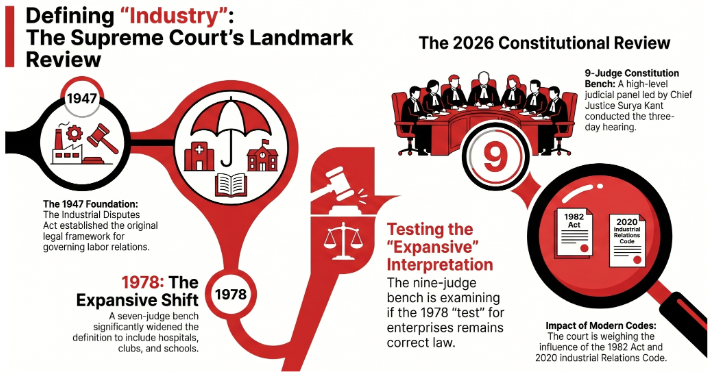
The Nine-Judge Constitution Bench
The hearing lasted three days and involved submissions from high-ranking government legal officers and senior advocates. The bench, led by Chief Justice Surya Kant, is comprised of the following justices:
Position | Name |
Head of Bench | Chief Justice Surya Kant |
Member Justice | B V Nagarathna |
Member Justice | P S Narasimha |
Member Justice | Dipankar Datta |
Member Justice | Ujjal Bhuyan |
Member Justice | Satish Chandra Sharma |
Member Justice | Joymalya Bagchi |
Member Justice | Alok Aradhe |
Member Justice | Vipul M Pancholi |
Key Counsel Involved:
Attorney General R Venkataramani
Additional Solicitor General K M Nataraj
Senior Advocates: Shekhar Naphade, Indira Jaising, C U Singh, and Sanjay Hegde.
Historical Context: The 1978 Precedent
The current deliberations focus on the validity of the verdict delivered on February 21, 1978, by a seven-judge bench in the case of Bengaluru Water Supply and Sewerage Board.
The Expansive Interpretation: The 1978 ruling, specifically the opinion rendered by Justice V R Krishna Iyer, widened the definition of "industry."
Impact: This interpretation brought millions of employees under the protection of the Industrial Disputes Act, 1947.
Covered Entities: The expanded definition included:
Hospitals
Educational institutions
Clubs
Government welfare departments
Core Legal Questions for Adjudication
On February 16, 2026, the Supreme Court formulated specific issues to guide the nine-judge bench's adjudication. The primary objective is to determine if the 1978 "test" for an undertaking or enterprise remains the correct law.
1. Validity of the Bengaluru Water Supply Test
The court is examining the legal correctness of the tests laid down in paragraphs 140 to 144 of the 1978 opinion to determine if an enterprise falls within the definition of "industry."
2. Impact of Subsequent Legislation
The bench will evaluate how the following legislative developments affect the interpretation of the expression "industry" as found in the principal 1947 Act:
The Industrial Disputes Act, 1982
The Industrial Relations Code, 2020
3. Classification of Government Activities
A critical component of the inquiry is whether activities undertaken by the state can be classified as "industrial." Specifically, the court will decide:
Whether social welfare activities and schemes undertaken by government departments or their instrumentalities can be construed as "industrial activities" under Section 2 of the Industrial Disputes Act, 1947.
Conclusion
The Supreme Court’s reserved verdict represents a significant moment in Indian labor law. By revisiting the 1978 Bengaluru Water Supply case, the nine-judge bench is poised to redefine the boundaries between labor relations, social welfare, and government administration. The outcome will determine the future legal protections for millions of workers across various sectors that were previously integrated into the "industry" definition by judicial interpretation.