
Introduction
On April 18, 2026, the Lok Sabha failed to pass the Constitution (131st Amendment) Bill, 2026. The legislation was designed to accelerate the implementation of the 33% reservation for women in Indian legislatures, originally introduced by the 106th Constitutional Amendment Act (2023), by authorizing a delimitation exercise based on the 2011 Census.
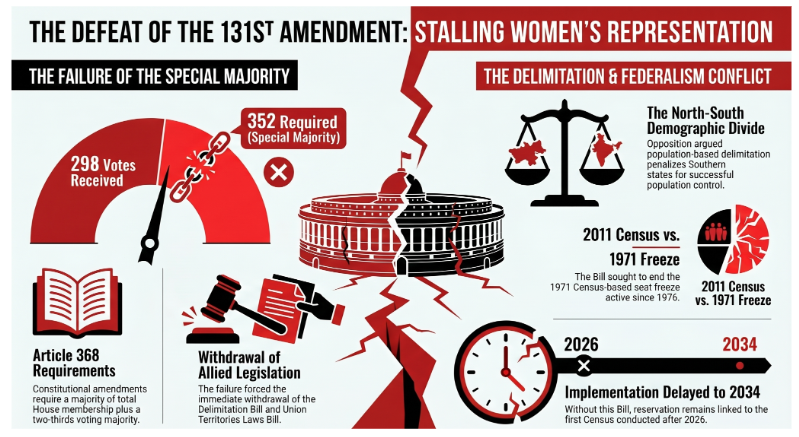
The bill's failure resulted from a lack of the "special majority" required under Article 368 of the Constitution. This legislative collapse necessitated the immediate withdrawal of two dependent bills: the Union Territories Laws (Amendment) Bill, 2026, and the Delimitation Bill, 2026. The primary point of contention centered on the "North-South Divide," with opposition members arguing that population-based delimitation would unfairly penalize Southern states that have successfully implemented population control measures. Consequently, the implementation of women's reservations remains linked to a post-2027 census delimitation, making it unlikely to take effect before 2034.
Core Objectives of the 131st Amendment Bill
The bill was introduced as a strategic intervention to bypass the implementation delays inherent in the 106th Constitutional Amendment, also known as the Nari Shakti Vandan Adhiniyam.
Fast-tracking Reservation: While the 106th Amendment came into force on April 16, 2026, its implementation is deferred by Article 334A, which links it to a delimitation exercise following the first census conducted after 2027.
Targeting 2029: The 131st Amendment sought to decouple this delay by enabling delimitation based on the existing 2011 Census data, aiming to make women's reservations functional by the 2029 elections.
Democratic Principle: The legislation intended to restore the principle of “one person, one vote, one value” by adjusting parliamentary constituency boundaries to reflect current population patterns.
Technical Failure: The Special Majority Requirement
Under Article 368 of the Indian Constitution, amendments require a specific voting threshold known as a special majority. The 131st Amendment Bill failed to meet these criteria in the Lok Sabha.
Voting Breakdown
Category | Requirement / Status | Actual Count |
Total House Strength | 528 Members | — |
Required Majority (Total Membership) | Majority of the House | 265+ Votes |
Required Majority (Present & Voting) | Two-thirds (2/3) of members | 352 Votes |
Actual Votes Secured | Failure to meet 2/3 threshold | 298 Votes |
The bill fell 54 votes short of the required 352-vote benchmark for the two-thirds majority of those present and voting.
Historical Context of Delimitation and the Census
The bill represented an attempt to end a decades-long freeze on the boundaries of parliamentary constituencies.
The 1976 Freeze: The 42nd Constitutional Amendment (1976) froze constituency boundaries based on the 1971 Census to ensure that states' representation in Parliament was not affected by their population control efforts.
The 2001 Extension: The 84th Constitutional Amendment (2001) extended this freeze until the first census conducted after the year 2026.
The Proposed Shift: The 131st Amendment sought to break this freeze early by utilizing 2011 Census data, rather than waiting for the post-2026 census results.
Key Themes and Legislative Roadblocks
The North-South Divide and Federalism
The most significant hurdle to the bill's passage was the demographic disparity between Indian states. Opposition members raised concerns regarding the "penalization" of Southern states. Because these states have effectively managed population growth, a delimitation exercise based strictly on population size (like the 2011 Census) would likely result in a reduced share of parliamentary seats for the South relative to the North.
Decoupling Reservation from Delimitation
A central demand from the opposition was the complete delinking of women's reservation from the delimitation exercise. Critics argued that the rights of women to legislative representation should not be held hostage to the complex and politically sensitive process of redrawing constituency boundaries.
Withdrawal of Dependent Legislation
The defeat of the constitutional amendment triggered a domino effect, leading to the withdrawal of two statutory bills that were contingent upon its passage:
Union Territories Laws (Amendment) Bill, 2026
Delimitation Bill, 2026
Conclusion and Future Outlook
The defeat of the 131st Amendment Bill reaffirms the current timeline established by the 106th Amendment. Unless new legislation is introduced and passed with a special majority, the 33% reservation for women in the Lok Sabha and State Assemblies will remain deferred.
Given that Article 334A requires a census to be conducted after 2027 followed by a delimitation exercise, the most realistic window for the implementation of these reservations is now approximately 2034. The legislative impasse highlights the ongoing tension between the pursuit of gender-based affirmative action and the maintenance of federal balance in a demographically diverse nation.