
Introduction
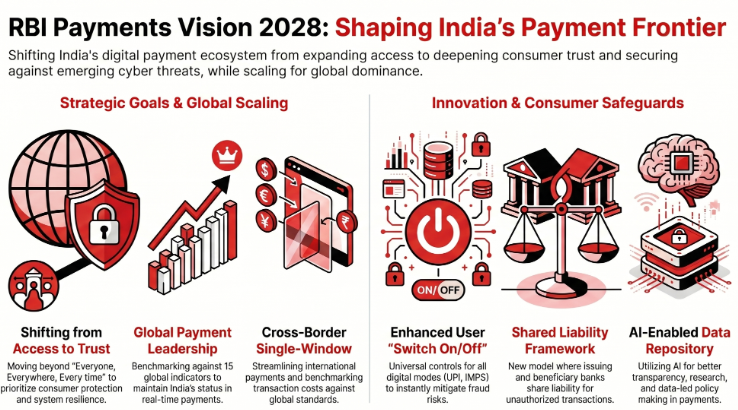
The Reserve Bank of India (RBI) has unveiled "Payments Vision 2028," a strategic roadmap designed to evolve India’s digital payment ecosystem. Succeeding the 2025 "4Es" vision (Everyone, Everywhere, Every time), the 2028 framework shifts the primary focus toward deepening consumer trust and scaling global dominance. The document outlines a comprehensive policy framework aimed at ensuring the digital ecosystem remains secure, interoperable, and resilient against emerging cyber threats. Key pillars of this vision include enhanced user controls, shared liability models for fraud, technological modernization of traditional systems, and a concerted effort to maintain India's status as a world leader in real-time digital payments.
Strategic Shift: From Reach to Trust
The transition from the previous 2025 vision to the 2028 roadmap marks a maturation of the Indian digital payment landscape. While previous efforts focused on expanding the reach of payment systems, the current vision prioritizes:
Deepening Consumer Trust: Strengthening the security infrastructure to ensure users feel safe using digital platforms.
Global Dominance: Benchmarking India’s systems against 15 global indicators to maintain its leadership in real-time transactions.
Resilience and Interoperability: Building systems that are not only interconnected but also capable of withstanding cyber-attacks and technical failures.
Security and Consumer Protection Frameworks
A central theme of the 2028 vision is the empowerment of users through robust safeguards and a more equitable distribution of risk.
Enhanced User Controls
To mitigate fraud, the RBI proposes introducing a "Switch On/Off" facility for all digital payment modes, including UPI and IMPS. This mirrors existing controls for credit and debit cards, allowing users to deactivate their digital payment capabilities when not in use.
Shared Liability Framework
The vision introduces a new responsibility model for unauthorized transactions. Under this framework:
Liability is shared between issuing banks and beneficiary banks.
The goal is to provide a stronger safety net for consumers and ensure both ends of a transaction are incentivized to maintain high security standards.
Cyber Resilience and Monitoring
The RBI will introduce Cyber Key Risk Indicators (KRI) specifically for non-bank payment operators. These indicators serve as early warning signals to identify and address potential security breaches before they escalate.
Technological and Operational Innovations
The 2028 roadmap introduces several technical services designed to improve the efficiency and flexibility of the payment ecosystem.
Feature | Description |
Payments Switching Service (PaSS) | A centralized service enabling Account Portability, allowing customers to migrate payment instructions seamlessly when switching bank accounts. |
AI and Data Integration | Creation of an AI-enabled payments data repository to enhance transparency and support research-led policy making. |
Cheque Modernization | A dual approach involving a review of physical cheque security and the introduction of Electronic Cheques to combine traditional reliability with digital speed. |
Perpetual Regulatory Sandbox | Recognition of Small Payment System Providers (SPSPs) under a sandbox environment to encourage niche innovations. |
Trade and Cross-Border Enhancements
The vision seeks to streamline international transactions and support the domestic manufacturing sector through targeted financial infrastructure improvements.
MSME and Trade Financing
Interoperability in TReDS: The RBI proposes a unified framework for Trade Receivables Discounting Systems.
Expanded Reach: Services will be extended to export-oriented MSMEs to streamline financing.
Economic Impact: These changes, including factoring with recourse, are intended to unlock liquidity for small businesses and support the "Make in India" initiative.
International Payments Overhaul
To improve India's standing in global finance, the roadmap includes:
Single-Window Authorization: Simplifying the process for international payments.
Global Benchmarking: Periodic reviews of transaction costs and speeds against international standards to ensure competitiveness.
Conclusion
The RBI Payments Vision 2028 represents a transition toward a more mature, secure, and globally integrated digital payment environment. By focusing on shared liability, real-time cyber monitoring, and enhanced user controls, the framework aims to solidify consumer confidence while maintaining the innovative momentum that has placed India at the forefront of the global digital payments industry.