
Introduction
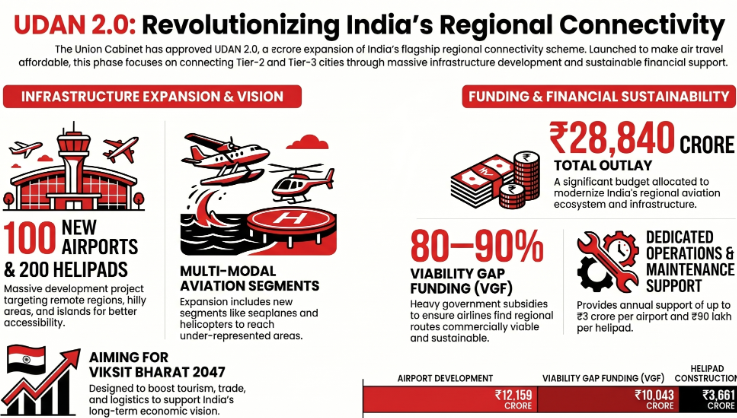
The Union Cabinet has approved the modified UDAN 2.0 (Ude Desh ka Aam Nagrik) scheme, a strategic expansion of India's regional aviation framework first launched in 2016. With a significant financial outlay of ₹28,840 crore, the scheme is designed to transform the domestic aviation landscape by developing 100 new airports and 200 modern helipads. The initiative focuses on enhancing connectivity in Tier-2 and Tier-3 cities, as well as remote and under-represented regions, including the North-East, hilly areas, and islands. By integrating new aviation segments such as seaplanes and helicopters, UDAN 2.0 aims to ensure long-term sustainability and commercial viability for airlines through substantial Viability Gap Funding (VGF) and ongoing operational support. This program is a core component of the "Viksit Bharat 2047" vision, intended to stimulate tourism, trade, and logistics nationwide.
Overview and Strategic Evolution
The original UDAN scheme was established in 2016 to democratize air travel, making it both affordable and accessible to the general public. UDAN 2.0 represents a significant evolution of this mandate, shifting focus from initial establishment to large-scale expansion and operational sustainability.
Key Strategic Objectives
Expansion: Reaching deep into the nation’s interior to connect underserved Tier-2 and Tier-3 cities.
Viability: Ensuring that regional routes remain commercially sustainable for operators.
Modernization: Investing in contemporary infrastructure to support a diverse range of aircraft.
Inclusion: Prioritizing remote regions that have historically lacked reliable transportation links.
Infrastructure Development and Scope
The modified scheme outlines a massive infrastructure buildup intended to bridge the connectivity gap in remote areas.
Target Infrastructure
New Airports: 100 facilities to be developed across the country.
Modern Helipads: 200 units specifically designed to provide connectivity to remote and difficult terrains.
New Segments: For the first time, the scheme provides dedicated support for seaplanes and specialized regional aircraft operations.
Financial Framework and Funding Structure
The total budget for UDAN 2.0 is ₹28,840 crore. The government has segmented this funding to address both the high capital expenditure of construction and the recurring costs of regional operations.
Capital and Operational Expenditure Breakdown
Funding Category | Allocated Amount | Purpose |
Airport Development | ₹12,159 crore | Construction and upgrade of 100 airports. |
Helipad Construction | ₹3,661 crore | Development of 200 modern helipads. |
Viability Gap Funding (VGF) | ₹10,043 crore | Subsidies of 80–90% to make remote routes commercially viable for airlines. |
Operations & Maintenance (O&M) | ₹2,577 crore | Ongoing support for infrastructure upkeep. |
Annual Operational Support Limits
To maintain the quality and safety of the new infrastructure, the scheme provides annual O&M support:
Airports: Up to ₹3 crore per airport annually.
Helipads: Up to ₹90 lakh per helipad annually.
Anticipated Socio-Economic Impact
The government expects UDAN 2.0 to serve as a catalyst for multi-sectoral economic growth, aligned with the broader goals of national development.
Tourism and Accessibility
By opening routes to unexplored regions in the North-East, hilly areas, and islands, the scheme is expected to significantly increase tourist arrivals. Improved accessibility allows for the growth of local hospitality and service industries in previously isolated locations.
Trade and Logistics
Enhanced air connectivity facilitates the faster movement of goods and services. This improvement in logistics is critical for Tier-2 and Tier-3 cities to integrate into the national and global supply chains, fostering local trade.
Regional Integration
The focus on Tier-2 and Tier-3 cities ensures that the benefits of economic growth are distributed more equitably across the country, reducing the reliance on major metropolitan hubs for trade and travel.
Conclusion
UDAN 2.0 is a comprehensive overhaul of India’s regional aviation strategy. Through its massive financial commitment and focus on diverse aviation segments (airplanes, helicopters, and seaplanes), the scheme aims to create a self-sustaining ecosystem that supports the "Viksit Bharat 2047" vision of a developed and hyper-connected nation.