
Introduction
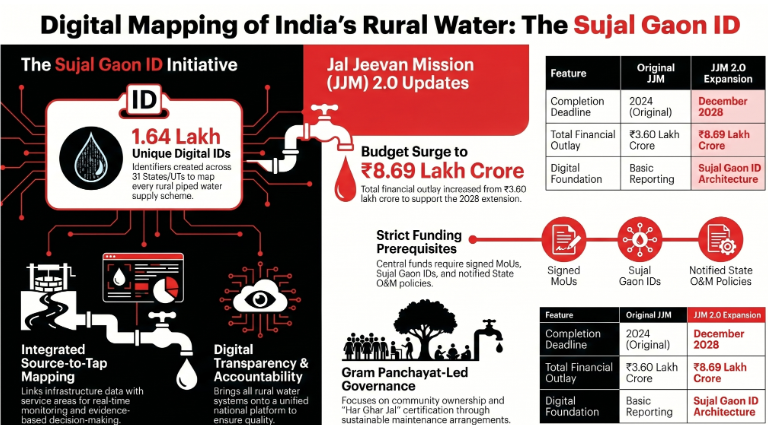
In a significant move toward the digital modernization of India’s rural infrastructure, the Union Ministry of Jal Shakti has launched the Sujal Gaon ID, a unique digital identifier designed to map and monitor every rural piped water supply scheme across the country. This initiative is a cornerstone of the newly extended Jal Jeevan Mission (JJM) 2.0, which aims to achieve universal tap water coverage by December 2028.
The program represents a massive financial commitment, with the total outlay increasing from ₹3.60 lakh crore to ₹8.69 lakh crore. Beyond infrastructure construction, JJM 2.0 shifts the focus toward long-term sustainability, quality assurance, and community-led governance. By integrating infrastructure data with service area mapping through the Sujalam Bharat digital architecture, the government aims to ensure transparency, real-time monitoring, and evidence-based decision-making to support the vision of a "Viksit Bharat @2047."
The Sujal Gaon ID: A Digital Reform for Water Governance
The Sujal Gaon ID serves as the first-of-its-kind unified national digital platform for rural water systems. It is designed to bring transparency to the management of water resources through comprehensive mapping.
Key Technical Aspects
Unique Identification: Each rural drinking water scheme is assigned a unique digital identifier.
Infrastructure Integration: The ID integrates a scheme’s infrastructure data with its specific service area ID.
Current Scale: To date, 1.64 lakh Sujal Gaon IDs have been created across 31 States and Union Territories.
Digital Linking: These IDs are linked to 67,000 Sujalam Bharat IDs, facilitating a "source-to-tap" digital architecture.
Strategic Impact
The digital mapping enables real-time monitoring of rural water supply, reducing the likelihood of technical shortcomings and providing a platform for evidence-based governance. This reform is intended to empower both state officials and local communities by providing a clear digital footprint of every water asset.
Jal Jeevan Mission 2.0: Strategic Roadmap and Financial Reforms
The Cabinet's approval of JJM 2.0 includes an extension of the mission’s timeline and a substantial increase in financial resources. The mission now emphasizes structural reforms and strict compliance for fund disbursement.
Financial Outlay and Compliance
The financial scale of the mission has more than doubled to ₹8.69 lakh crore. However, the release of central funds is now contingent upon States and UTs meeting four specific compliance requirements:
Memorandum of Understanding (MoU): Execution of a formal agreement between the State/UT and the Central government.
Sujal Gaon ID Creation: Full digital mapping of schemes.
Financial Reconciliation: Timely reporting and reconciliation of accounts.
O&M Policy Notification: Official notification of State-level Operation and Maintenance (O&M) policies.
Modes of Fund Release
The government has established specific mechanisms for funding different types of projects:
Mode | Application |
Upfront Payment | Small and non-piped water systems (PWS) in quality-affected areas. |
Reimbursement | Ongoing medium-scale and bulk water supply schemes. |
Viability Gap Funding (VGF) | Public-Private Partnership (PPP) based bulk water schemes. |
No Central Funding | Retrofitting of existing schemes is excluded from central financial support. |
Governance and Community Participation
JJM 2.0 transitions the responsibility of water management to local levels, emphasizing "Jan Bhagidari" (people's participation) and Gram Panchayat leadership.
Localized Management
Gram Panchayat Empowerment: Gram Panchayats are responsible for certifying "Har Ghar Jal" (Water in Every Home) status, which can only be done once sustainable O&M arrangements are finalized.
Asset Management: Panchayati Raj Institutions are being empowered to handle asset management and service delivery.
District Support: The formation of District Technical Units (DTUs) and District Water and Sanitation Mission (DWSM) meetings are mandated to create service improvement plans.
Citizen Oversight and Digital Tools
To ensure accountability, several digital tools have been introduced:
Meri Panchayat App: Strengthens citizen oversight and allows for community-level monitoring of projects.
Jal Seva Aankalan: A system for village-level assessment of service quality and reliability.
Focus on Quality and Sustainability
The Union Minister has underscored that the quality of work is as critical as the quality of the water itself. States are held responsible for the long-term sustainability of systems and must adhere to strict technical standards.
Infrastructure Standards: States must avoid technical shortcomings and are financially responsible for any overspending or non-compliant works.
Socio-Economic Benefits: Beyond health, the mission aims to reduce the drudgery of women, create rural employment, and improve overall public health.
Jal Mahotsav: Community engagement is encouraged through events like Jal Arpan and Jal Utsav. These events, organized at the Gram Panchayat and District levels, are intended to build public confidence and celebrate water security.
Institutional and Policy Reforms
The MoUs signed by States and UTs outline a comprehensive reform agenda, including:
Skilling: Capacity building for the rural water workforce.
Surveillance: Enhanced water quality monitoring and surveillance systems.
Institutional Governance: Clearly defined roles for asset ownership and technical support.
Data Governance: Strict adherence to digital systems and data-driven monitoring protocols.