
Introduction
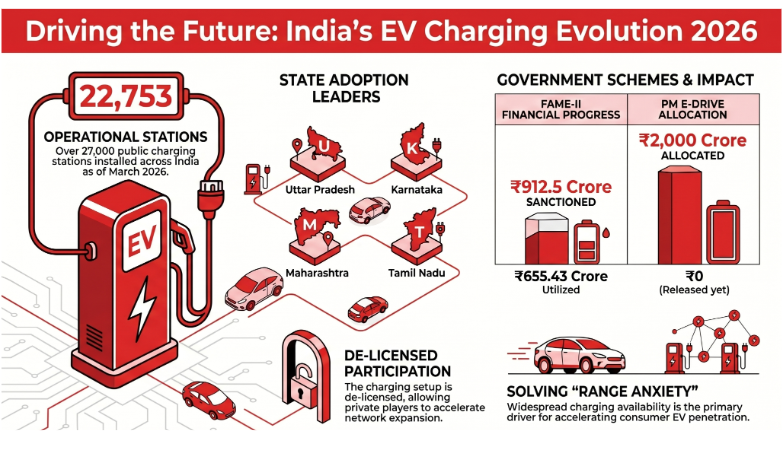
As of March 2026, India’s Electric Vehicle (EV) charging landscape is characterized by significant expansion and a shifting policy framework. With over 27,000 stations installed, the infrastructure serves as the backbone for the nation's transition toward clean mobility. While the Faster Adoption and Manufacturing of (Hybrid &) Electric Vehicles (FAME-II) scheme has reached a mature stage of fund utilization, the newly introduced PM E-DRIVE scheme represents a substantial financial commitment of ₹2,000 crore, though its implementation is in the nascent stages. The de-licensing of charging setups remains a pivotal policy lever, successfully inviting private sector participation to mitigate "range anxiety" and decrease fossil fuel dependency.
Infrastructure Overview and Definitions
Electric Vehicle Charging Infrastructure encompasses the network of Public Charging Stations (EVPCS) required to supply electricity for recharging electric vehicles. This infrastructure is categorized into three primary delivery systems:
Public Systems: Open-access stations for general use.
Private Systems: Restricted-access units often used for residential or commercial fleets.
Highway-Based Systems: Critical infrastructure placed along transit corridors to facilitate long-distance travel.
Current State of Deployment (Data through March 2026)
The growth of India’s EV charging network shows a robust installation rate, though a gap remains between installed hardware and operational availability.
Key Infrastructure Statistics
Metric | Detail |
Total Installed Stations | 27,737 |
Total Operational Stations | 22,753 |
Regulatory Status | De-licensed (Enabling private participation) |
Regional Leadership
Installation density is highest in industrialized and high-urbanization states. The leading states in EVPCS deployment are:
Uttar Pradesh
Karnataka
Maharashtra
Tamil Nadu
Policy Framework and Financial Incentives
The Government of India has utilized two primary schemes to incentivize the development of charging networks. The transition between these schemes marks a critical juncture in the 2026 fiscal environment.
FAME-II Scheme
The FAME-II scheme has been the primary driver of infrastructure growth to date.
Sanctioned Funds: ₹912.5 crore.
Utilized Funds: ₹655.43 crore.
Impact: Provided the initial capital necessary for widespread installation across major cities and highways.
PM E-DRIVE Scheme
The PM E-DRIVE scheme represents the next phase of government support, with a significantly larger budget aimed at scaling the network further.
Allocated Funds: ₹2,000 crore.
Status: As of the latest report, no funds have been released yet, indicating that the impact of this scheme is expected in the subsequent fiscal periods.
Strategic Significance of EV Infrastructure
The expansion of the EVPCS network is not merely an engineering requirement but a strategic necessity for India’s broader economic and environmental goals:
Decarbonization and Energy Security: Facilitates a structural shift from fossil fuel-based transport to clean mobility. This reduces overall carbon emissions and lessens the national dependence on imported oil.
Mitigation of Range Anxiety: The visibility and availability of charging stations are critical to accelerating consumer adoption of EVs, as they address the primary psychological barrier (fear of running out of power).
Economic Growth: The development of green infrastructure encourages domestic and foreign investment, fosters technological innovation in the energy sector, and creates new employment opportunities within the EV ecosystem.
Governance and Implementation
The government has adopted a liberalized regulatory approach by de-licensing the setup of EV charging stations. This move is designed to:
Foster public-private partnerships.
Encourage private sector entrepreneurs to enter the market without the burden of traditional utility licensing.
Ensure that the speed of infrastructure deployment keeps pace with the increasing sales of electric vehicles.