
This briefing document synthesizes critical updates regarding India’s energy efficiency framework and recent scientific findings on glacial hazards in the Himalayan region.
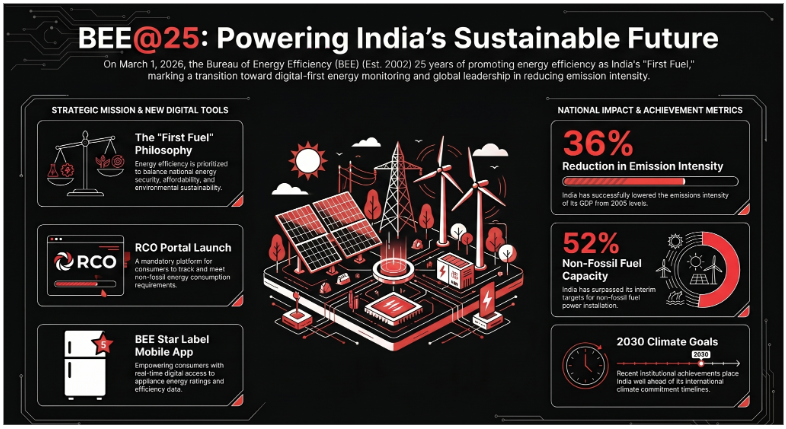
On March 1, 2026, the Bureau of Energy Efficiency (BEE) marked its 25th Foundation Day by introducing new digital oversight mechanisms and reporting significant progress toward national climate targets. Central to these updates is the conceptualization of energy efficiency as India’s "First Fuel," critical for maintaining energy security and affordability. Notably, India has achieved a 36% reduction in emission intensity of its GDP from 2005 levels, surpassing interim targets.
Parallelly, a study by the Indian Space Research Organisation (ISRO), published in NPJ Natural Hazards, provides a forensic analysis of the August 2025 flash flood in Dharali, Uttarakhand. The research identifies "ice-patch collapse", a phenomenon distinct from Glacial Lake Outburst Floods (GLOFs), as a significant and under-monitored risk driven by deglaciation and warming temperatures. These findings necessitate a shift in disaster monitoring strategies toward smaller, exposed ice instabilities in high-altitude nivation zones.
Part I: Bureau of Energy Efficiency (BEE) 25th Foundation Day
The BEE, a statutory body under the Ministry of Power, celebrated its silver jubilee by reaffirming its role as the lead agency for reducing the energy intensity of the Indian economy.
Institutional Framework and Strategic Vision
Establishment: Founded on March 1, 2002, under the provisions of the Energy Conservation Act, 2001.
Core Mandate: To reduce energy intensity (energy used per unit of economic output) through multi-sectoral interventions in industry, transport, buildings, agriculture, and appliances.
Operational Structure: BEE coordinates national policies through State Designated Agencies (SDAs) to ensure localized implementation across the federal structure.
Key Performance Indicators and Achievements
The BEE’s efforts have contributed significantly to India’s international climate commitments, reaching milestones well ahead of the 2030 timeline:
Metric | Achievement Level (as of 2026) | Baseline/Target Reference |
Emission Intensity Reduction | 36% Reduction | Relative to 2005 levels |
Non-Fossil Fuel Capacity | 52% of Total Installed Capacity | 2030 Climate Targets |
New Digital Initiatives Launched
To commemorate its 25th year, the BEE launched several tools designed to enhance transparency and consumer engagement:
Renewable Consumption Obligation (RCO) Portal: A mandatory monitoring platform established under the Energy Conservation (Amendment) Act, 2022. It requires designated consumers to source a specific minimum percentage of electricity from non-fossil sources (e.g., solar, wind, hydro, and biomass).
BEE Star Label Mobile App: A digital tool aimed at empowering consumers by providing accessible information on the energy efficiency of appliances.
BEE@25 Logo: A commemorative symbol representing the agency's commitment to energy efficiency as a national priority.
Part II: ISRO Study on Srikanta Glacier and Himalayan Flash Floods
A forensic study by ISRO scientists investigates the mechanisms behind the August 2025 flash flood that impacted Dharali village in Uttarakhand, revealing new insights into the vulnerabilities of the Himalayan cryosphere.
The Dharali Village Incident
Dharali is situated in the upper Bhagirathi river basin in the Uttarkashi district. The village is uniquely vulnerable due to its position along the Khir Gad stream, which originates from the Srikanta glacier and bisects the village into right- and left-bank settlements before joining the Bhagirathi River.
Srikanta Glacier Profile
Type: Small to medium-sized valley glacier.
Elevation: 6,133 meters.
Topography: Characterized by steep accumulation and ablation zones, seasonal snow cover, and extensive nivation areas.
Status: A retreating glacier significantly impacted by rising regional temperatures.
Mechanism of the Hazard: Ice-Patch Collapse
The ISRO study concludes that the 2025 flood was not a standard GLOF but was triggered by an ice-patch collapse within the glacier's nivation zone.
Nivation Defined: The erosion of ground beneath and around a snow bank, caused by alternate freezing and thawing cycles.
The Collapse Trigger: High-resolution satellite imagery and topographic analysis revealed that warming temperatures have thinned the seasonal snow and firn cover. While firn-covered ice is resistant to short-term temperature fluctuations, exposed ice patches on steep north-to-northeast facing slopes become unstable and are prone to sudden detachment.
Scientific and Policy Implications
The ISRO study advocates for a broader paradigm in glacial hazard monitoring:
Beyond GLOFs: Current monitoring focuses heavily on glacial lakes. The study argues that smaller, overlooked instabilities—such as exposed ice patches—represent a critical, under-recognized risk.
The Role of Satellite Monitoring: Pre-event imagery during the ablation period (when the glacier loses ice and snow) is vital for identifying unstable ice patches.
Disaster Preparedness: Integrating satellite-based observations of nivation zones into early warning systems can improve climate risk understanding and community preparedness in the high-altitude Himalayan ridge-to-valley systems.