
Introduction
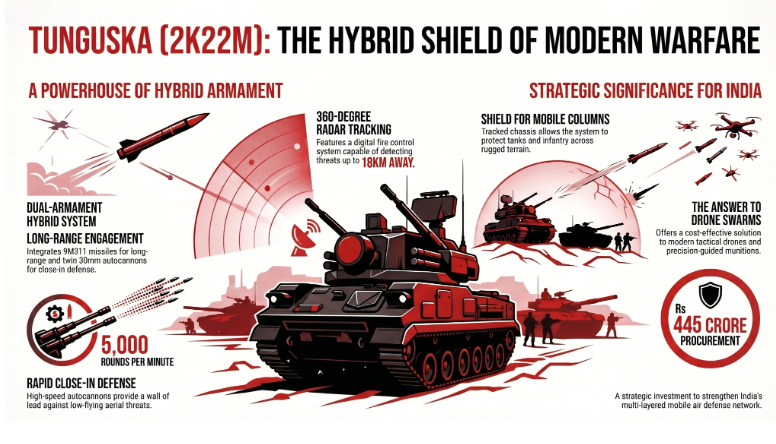
The Ministry of Defence has finalized a Rs 445 crore contract with Russia’s JSC Rosoboronexport to procure the Tunguska Air Defence Missile System (2K22M) for the Indian Army. Known by the NATO reporting name SA-19 Grison, the Tunguska is a Soviet-origin, tracked, self-propelled anti-aircraft platform. It is distinguished by its hybrid design, which integrates both surface-to-air missiles and high-speed autocannons on a single mobile chassis.
The system is specifically engineered to provide low-altitude protection for infantry and armored regiments against a variety of threats, including attack helicopters, cruise missiles, and modern tactical drones. For the Indian Army, the Tunguska serves as a critical asset for protecting mobile columns and offers a cost-effective solution for neutralizing swarm drone threats through its rapid-fire gun capabilities.
System Overview and Development
The Tunguska (2K22M) was originally developed by the KBP Instrument Design Bureau in the Soviet Union. Currently, the system's management and international export are handled by JSC Rosoboronexport in Russia.
Core Architecture
Platform Type: Tracked, self-propelled anti-aircraft weapon system.
Hybrid Capability: The system is unique for its integration of dual-layered defense mechanisms—missiles for long-range engagement and guns for close-in protection.
Mobility: Mounted on a tracked armored chassis, the system is designed for high mobility, allowing it to maintain pace with tanks and infantry fighting vehicles across rugged terrain and in varying weather conditions.
Technical Specifications and Armament
The 2K22M system utilizes a dual-armament approach to engage aerial targets at multiple ranges and altitudes.
Dual-Armament Hybrid System
Feature | Missile Component | Gun Component |
Model | 9M311 Missiles | Twin 30 mm Autocannons |
Engagement Range | 8 – 10 km | Close-in defense |
Fire Rate | N/A | Up to 5,000 rounds per minute |
Max Altitude | Up to 3,500 meters | Close-in saturation |
Operational Capabilities
Target Acquisition: The system features a 360-degree radar capable of detecting threats at a distance of up to 18 km.
Precision Control: Engagement is managed via a digital fire control system to ensure high accuracy.
Electronic Warfare Resilience: The system includes an optical backup for tracking and engagement. This allows the Tunguska to remain operational even in environments where its primary radar is being compromised by enemy jamming or electronic warfare.
Primary Defensive Objectives
The Tunguska is designed to fill the defensive gap between man-portable systems and long-range, high-altitude missile batteries. Its primary mission is the protection of ground troops on the move from low-altitude aerial threats.
Targets include:
Manned Aircraft: Attack helicopters and close-support aircraft.
Guided Munitions: Cruise missiles and precision-guided munitions.
Unmanned Systems: Modern tactical drones and Unmanned Aerial Vehicles (UAVs).
Strategic Significance for India
The procurement of the Tunguska system provides several strategic advantages to the Indian Army’s current defense posture:
Countering Drone Swarms: As modern warfare increasingly utilizes drone-heavy tactics, the system’s high-speed 30 mm autocannons provide an efficient and cost-effective method to neutralize drone swarms compared to using expensive missiles.
Multi-Layered Network: The Tunguska strengthens India's multi-layered air defense network by providing specialized protection for the "low-altitude" tier.
Mobile Force Protection: It acts as a vital shield for mobile army columns, which are often vulnerable to sudden aerial strikes while maneuvering in the field.