
Introduction
The Digital Trade Facilitation Bill, 2026, represents a landmark legislative effort by the Indian government to modernize cross-border trade procedures. Introduced in February 2026 by the Directorate General of Foreign Trade (DGFT) under the Ministry of Commerce and Industry, the Bill seeks to transition India from a paper-heavy trade environment to a fully digitized, "paperless" ecosystem. By providing legal recognition to electronic trade documents and harmonizing digital signatures and trust services, the legislation aims to reduce transaction costs, minimize human error and fraud, and drastically accelerate the speed of global trade—shifting processing times from days to minutes. This reform is a central pillar of the "Ease of Doing Business 2.0" framework, supported by broader fiscal adjustments like the rationalization of the Minimum Alternate Tax (MAT) to 14%.
Overview of the Legislative Intent
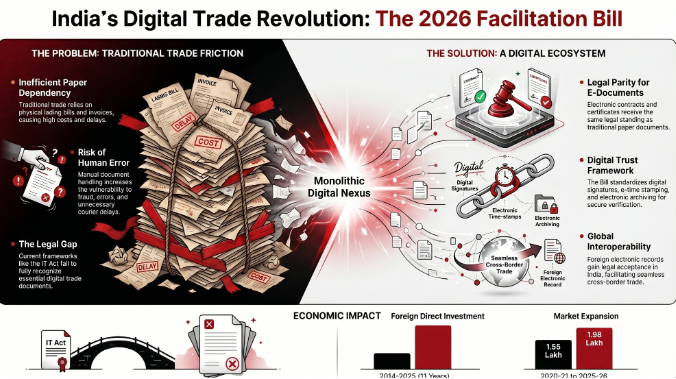
The Digital Trade Facilitation Bill was drafted to address the limitations of existing legal frameworks, such as the IT Act, which do not provide full recognition for certain critical digital trade documents. As global trade becomes increasingly intertwined, the traditional reliance on physical paperwork—including bills of lading, invoices, and letters of credit—has become a bottleneck characterized by delays and high overheads.
The fundamental objectives of the Bill include:
Legal Validity: Establishing enforceability and validity for digital trade documents so they cannot be rejected solely because they are in electronic form.
Cross-Border Endorsement: Facilitating the international exchange and recognition of digital identities and documentation.
Infrastructure Support: Providing a legal foundation for national digital initiatives like BharatTradeNet and the Integrated Customs Ecosystem (ICE).
Interoperability: Aligning Indian trade rules with global digital standards to reduce friction in import and export practices.
Key Features of the Draft Bill
The Bill introduces a standardized framework for the digital lifecycle of trade documentation, focusing on security, reliability, and cross-border acceptance.
Feature | Description |
Electronic Trade Documents | Grants electronic formats (contracts, bills of lading, certificates) the same legal standing as paper. |
Identity & Trust Services | Establishes frameworks for digital signatures, digital seals, e-time stamping, registered digital delivery, and electronic archiving. |
Global Recognition | Permits legal acceptance in India for electronic documents formulated in foreign jurisdictions. |
Secured Verification | Implements standards for authentication and digital signatures to ensure the integrity and reliability of trade data. |
Strategic and Economic Impact
The shift toward digital trade facilitation is viewed as a decadal trajectory for structural adjustment and institutional modernization.
Economic Growth and Investment
The Bill is expected to bolster investor confidence by increasing transparency and mitigating administrative overheads.
FDI Growth: The market attracted approximately USD 748.38 billion in FDI in 2014-15; recent figures show a continued upward trajectory.
Business Expansion: The number of active business entities increased from 1.55 lakh in 2020-21 to 1.98 lakh in 2025-26, representing a 27% growth over five years.
Tax Certainty: The Union Budget 2026-27 proposes a terminal MAT rate of 14%, aimed at minimizing disputes and providing a definitive levy framework.
Operational Efficiency
The implementation of a "monolithic digital nexus" allows for end-to-end synergy in regulatory compliance. Trusted importers benefit from reduced manual verifications, enabling "factory-to-ship" clearance and significantly cutting down transaction times.
Inclusivity and Sustainability
SME Access: Simplified digital procedures lower the barrier to entry for small and medium-sized enterprises (SMEs) to participate in global markets.
Environmental Impact: Moving to a paperless system reduces paper consumption and lowers the carbon emissions associated with physical logistics and courier services.
Challenges and Implementation Concerns
Despite the clear benefits, the transition to a digital-first trade environment presents several hurdles:
Cybersecurity Risks: The transition makes trade systems vulnerable to malicious attacks, hacking, and data breaches, which could compromise confidential trade data.
Infrastructure Disparity: There are concerns regarding internet access and digital system readiness, particularly in developing nations or regions with limited connectivity.
Legal Harmonization: Respective countries must update domestic laws to ensure they are compatible with the new digital trade frameworks.
Adoption and Trust: Businesses may initially hesitate to fully embrace electronic documents due to concerns regarding the reliability and security of new systems.
Global Context and Benchmarking
India's move aligns with a broader international trend toward the digitalization of trade networks. Several nations have already implemented similar reforms:
United Kingdom: Enacted the Electronic Trade Document Act 2023 to permit digital trade documents.
Singapore: Has adopted laws aligned with international electronic trade standards.
Australia: Currently exploring reforms to support comprehensive paperless trade systems.
Future Expectations
The successful implementation of the Digital Trade Facilitation Bill, 2026, is expected to result in:
Standardization: Widespread legal recognition and technical standardization of trade documents.
Digital Logistics: Enhanced operational efficiency across the supply chain.
Data Integrity: A higher level of trust through secured verification mechanisms.
Trade Finance Optimization: Streamlined documentation processes for trade financing and claims.
In conclusion, the Bill is viewed by industry stakeholders as a strategic pivot that moves beyond mere digitization to achieve a full-fledged, legally binding, paperless trading system.