
Introduction
The Union government has introduced the Central Armed Police Forces (General Administration) Bill, 2026, a landmark legislative proposal designed to provide a statutory framework for the deputation of Indian Police Service (IPS) officers into the Central Armed Police Forces (CAPFs). Following recent directions from the Supreme Court, the Bill seeks to replace decades of informal executive instructions with formal legislation. The primary objectives are to resolve long-standing service disputes, clarify promotion and appointment protocols, and balance the institutional autonomy of CAPF cadre officers with the historical leadership role of the IPS. This synthesis examines the Bill’s features, the existing administrative challenges it aims to solve, and the broader implications for India’s internal security governance.
Background and Institutional Context
The CAPFs are the primary agencies responsible for India's internal security and border management. These forces operate under a leadership structure shared between cadre-based officers (direct recruits) and IPS officers on deputation.
Primary CAPF Entities
Central Reserve Police Force (CRPF): Internal security and law and order.
Border Security Force (BSF): Border guarding.
Indo-Tibetan Border Police (ITBP): Specialized border security.
Central Industrial Security Force (CISF): Protection of critical infrastructure.
Sashastra Seema Bal (SSB): Border guarding and internal security.
Historical Leadership Dynamics
Traditionally, IPS officers—part of the All India Service established under Article 312—have occupied senior leadership positions in these forces. This arrangement was designed to:
Ensure seamless coordination between Central and State security apparatuses.
Infuse CAPFs with the administrative and policing experience gained by IPS officers in state-level roles.
Challenges in the Existing System
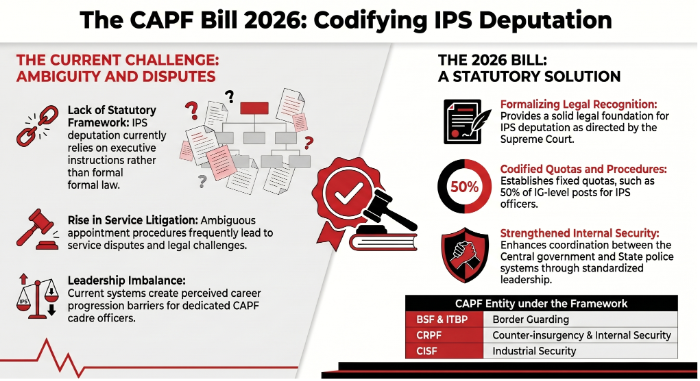
Prior to the 2026 Bill, IPS deputation was managed through executive orders rather than law, leading to several systemic inefficiencies:
Feature | Description of Status Quo |
Legal Basis | Governed by executive instructions; lacked statutory backing. |
Current Quotas | Approximately 20% of DIG-level and 50% of IG-level posts are reserved for IPS officers. |
Operational Ambiguity | Unclear procedures for appointments, promotions, and repatriations. |
Service Friction | Perceived imbalance between IPS officers and CAPF cadre officers, resulting in frequent litigation. |
Career Progression | CAPF cadre officers often face limited upward mobility due to IPS dominance in senior ranks. |
Key Features of the CAPF Bill 2026
The proposed legislation introduces a structured, legal approach to managing force leadership and personnel.
Statutory Backing: Provides formal legal recognition to the practice of IPS deputation, ending the reliance on flexible executive orders.
Codification of Quotas: Explicitly defines the proportion of senior posts reserved for IPS officers, ensuring transparency.
Standardized Procedures: Establishes clear, uniform rules for the selection of officers, their duration of tenure, and the process for repatriation to their home cadres.
Dispute Mitigation: Aims to reduce the volume of service-related litigation by removing administrative ambiguity.
Judicial Compliance: Integrates legal principles regarding service matters as established by the Supreme Court.
The Broader Administrative Debate
The introduction of the Bill has intensified the debate regarding civil service reforms and the future of specialized security forces.
1. Institutional Autonomy and Identity
There is a growing demand for CAPFs to strengthen their internal identity. Many argue for a shift toward greater internal, cadre-based promotions to reward the specialized expertise of officers who have spent their entire careers within these forces.
2. Career Progression and Mobility
A central concern is the perceived "ceiling" for CAPF cadre officers. The dominance of the IPS in senior leadership is often viewed as a barrier to the upward mobility of dedicated CAPF personnel, creating an environment of unequal opportunity.
3. Role of All India Services
The Bill forces a re-evaluation of whether the IPS should continue to dominate leadership in specialized forces or if their role should be rationalized to prioritize operational necessity over tradition.
Significance of the Legislation
The Bill is viewed as a critical step toward modernizing personnel management within India's security architecture.
Governance Clarity: By bringing predictability to appointments, the Bill improves the internal governance of the forces.
Enhanced Internal Security: Better coordination between central forces and state police systems is anticipated through a more formalized IPS-CAPF relationship.
Federal and Administrative Balance: The Bill attempts to reinforce the Centre’s control and Centre-State coordination (via the IPS) while acknowledging the grievances of the CAPF cadres.
Reform Momentum: This move is seen as part of a larger effort to rationalize the roles of All India Services and modernize security force management.
Strategic Recommendations and Way Forward
To maximize the effectiveness of the Bill, the following actions are suggested in the source context:
Ensure Balanced Representation: Maintain a fair distribution of leadership roles between IPS and CAPF cadre officers.
Merit-Based Pathways: Develop clear, merit-based promotion tracks specifically for internal CAPF officers.
Periodic Quota Reviews: Establish a mechanism to review deputation quotas periodically based on shifting operational requirements.
Leadership Development: Invest in advanced training and leadership programs specifically for internal CAPF cadres to prepare them for senior command.
Stakeholder Consultation: Build a consensus by engaging in continuous dialogue with representatives from both the IPS and CAPF cadres.