
Introduction
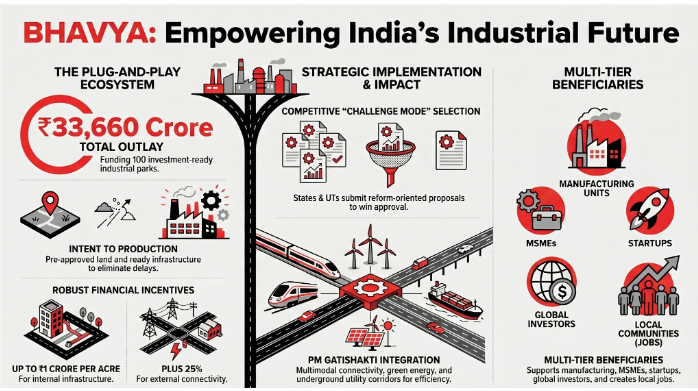
The Union Cabinet has approved the Bharat Audyogik Vikas Yojna (BHAVYA), a landmark initiative designed to revolutionize India's industrial landscape. With a substantial financial outlay of Rs. 33,660 crore, the scheme aims to establish 100 plug-and-play industrial parks across the country. By providing pre-approved land and ready-to-use infrastructure, BHAVYA seeks to drastically reduce the lead time for industries moving from "intent to production." The scheme is strategically aligned with PM GatiShakti principles and will be implemented through a competitive "Challenge Mode" to ensure high-quality, reform-oriented industrial development.
Core Objectives and the Plug-and-Play Ecosystem
The central philosophy of BHAVYA is the creation of a seamless "plug-and-play" environment. This model is specifically engineered to eliminate traditional bottlenecks associated with industrial setup, such as land acquisition delays and complex approval processes.
Infrastructure Readiness: The scheme provides pre-approved land parcels ranging from 100 to 1,000 acres, complete with ready-to-use infrastructure.
Operational Efficiency: By streamlining the transition from investment intent to active manufacturing, the scheme aims to enhance India's global competitiveness in production.
"No-Dig" Environment: Parks will feature integrated underground utility corridors, ensuring that maintenance and utility management do not disrupt surface operations.
Financial Framework and Support Mechanisms
The Government of India has committed significant capital to ensure the success of these industrial hubs. The financial support is categorized into core development and connectivity:
Support Category | Financial Provision |
Internal Infrastructure | Up to Rs. 1 crore per acre for core (roads, drainage), value-added (testing labs), and social (worker housing) infrastructure. |
External Connectivity | The Centre will provide 25% of the project costs to ensure the parks are linked to external transport and logistics networks. |
Total Program Outlay | Rs. 33,660 crore. |
Strategic Selection and Implementation Framework
BHAVYA is not a traditional grant-based scheme; it utilizes a competitive and structured approach to ensure only the most viable projects receive funding.
Selection via "Challenge Mode"
Projects will be selected through a "Challenge Mode." This mechanism requires States and Union Territories (UTs) to submit proposals that are:
High-quality and investment-ready.
Reform-oriented, ensuring that the local regulatory environment is conducive to industrial growth.
Implementation Hierarchy
The scheme is integrated into the existing national industrial architecture:
Ministry Level: Functions under the Department for Promotion of Industry and Internal Trade (DPIIT), Ministry of Commerce and Industry.
Programmatic Framework: Implemented under the National Industrial Corridor Development Programme (NICDP).
Executing Agency: The National Industrial Corridor Development Corporation (NICDC) serves as the primary implementation body, collaborating with state governments and the private sector.
Integration with National Strategic Initiatives
The BHAVYA parks are designed to be modern, sustainable, and highly connected, reflecting broader national policy goals:
PM GatiShakti Alignment: The parks will incorporate multimodal connectivity, ensuring efficient movement of goods via various transport modes.
Sustainability: Development plans include provisions for green energy to power industrial operations.
Integrated Utilities: The use of underground corridors reflects a move toward sophisticated, long-term urban and industrial planning.
Beneficiary Analysis
The impact of the Bharat Audyogik Vikas Yojna extends across multiple layers of the economy, from global corporations to local communities.
Primary Beneficiaries
Manufacturing Units: Large-scale enterprises requiring rapid deployment capabilities.
MSMEs and Startups: Smaller entities that benefit from reduced capital expenditure on basic infrastructure.
Global Investors: International stakeholders seeking "investment-ready" locations in the Indian market.
Secondary Beneficiaries
Workforce: Beneficiaries of social infrastructure, specifically dedicated worker housing.
Logistics and Service Sectors: Enterprises providing support services to the industrial hubs.
Local Communities: Regional economic development resulting from increased industrial activity and employment opportunities.