Introduction
The "Bal Vivah Mukt Bharat" (Child Marriage Free India) initiative represents a comprehensive national effort by the Government of India to eliminate child marriage. Launched on November 27, 2024, the campaign addresses the systemic social issues that compromise the rights, health, and educational prospects of children, particularly young girls. The initiative is built upon a robust legal framework, primarily the Prohibition of Child Marriage Act (PCMA) of 2006, and utilizes a multi-dimensional strategy involving community mobilization, legal enforcement through Child Marriage Prohibition Officers (CMPOs), and digital monitoring.
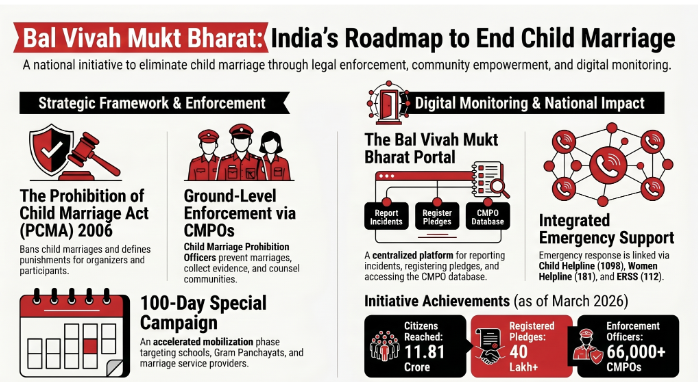
Key successes as of March 2026 include reaching over 11.81 crore citizens through awareness programs and securing more than 40 lakh individual pledges against child marriage. The initiative is further bolstered by targeted interventions like the "100 Days Special Campaign" and integration with existing social welfare programs such as Beti Bachao Beti Padhao.
Legal and Administrative Framework
The government's strategy to combat child marriage is grounded in two primary legislative pillars that define the legal consequences for arranging or participating in child marriages:
The Prohibition of Child Marriage Act, 2006 (PCMA): The central legislation that bans child marriages and mandates punishments for offenders.
Child and Adolescent Labour (Prohibition and Regulation) Act, 1986: While focused on labor, this act provides administrative empowerment to officials to protect children from various forms of exploitation.
Enforcement Hierarchy and Roles
The administration of these laws is managed through a specific hierarchy of officials working under the jurisdiction of State Governments and Union Territories:
Official Title | Primary Responsibilities |
District Magistrates | Appointed under the Labour Act to supervise general enforcement and designate District Nodal Officers (DNOs). |
Child Marriage Prohibition Officers (CMPOs) | Tasked with preventing marriages, collecting legal evidence, counseling communities, and raising awareness regarding the harms of the practice. |
Strategic Implementation: Bal Vivah Mukt Bharat
The national campaign employs a mix of social mobilization and administrative accountability to drive results.
Core Objectives
Community Mobilization: Generating widespread awareness to shift social norms.
Capacity Building: Strengthening the institutional role of CMPOs to ensure they can intervene effectively.
At-Risk Identification: Proactively identifying girls at risk of child marriage and providing them with education and skill development opportunities.
Reporting: Facilitating the timely reporting of cases to ensure legal intervention before marriages occur.
The 100 Days Special Campaign
Launched on December 4, 2025, this intensive campaign was designed to accelerate the initiative's goals through:
Local Governance Participation: Mobilizing Gram Panchayats and Municipal Wards to officially declare their jurisdictions "child-marriage-free."
Stakeholder Outreach: Targeted engagement with schools, community leaders, and service providers involved in marriage ceremonies (e.g., priests, caterers, or venue owners).
Administrative Transparency: Uploading details of all CMPOs to a national portal to ensure public accessibility and accountability.
Digital Monitoring and Reporting Infrastructure
A critical component of the initiative is the Bal Vivah Mukt Bharat Portal (https://stopchildmarriage.wcd.gov.in), which serves as a centralized digital hub for monitoring and reporting.
Key Features of the Digital Platform:
Incident Reporting: A streamlined mechanism for citizens to report child marriage cases.
Information Repository: Dissemination of awareness materials and campaign data.
Pledge Registration: A public forum for citizens to register formal pledges against the practice.
CMPO Database: A comprehensive directory of over 66,000 Child Marriage Prohibition Officers active across India.
Integrated Support Ecosystem
The initiative does not operate in isolation but is supported by a network of existing government programs and emergency response systems.
Complementary Initiatives
Beti Bachao Beti Padhao (BBBP): Launched January 22, 2015, under Mission Shakti, this program focuses on long-term empowerment and addressing gender discrimination.
National Legal Services Authority (NALSA): Provides free legal aid to those affected through a dedicated helpline (15100).
Emergency Response and Support Lines
Support Service | Contact / Integration | Function |
Child Helpline | 1098 | 24/7 emergency support for children in distress. |
Women Helpline | 181 | Assistance for women and girls facing violence or exploitation. |
Emergency Response Support System (ERSS) | 112 | Integrated with the Child Helpline for round-the-clock emergency response. |
Jurisdictional Responsibilities
The implementation of "Bal Vivah Mukt Bharat" relies heavily on the cooperation of regional administrations. Because "Police" and "Public Order" are classified as State subjects under the Indian Constitution, the primary responsibility for enforcement lies with:
State Governments
Union Territory Administrations
These entities are responsible for coordinating the efforts of CMPOs, DNOs, and various community organizations to ensure that the national legal framework is applied effectively at the local level.