
Analysis of the 2026 Amendments to Uniform Consent Guidelines for Air and Water Pollution
On January 23, 2026, the Ministry of Environment, Forest and Climate Change (MoEFCC) notified significant amendments to the Uniform Consent Guidelines under the Air (Prevention and Control of Pollution) Act, 1981, and the Water (Prevention and Control of Pollution) Act, 1974. Effective as of January 27, 2026, these reforms are designed to accelerate industrial approvals, reduce regulatory burdens, and harmonize environmental compliance across India.
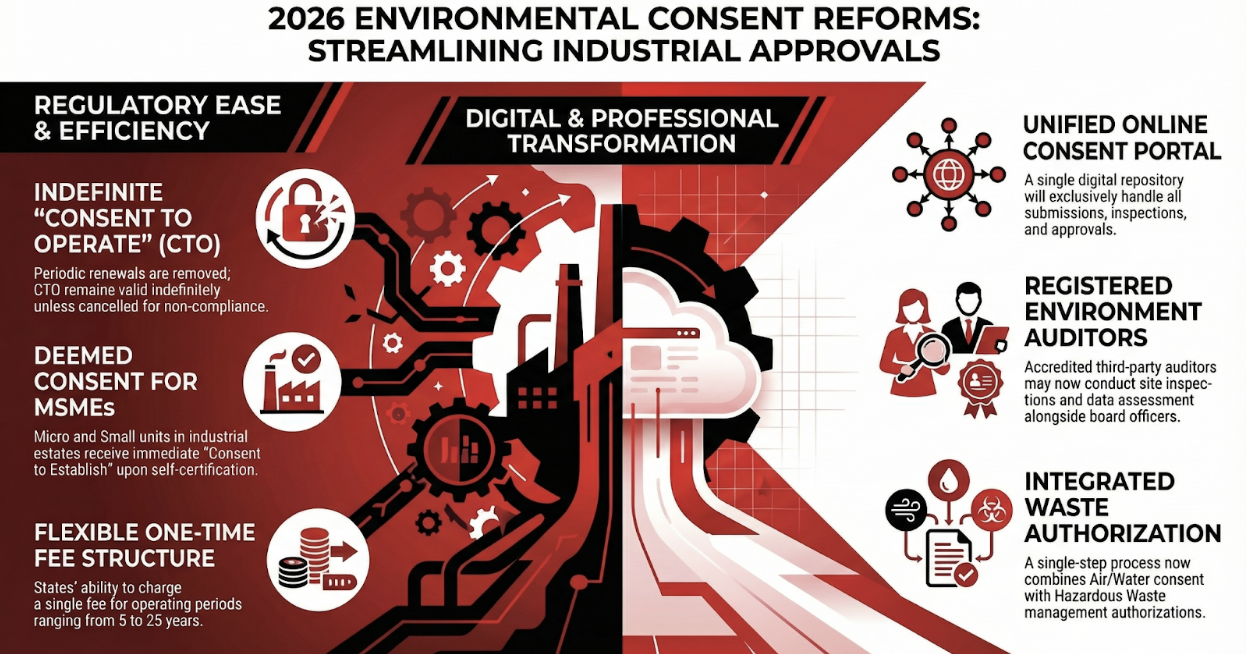
The most critical shifts include the transition of the Consent to Operate (CTO) to an indefinite validity period, the introduction of Registered Environment Auditors to augment or replace state-led inspections, and the creation of a single unified online portal for all consent and authorization processes. Additionally, Micro and Small Enterprises (MSMEs) in notified industrial areas will now benefit from "deemed" Consent to Establish (CTE) upon self-certification. These measures collectively aim to streamline governance without compromising environmental safeguards.
 Structural and Procedural Modernisation
The 2026 amendments introduce a centralized digital framework and private-sector involvement to modernize the application and verification process.
The Unified Online Portal
A cornerstone of the reform is the development of a single unified portal (referred to as the "online unified consent and authorization management portal" under the Water Act).
Timeline: The portal is to be completed within 6 to 12 months of the notification date.
Exclusivity: Once operational, this portal will become the sole medium for submission, scrutiny, verification, inspection, and disposal of applications across all States and Union Territories.
Functionality: It will serve as a single-point data repository for all actions taken under Section 21 of the Air Act and Section 25 of the Water Act.
Role of Registered Environment Auditors
The regulations introduce the "Registered Environment Auditor," a designation aligned with the Environment Audit Rules, 2025.
Expanded Oversight: These auditors are authorized to conduct site visits, verification, inspections, and data assessments.
Alternative to State Boards: Proponents may engage these auditors in place of, or in addition to, State Pollution Control Board (SPCB) officers.
Inspection Protocols: SPCB officers are now required to provide prior notice before inspections, while applicants are mandated to provide full access and technical data.
Reforms in Consent Validity and Fee Structures
The amendments significantly alter the lifecycle of industrial consents to eliminate the need for frequent renewals.
Feature | New Regulatory Provision |
CTO Validity | Consent to Operate remains valid indefinitely unless cancelled for non-compliance. |
Periodic Renewal | The requirement for periodic renewal has been abolished to reduce the regulatory burden. |
Fee Structure | States/UTs may charge a one-time fee for a period ranging between 5 and 25 years. |
Re-payment | Fees are only required again if the validity period is extended after its initial expiry. |
Streamlined Compliance for MSMEs and Industrial Zones
Specific provisions have been introduced to lower entry barriers for smaller industrial units and those located in planned industrial clusters.
Deemed Consent to Establish (CTE): Micro and Small units located in government-notified industrial estates or areas will receive CTE immediately upon the submission of a self-certified "Form-I."
Location-Specific Safeguards:
For industries requiring Environmental Clearance (EC), safeguards are determined by the Expert Appraisal Committee (EAC).
For all other cases, the SPCB determines location-specific environmental requirements.
Integration of Environmental Authorizations
To provide a "single-step" experience, the guidelines consolidate various environmental permissions:
Consolidated Process: The amendments allow for a single-step process that combines consent under the Air and Water Acts with authorizations under the Hazardous and Other Waste Management Rules (issued under the Environment Protection Act, 1986).
Form Revision: Applications for CTE and CTO under the Water Act must now follow revised forms prescribed in the First Schedule, incorporating all mandated particulars and waste management authorizations.
Financial and Asset Definitions
The guidelines clarify how capital investment should be calculated, which directly impacts the assessment of fees and regulatory categories.
Defined Capital Investment
The following assets are included in the calculation of capital investment:
Land and Buildings (including staff quarters and guest houses).
Industrial premises.
Plant and machinery.
Pollution-control equipment.
Exclusions: Operating and Maintenance (O&M) costs and revenue expenses are explicitly excluded from the capital investment calculation.
Valuation of Leased Properties
For industries operating on leased land or buildings, the land cost for fee calculations is determined by:
Ten times the annual lease value, OR
The guidance value of the property/land.
Requirement: The higher of the two values must be used.
Conclusion
The Control of Air and Water Pollution Amendment Guidelines of 2026 represent a shift toward a more transparent, digital, and indefinite regulatory environment. By utilizing third-party auditors and self-certification for MSMEs, the government seeks to improve the speed of industrial approvals while maintaining a rigorous framework for environmental compliance and data management.