
Amendments to New Drugs and Clinical Trials Rules, 2019
The Union Ministry of Health and Family Welfare has notified significant amendments to the New Drugs and Clinical Trials (NDCT) Rules, 2019. These reforms are designed to streamline regulatory processes and accelerate pharmaceutical research within India’s "Ease of Doing Business" framework. The primary shift involves transitioning from a restrictive licensing regime to a trust-based "prior-intimation" mechanism for research-related drug manufacturing and low-risk clinical studies. Key outcomes include a reduction of 90 days in the drug development cycle and a 50% decrease in statutory processing times for remaining licence categories. These updates align with the government’s "Jan Vishwas" principles, aiming to position India as a premier global hub for pharmaceutical research and development (R&D).
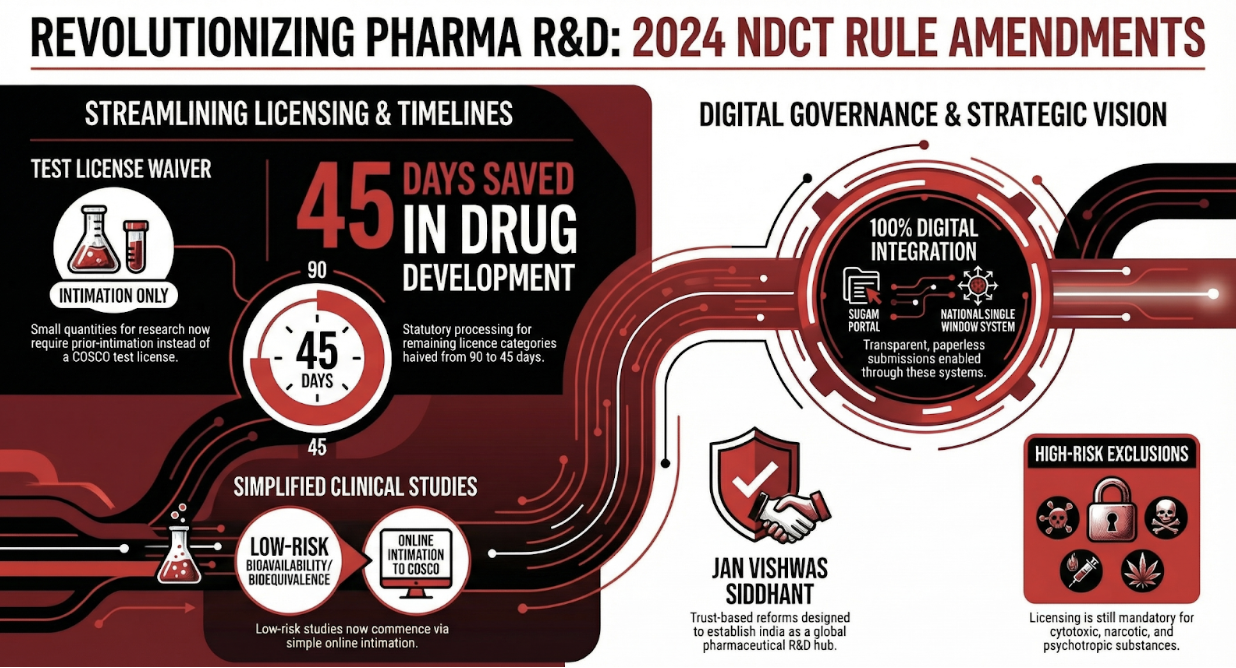
Overview of Regulatory Reforms
The amendments aim to optimize regulatory efficiency and improve the utilization of manpower within the Central Drugs Standard Control Organization (CDSCO). By removing redundant administrative hurdles, the Ministry intends to foster a more conducive environment for pharmaceutical innovation.
Transition to Prior-Intimation Mechanism
A central feature of the amendment is the replacement of mandatory test licences with a prior-intimation system for specific activities:
Waiver of Test Licence: The requirement to obtain a formal test licence from the CDSCO for the non-commercial manufacture of small quantities of drugs intended for research, examination, or analysis has been removed.
Low-Risk Clinical Studies: Prior permission for low-risk Bioavailability and Bioequivalence (BA/BE) studies is no longer required. Investigators can now commence these studies immediately following an online intimation to the CDSCO.
Exclusions for High-Risk Substances
While the reforms promote flexibility, stringent oversight remains for specific high-risk categories. A formal licence is still mandatory for the manufacture and analysis of:
Cytotoxic drugs
Narcotic drugs
Psychotropic substances
Efficiency Gains and Timeline Reductions
The reforms significantly compress the timeline for bringing new drugs to market by reducing administrative waiting periods.
Process Component | Previous Timeline | New Timeline / Impact |
Overall Drug Development Cycle | N/A | Reduced by 90 days |
Statutory Processing for Licences | 90 Days | Reduced to 45 Days |
Low-Risk BA/BE Studies | Prior Permission Required | Immediate start via Online Intimation |
Digital Integration and Governance
To facilitate these changes, the government is leveraging digital infrastructure to ensure a transparent and paperless regulatory environment.
National Single Window System (NSWS): Dedicated online modules will be launched to allow for the hassle-free submission of intimations.
SUGAM Portal: As the CDSCO’s e-governance platform, SUGAM will integrate these new modules to maintain a digital record and streamline interactions between pharmaceutical entities and regulators.
Jan Vishwas Siddhant: The amendments are rooted in "Jan Vishwas" (Trust-Based) principles, which prioritize transparency and minimize the compliance burden on researchers and manufacturers.
Conclusion
The 2024 amendments to the New Drugs and Clinical Trials Rules represent a strategic shift toward a more agile pharmaceutical regulatory framework. By halving processing times and removing licensing requirements for low-risk research activities, the Union Ministry of Health and Family Welfare is actively reducing the time-to-market for new therapies while maintaining necessary safeguards for high-risk substances. This regulatory evolution is a critical step in achieving the national objective of becoming a global leader in pharmaceutical R&D.