
Introduction
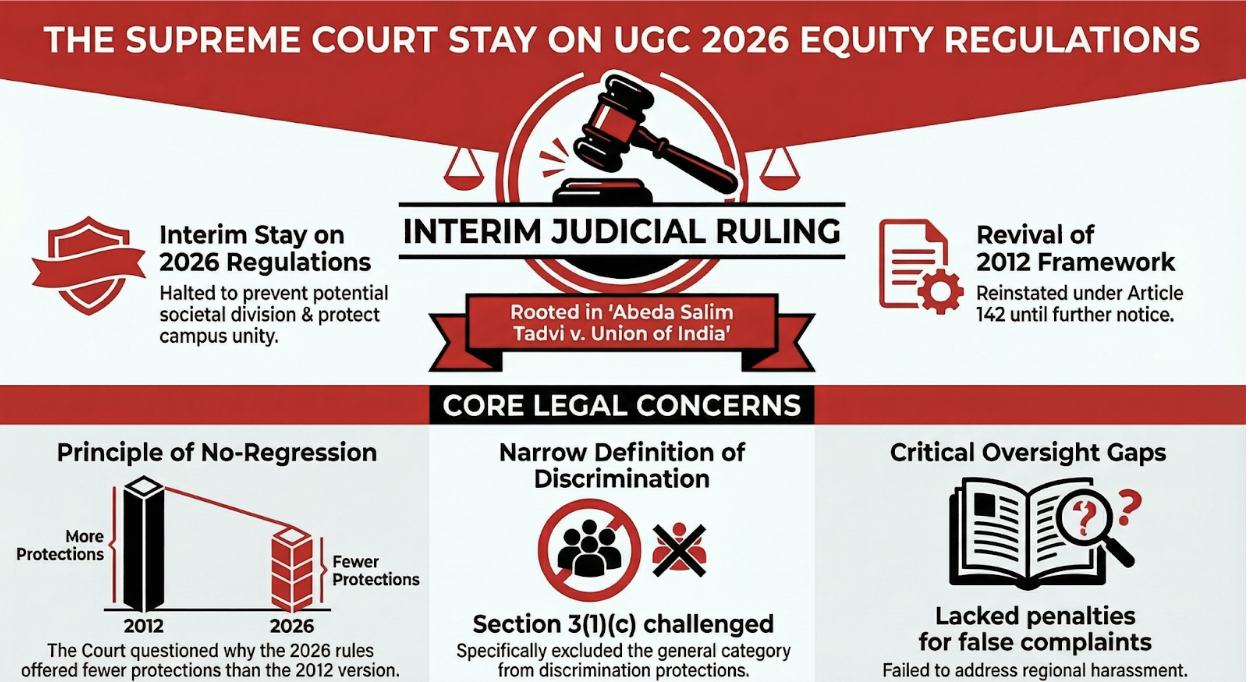
On January 31, 2026, the Supreme Court of India issued an interim stay on the University Grants Commission (Promotion of Equity in Higher Education Institutions) Regulations, 2026. The Court’s intervention was prompted by concerns that the new regulations could potentially divide society and undermine unity on educational campuses. Invoking its extraordinary powers under Article 142 of the Constitution, the Court directed that the previous 2012 Regulations which had been repealed to make way for the 2026 version will continue to apply until further orders. The stay highlights significant legal and definitional gaps in the 2026 framework, specifically regarding its narrow definition of discrimination and its failure to address broader forms of campus harassment.
Background and Legal Context
The UGC (Promotion of Equity in Higher Education Institutions) Regulations, 2026, were developed in response to the legal proceedings in Abeda Salim Tadvi v. Union of India (2019). That case sought the establishment of a robust mechanism to eliminate caste-based discrimination within higher education institutions.
While the 2026 Regulations were intended to update the existing 2012 framework, they faced immediate legal challenges upon their introduction. These challenges center on whether the new rules are sufficiently inclusive and whether they inadvertently create social friction.
Critical Judicial Concerns
The Supreme Court raised several fundamental objections to the 2026 Regulations, focusing on their potential impact on the social fabric of higher education.
Potential for Societal Division
The bench expressed concern that the regulations, as drafted, might lead to a "division of society" and could "undermine campus unity." This led to the determination that an interim stay was necessary to prevent immediate harm to the educational environment.
The "Principle of No-Regression"
A significant factor in the Court's decision was the "principle of no-regression," a concept derived from environmental and social justice law. The Court questioned why the 2026 Regulations appeared to be less inclusive and comprehensive than the 2012 version they were meant to replace. Under this principle, the state is expected to advance social protections rather than dilute them.
Constitutional Basis
The Court examined the regulations through the prism of Article 15(4) of the Constitution, which empowers the State to make special provisions for the advancement of socially and educationally backward classes, including Scheduled Castes (SCs) and Scheduled Tribes (STs).
Analysis of Legal and Definitional Challenges
The petitions against the 2026 Regulations highlighted specific sections that the Supreme Court found problematic or redundant.
Exclusivity vs. Inclusivity
The Court focused on a perceived contradiction within the definitions of discrimination:
Regulation Section | Scope and Definition | Judicial Observation |
Section 3(1)(c) | Exclusively defines discrimination against SC, ST, and OBC members. | Questioned for being a "narrow provision" that excludes the general category. |
Section 3(1)(e) | Provides a broad definition of discrimination based on religion, race, caste, gender, place of birth, or disability. | Seen as already providing the necessary inclusive coverage, making the narrowness of 3(1)(c) questionable. |
Identified Regulatory Gaps
The Supreme Court identified several areas of campus life and misconduct that the 2026 Regulations failed to address adequately:
Regional Harassment: The rules do not sufficiently cover discrimination based on regional lines.
Intra-Caste Harassment: The regulations overlook harassment occurring within the same caste groups, specifically by economically privileged individuals against others.
Ragging: The Court noted a lack of specific coverage regarding incidents of ragging.
Procedural Safeguards: The Regulations contain no established mechanism to penalize or deter false complaints.
Current Status and Judicial Remedy
Because the 2012 Regulations had already been repealed to facilitate the 2026 update, the Supreme Court's stay created a potential regulatory vacuum. To address this, the Court utilized Article 142, which allows the Supreme Court to pass such decrees or orders as necessary for doing "complete justice."
Current Directive:
The UGC (Promotion of Equity in Higher Educational Institutions) Regulations, 2012, are reinstated and will remain in force until further orders from the Court.
The 2026 Regulations are currently suspended under an interim stay.