
Menstrual Health as a Fundamental Right
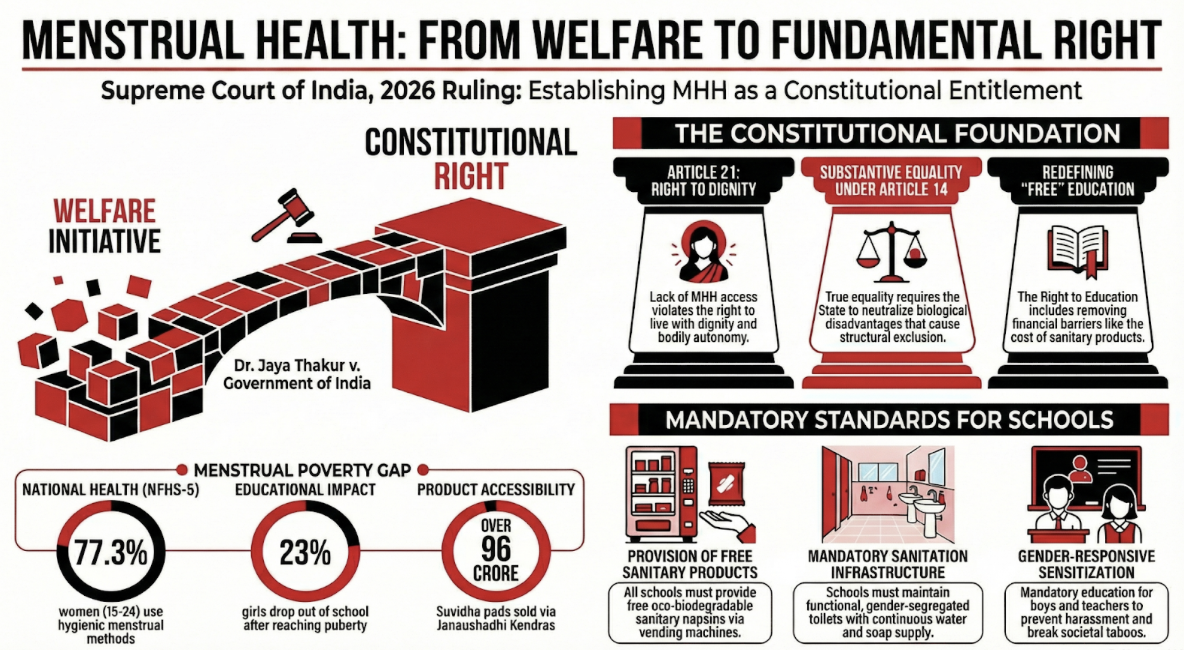
In the landmark case of Dr. Jaya Thakur v. Government of India & Ors. (2026), the Supreme Court of India officially recognized Menstrual Health and Hygiene (MHH) as a fundamental right under Article 21 (Right to Life and Dignity) and Article 14 (Right to Equality). This ruling transitions menstrual health from a welfare-based policy concern to a binding constitutional entitlement.
The Court identified "menstrual poverty" the lack of access to sanitary products, water, and private facilities as a primary driver of educational exclusion, noting that approximately 23% of girls drop out of school after reaching puberty. To address this, the Court issued a continuing mandamus directing both Union and State governments to provide free sanitary napkins and functional infrastructure in all schools. This judgment establishes the concept of "biological citizenship," asserting that the State must intervene to neutralize the "biological tax" or disadvantages inherent to the female reproductive cycle to ensure true substantive equality.
Judicial Foundations and Constitutional Interpretations
The Supreme Court’s ruling is built upon a reinterpretation of several constitutional and statutory provisions, focusing on the material realities of menstruating individuals.
1. Article 21: Dignity and Bodily Autonomy
Beyond Survival: The Court held that MHH is essential for a life lived with dignity, not just mere survival.
Protection from Stigma: Inadequate access to MHH facilities subjects girls to "stigma, stereotyping, and humiliation," which constitutes a violation of their fundamental rights.
Privacy: The right encompasses bodily autonomy, privacy, and the reproductive health of menstruating students.
2. Article 14: Substantive Equality
Structural Exclusion: The Court moved beyond "formal equality" (treating everyone the same) to "substantive equality."
Biological Realities: It argued that ignoring unique biological needs creates a structural exclusion. To achieve an equal footing with male peers, the State must actively address these specific biological disadvantages.
3. Right to Education (RTE) Act 2009
Redefining "Free": The Court ruled that "free" education must mean removing all financial barriers, including the cost of sanitary products.
Infrastructural Failure: Separate, functional toilets are now classified as "substantive" rather than merely "infrastructural" guidelines. Failure to provide them is termed a "stark constitutional failure."
Mandatory Pan-India Standards for Schools
The Supreme Court issued specific directions that apply to all government and private schools, overseen by the National Commission for Protection of Child Rights (NCPCR).
Feature | Mandatory Requirement |
Product Provision | Every school must provide free oxo-biodegradable sanitary napkins via vending machines. |
MHM Corners | Dedicated corners stocked with spare innerwear, uniforms, and disposable bags for exigencies. |
Sanitation | Functional, gender-segregated toilets with continuous water connectivity and soap. |
Waste Management | Environmentally compliant disposal mechanisms as per Solid Waste Management (SWM) Rules, 2026. |
Accountability | Periodic inspections by District Education Officers (DEO) and anonymous student feedback surveys. |
Curriculum | NCERT and SCERTs must integrate gender-responsive curricula to sensitize boys and male teachers. |
Current Landscape and Government Initiatives
The ruling builds upon existing government frameworks intended to improve menstrual hygiene across India.
PMBJP (Pradhan Mantri Bharatiya Janaushadhi Pariyojna): Over 16,000 Janaushadhi Kendras provide 'Suvidha' oxo-biodegradable napkins at Rs. 1 per pad. Sales exceeded 96 crore pads by November 2025.
ASHA Network: Distributes subsidized packs (Rs. 6 for 6 napkins) and conducts community meetings to dismantle societal taboos.
Ministry Schemes:
Scheme for Promotion of Menstrual Hygiene: Targets adolescent girls (10–19 years) for awareness and access.
Samagra Shiksha: Provides funding for sanitary pad vending machines and incinerators in schools.
Mission Shakti: Includes menstrual health as a core component of "Beti Bachao Beti Padhao."
Sanitation Guidelines: Swachh Bharat Mission and UGC advisories mandate menstrual hygiene management (MHM) in rural areas and Higher Educational Institutions (HEIs).
Implementation Challenges and Barriers
Despite the constitutional mandate, several systemic hurdles threaten the effective implementation of MHH guidelines:
Infrastructure Deficit: While toilets may exist on paper, many lack running water, soap, and consistent cleaning staff or maintenance budgets.
Logistical Constraints: Scaling the procurement of high-quality oxo-biodegradable pads within tight timelines is difficult for state governments.
Waste Protocols: Many schools lack the technical capacity to operate incinerators safely, risking environmental non-compliance.
Social Power Hierarchies: Stigma and embarrassment often persist despite directives. Power imbalances in schools may lead to "dishonest" feedback in surveys, as students may fear reporting deficiencies.
Funding Strains: Without specific earmarked funds, MHM expenditures may compete with other critical school needs like midday meals or teacher salaries.
Strategic Recommendations for Strengthening MHH
To realize the Court's vision of "gender justice," the following measures are proposed:
Integrated Infrastructure: School toilets should be integrated with the Jal Jeevan Mission to ensure 24/7 running water.
Privacy-First Design: Toilets should include "privacy screens," internal latches, mirrors, and hooks to allow for safe changing and washing.
Economic Empowerment: State governments should leverage Self-Help Groups (SHGs) for the local production of biodegradable napkins to ensure supply and provide local employment.
Direct Benefit Transfer (DBT): In areas with broken supply chains, "Pad Credits" or DBT could be provided directly to students or their mothers to purchase hygienic products.
Standardized Procurement: Establishing Centralized Procurement Cells to ensure napkins meet biodegradability standards (ASTM D-6954 or IS 17518) and prevent the distribution of low-quality plastic alternatives.
Inclusive Policy: Extending MHH policies to include trans-men and non-binary individuals who menstruate.
Conclusion
The Supreme Court’s 2026 ruling represents a shift from "Negative Liberty" (the State not interfering) to "Positive Liberty" (the State actively providing the material conditions necessary for rights to be exercised). By identifying menstrual health as central to dignity and education, the judiciary has mandated a structural reform aimed at ensuring that “a period should end a sentence, not a girl’s education.”