Solid Waste Management (SWM) Rules, 2026
The Union Ministry of Environment, Forest and Climate Change (MoEFCC) has notified the Solid Waste Management (SWM) Rules, 2026, which will supersede the existing 2016 framework under the Environment (Protection) Act, 1986. Effective from April 1, 2026, these rules represent a significant shift toward stricter accountability, mandatory source segregation, and the integration of digital oversight for both urban and rural local bodies.
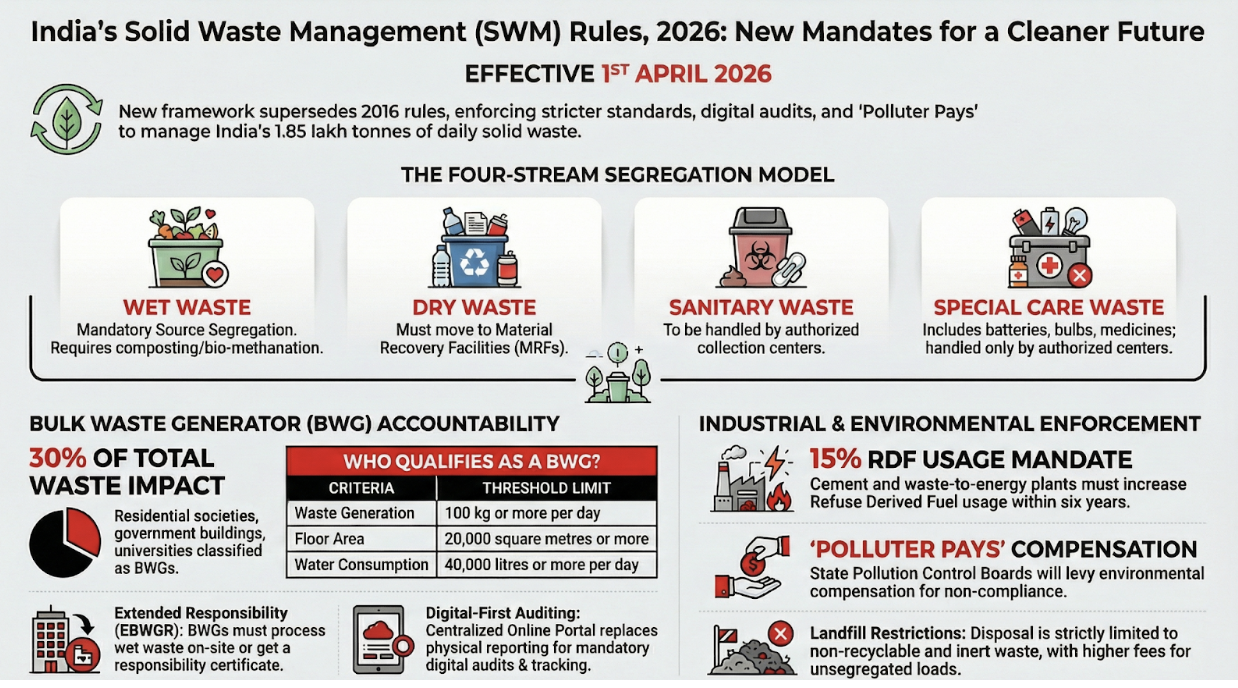
Critical takeaways include the introduction of a four-stream segregation mandate, the formalization of "Extended Bulk Waste Generator Responsibility" (EBWGR), and a legislative push for a circular economy through increased Refuse Derived Fuel (RDF) usage. With India generating approximately 1.85 lakh tonnes of solid waste daily, the 2026 rules aim to mitigate environmental degradation through the "Polluter Pays Principle" and time-bound remediation of legacy waste.
Regulatory Framework and Scope
The SWM Rules, 2026, establish a comprehensive legal structure for waste management across the country.
Effective Date: April 1, 2026.
Jurisdiction: The rules apply to all urban and rural local bodies.
Enforcement Mechanism: Implementation is overseen by state-level committees chaired by the State Chief Secretary.
Compliance and Penalties: Following the "Polluter Pays Principle," environmental compensation will be levied for non-compliance. The Central Pollution Control Board (CPCB) is responsible for preparing compensation guidelines, while State Pollution Control Boards and Pollution Control Committees will handle enforcement.
Mandatory Four-Stream Segregation
A central pillar of the 2026 Rules is the requirement for waste to be segregated into four distinct streams at the source.
Waste Stream | Examples | Disposal/Processing Requirement |
Wet Waste | Kitchen waste, food leftovers, fruit/vegetable peels | Must be composted or bio-methanated. |
Dry Waste | Plastic, paper, metal, glass | Sent to Material Recovery Facilities (MRFs) for recycling. |
Sanitary Waste | Diapers, sanitary napkins | Must be securely wrapped and stored separately. |
Special Care Waste | Bulbs, batteries, medicines | Handed over to authorized agencies or designated collection centers. |
Bulk Waste Generator (BWG) Obligations
The rules place a significant burden of responsibility on Bulk Waste Generators, who collectively account for 30% of India's total waste.
Definition of a BWG
An entity is classified as a Bulk Waste Generator if it meets any of the following criteria:
A floor area of 20,000 square metres or more.
Water consumption of 40,000 litres per day.
Waste generation of 100 kg per day.
Common Entities: Residential societies, government buildings, and universities.
Extended Bulk Waste Generator Responsibility (EBWGR)
The 2026 Rules introduce EBWGR, which mandates that these entities:
Process wet waste on-site.
In cases where on-site processing is not feasible, the generator must obtain a responsibility certificate.
Digital Integration and Circular Economy
The 2026 framework seeks to modernize waste tracking and promote industrial sustainability.
Digital Audits: A Centralized Online Portal will replace physical reporting. This system will track waste generation, collection, and disposal, facilitating transparent digital audits.
Refuse Derived Fuel (RDF) Mandate: To promote a circular economy, industries such as cement plants and waste-to-energy plants must increase their usage of RDF.
Usage Increase: RDF usage must rise from 5% to 15% over a six-year period.
Definition: RDF is a high-calorific, eco-friendly alternative to fossil fuels produced by shredding, drying, and pelletizing non-recyclable municipal solid waste.
Landfill Management and Environmental Remediation
Stricter controls have been placed on how waste is disposed of and how historical waste is managed.
Landfill Restrictions: Use of landfills is strictly limited to non-recyclable and inert waste. Local bodies are authorized to charge higher fees for depositing unsegregated waste into landfills.
Legacy Waste: The rules mandate the biomining and bioremediation of old dumpsites. This process is time-bound and requires quarterly progress reporting.
Special Provisions for Sensitive Regions
Recognizing the unique challenges of specific geographies, the rules provide local bodies in hilly areas and islands with additional powers:
Tourist User Fees: Local bodies can levy fees on tourists to fund waste management.
Inflow Regulation: Authorities may regulate the inflow of visitors based on the existing waste management capacity of the region.