India's First Paperless District Court: Kalpetta Judicial District
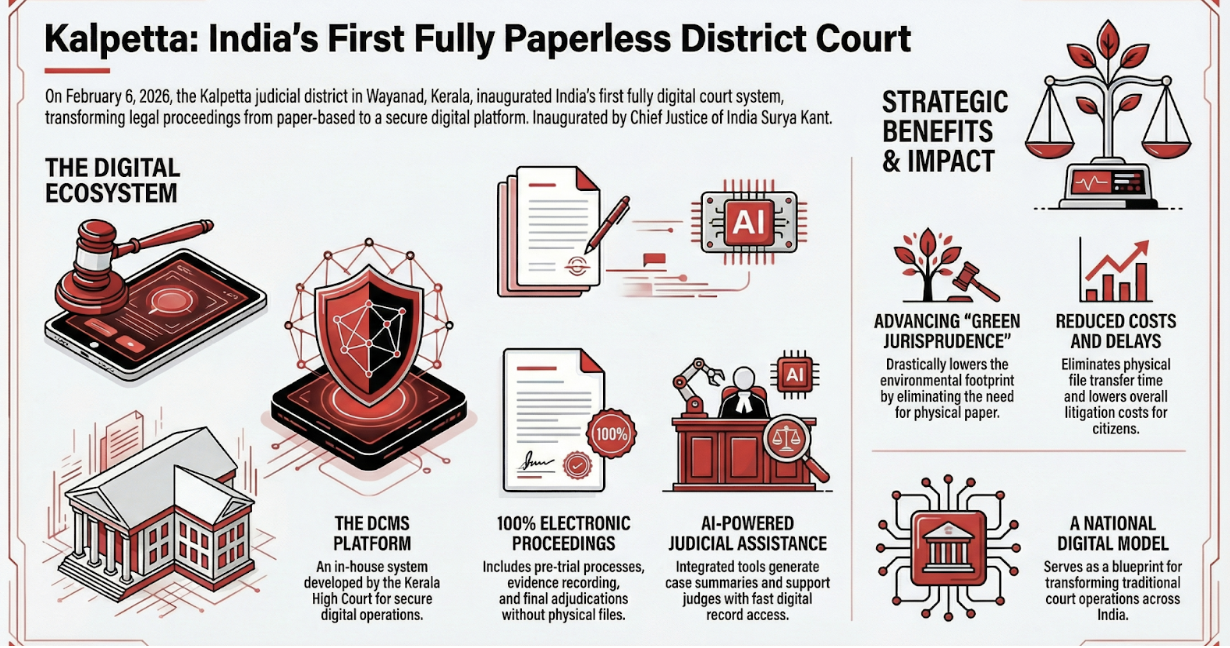
The Kalpetta judicial district in Wayanad, Kerala, has achieved a historic milestone by becoming India’s first district court to function as a fully paperless digital system. Officially inaugurated by the Chief Justice of India, Surya Kant, the court has successfully transitioned all judicial proceedings—from pre-trial stages to final adjudications—onto a digital platform known as the District Court Case Management System (DCMS). This transition, supported by integrated Artificial Intelligence (AI) tools, aims to reduce litigation costs, eliminate administrative delays, and promote "green jurisprudence." The initiative is positioned as a national model for the digital transformation of the Indian judiciary.
Overview of the Transition
As of February 6, 2026, the Kalpetta judicial district has eliminated the use of physical files in its daily operations. This shift represents a fundamental change in the traditional judicial process, moving toward a streamlined, electronic environment.
Key Administrative Details
Location: Kalpetta judicial district, Wayanad, Kerala.
Inaugural Authority: Chief Justice of India Surya Kant (via virtual inauguration).
Scope: The digital system encompasses the entire lifecycle of a case, including:
Pre-trial processes.
Recording of evidence.
Issuance of interlocutory orders.
Final adjudications.
Technical Framework: District Court Case Management System (DCMS)
The foundation of this paperless initiative is the District Court Case Management System (DCMS). This platform was developed to ensure that judicial operations are secure, efficient, and entirely digital.
In-House Development: The DCMS was designed and developed by the Kerala High Court’s IT department.
AI Integration: The system incorporates AI-based judicial assistance tools to enhance the efficiency of judges and legal staff. Key AI capabilities include:
Automated Case Summaries: Generating structured summaries of case histories.
Annotation Support: Assisting with digital notes and highlights within case files.
Query Functions: Allowing for rapid searching and querying of specific case details.
Digital Record Access: Providing near-instantaneous access to all relevant electronic records.
Strategic Benefits and "Green Jurisprudence"
The transition to a paperless system is expected to yield significant improvements in the delivery of justice and environmental sustainability.
Operational and Economic Benefits
Cost Reduction: Moving to digital files significantly lowers the expenses associated with physical litigation.
Efficiency: The system eliminates the logistical delays typically caused by the physical transfer of files between different departments or courtrooms.
Enhanced Access: Digitization is expected to broaden access to justice by making judicial processes more transparent and accessible.
Environmental Impact
A core theme of the Kalpetta initiative is the advancement of "green jurisprudence." By removing the reliance on paper, the judicial district is lowering its environmental footprint, aligning legal operations with modern sustainability goals.
National Implications
The successful implementation of the paperless system in Kalpetta serves as a pilot and a model for the rest of India. The initiative demonstrates the feasibility of converting traditional, paper-heavy court operations into modern digital systems. It is anticipated that this model will be replicated in other judicial districts nationwide to foster a more efficient and technologically advanced national judiciary.