
Introduction
Shaheed Diwas (Martyrs' Day) is observed annually on March 23rd to honor the sacrifice of Bhagat Singh, Shivaram Rajguru, and Sukhdev Thapar, who were executed by the British colonial government in 1931. Their journey from youth activists to revolutionary icons was catalyzed by the death of Lala Lajpat Rai and characterized by bold acts of defiance, including the killing of J.P. Saunders and the symbolic bombing of the Central Legislative Assembly. Operating under the banner of the Hindustan Socialist Republican Association (HSRA), these individuals sought not only political independence but a socialist transformation of Indian society. This document details the historical events leading to their execution, their ideological foundations, and their enduring role in the Indian freedom struggle.
Historical Context and Origins
Shaheed Diwas commemorates a pivotal period in the Indian independence movement, marked by a shift toward revolutionary action in response to colonial violence.
The Simon Commission and the Death of Lala Lajpat Rai (1928)
The Protest: In 1928, Lala Lajpat Rai led a high-profile protest against the Simon Commission.
The Incident: During the demonstration, Rai was fatally injured in a brutal lathi charge directed by the police.
The Impact: His death caused nationwide outrage and became the primary motivation for revolutionary retaliation.
The Lahore Conspiracy Case (1929)
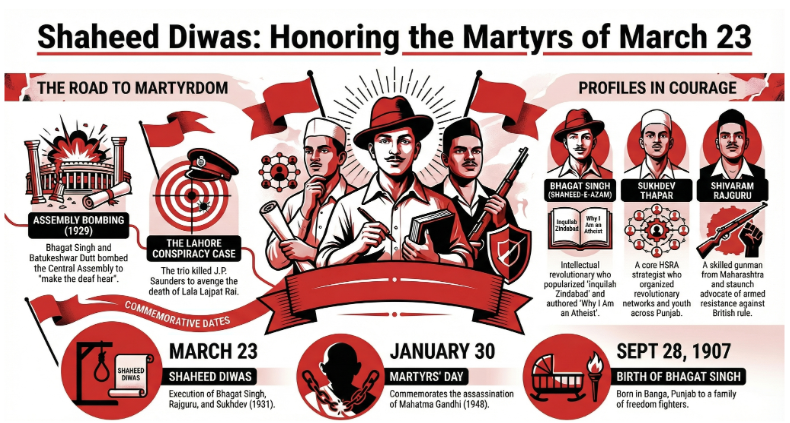
The Objective: Members of the Hindustan Socialist Republican Association (HSRA), including Singh, Rajguru, and Sukhdev, plotted to assassinate James A. Scott, the police officer responsible for the lathi charge.
The Error: In a case of mistaken identity, the revolutionaries killed J.P. Saunders instead.
The Legal Consequence: This event led to the Lahore Conspiracy Case trial, which eventually resulted in death sentences for the three primary participants.
The Central Legislative Assembly Bombing (1929)
The Action: Bhagat Singh and Batukeshwar Dutt threw low-intensity bombs into the Central Legislative Assembly.
The Intent: The act was a protest against repressive legislation, specifically the Public Safety Bill and the Trade Dispute Bill.
The Philosophy: The revolutionaries stated their aim was to "make the deaf hear" rather than to cause physical harm.
Profiles of the Revolutionaries
The success and coordination of the revolutionary movement relied on the distinct roles and backgrounds of its key members.
Bhagat Singh (1907–1931)
Known as "Shaheed-e-Azam," Singh remains one of the most influential figures in Indian history.
Background: Born on September 28, 1907, in Banga, Punjab, to a revolutionary Sikh family. His father, Kishan Singh, and uncle, Ajit Singh, were also active in the freedom struggle.
Ideology: He was deeply influenced by the Jallianwala Bagh massacre and studied at National College, Lahore. His beliefs were rooted in Marxism, socialism, rationalism, and equality.
Literary Contributions: He wrote "Why I Am an Atheist" and contributed to journals like Kirti under pseudonyms such as Balwant, Ranjit, and Vidhrohi.
Legacy: He popularized the slogan "Inquilab Zindabad."
Sukhdev Thapar (1907–1931)
Role: A core member of the HSRA and a key strategist.
Contributions: He was instrumental in organizing revolutionary networks and mobilizing youth throughout the Punjab region. He was a central participant in the Lahore Conspiracy Case.
Shivaram Rajguru (1908–1931)
Background: Hailing from Maharashtra, Rajguru was a staunch advocate of armed resistance.
Specialization: He was highly respected among his peers as a skilled gunman and played a critical role in the execution of the HSRA's military actions.
Organizational and Ideological Framework
The revolutionaries operated through structured organizations designed to mobilize the public and challenge colonial rule.
Organization | Purpose and Scope |
Hindustan Socialist Republican Association (HSRA) | Reorganized from the HRA in 1928, it aimed for armed struggle and a socialist transformation of India. |
Naujawan Bharat Sabha (1926) | Founded by Bhagat Singh to mobilize the youth for the national cause. |
Core Ideological Pillars
Socialism: A commitment to the equitable distribution of resources and social justice.
Rationalism: An emphasis on logical thinking and atheism as a challenge to traditional dogma.
Armed Resistance: The belief that symbolic and direct actions were necessary to awaken the masses and pressure the colonial government.
The Execution and Commemoration
The final chapters of the lives of Singh, Rajguru, and Sukhdev solidified their status as national martyrs.
Execution: The three men were hanged in the Lahore Central Jail on March 23, 1931.
Final Rites: They were cremated at the Hussainiwala National Martyrs Memorial in Punjab.
National Observation: March 23 is recognized as Shaheed Diwas to honor their "supreme sacrifice."
Distinction: It is important to note that India also observes Martyrs' Day on January 30 to mark the assassination of Mahatma Gandhi.
Summary of Key Facts for Record
Date of Execution: 23rd March 1931.
Location of Execution: Lahore Central Jail.
Victim in Mistaken Identity: J.P. Saunders.
Key Protested Bills: Public Safety Bill and Trade Dispute Bill.
Bhagat Singh’s Birthplace: Banga, Punjab (now in Pakistan).