
Introduction
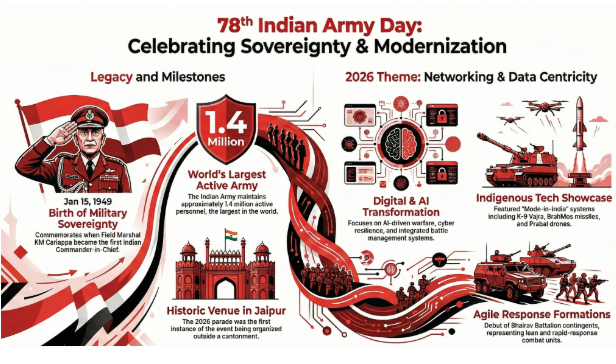
The 78th Army Day, celebrated on January 15, 2026, signifies a pivotal moment in the Indian Army’s transition toward modern, technology-driven warfare. Held in Jaipur, Rajasthan, the event highlighted the force's current strategic priority: "Year of Networking and Data Centricity." This theme underscores a comprehensive shift toward digital transformation, AI-driven operations, and integrated battle management.
As the world’s largest army with approximately 1.4 million active personnel, the Indian Army utilized the 78th anniversary to showcase its increasing reliance on indigenous defense technology and agile, lean formations. The celebration also continued the recent tradition of decentralizing major military events, marking the fourth time the parade was held outside of Delhi and the first time it was conducted outside a traditional military cantonment.
Historical Significance and Governance
Army Day is observed annually on January 15th to commemorate a landmark moment in India's military history.
Historical Foundation: The date marks January 15, 1949, when Field Marshal KM Cariappa took over as the first Indian Commander-in-Chief of the Indian Army, signifying the achievement of full military sovereignty.
Supreme Command: Under the current constitutional framework, the President of India serves as the Supreme Commander of the Indian Armed Forces, overseeing the Army, Navy, and Air Force.
Regional Outreach: In a move to increase public engagement and showcase military presence across various regions, the annual parade has been moved outside the national capital in recent years:
2023: Bengaluru
2024: Lucknow
2025: Pune
2026: Jaipur (First instance held outside a cantonment).
Strategic Theme: Year of Networking and Data Centricity
The 2026 theme reflects an institutional commitment to evolving warfare requirements. The Army’s focus has moved beyond traditional maneuvers toward a sophisticated, multi-domain approach:
Digital Transformation: Emphasizing cyber resilience and the integration of data into every level of command.
AI and Automation: Increasing the role of Artificial Intelligence in warfare and decision-making processes.
Integrated Systems: Development of battle management systems to ensure seamless communication and coordination between different units.
Agile Formations: The parade saw the debut of the Bhairav Battalion contingents. These represent a new model of lean, agile formations designed for rapid response in modern conflict scenarios.
Showcase of Indigenous Technology
A central component of the 78th Army Day was the display of "Made-in-India" military hardware, reflecting a drive toward self-reliance in defense production.
Category | Specific Systems Displayed |
Armored Vehicles | T-90 Tanks, Arjun Tanks |
Artillery Systems | K-9 Vajra, Dhanush, ATAGS (Advanced Towed Artillery Gun System) |
Rocket & Missile Systems | BrahMos Supersonic Cruise Missile, Pinaka Multi-Barrel Rocket Launcher |
Unmanned Aerial Vehicles | Prabal, Switch, and Baaz drones |
Cultural Integration and Heritage
The celebrations in Jaipur integrated military precision with India's diverse cultural heritage, featuring both regional folk traditions and ancient martial arts:
Regional Performances: The event included Rajasthani folk dances, specifically Kalbelia and Gair.
Musical Traditions: A performance of the Chenda, a traditional percussion instrument from Kerala, was featured.
Martial Arts: Displays of Kalaripayattu and Malkhamb showcased traditional Indian physical culture and combat techniques.
Conclusion
The 78th Army Day served as a demonstration of the Indian Army's dual identity: a force deeply rooted in historical tradition and military sovereignty, yet aggressively pursuing a future defined by technological superiority. By focusing on data centricity and indigenous innovation, the Army aims to maintain its position as a dominant global force while adapting to the complexities of 21st-century warfare.