
Introduction
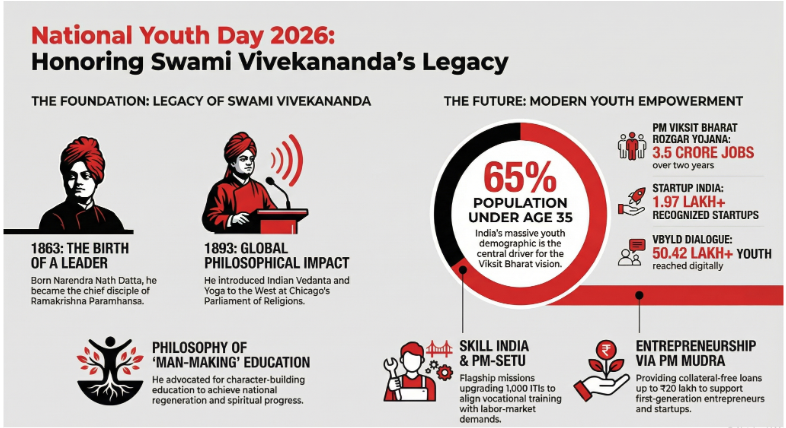
National Youth Day, observed annually on January 12, marks the birth anniversary of Swami Vivekananda. With over 65% of the Indian population under the age of 35, the youth demographic is the primary driver behind the "Viksit Bharat @2047" vision. This document synthesizes the strategic initiatives currently employed by the Indian government to harness this demographic dividend, ranging from AI-enabled digital platforms and large-scale employment schemes to comprehensive health programs. Furthermore, it outlines the life and philosophical contributions of Swami Vivekananda, whose ideals of character-building and service remain the bedrock of national youth policy.
The Strategic Role of Youth in National Development
The empowerment of youth is central to India's long-term developmental goals. The current demographic profile reveals a significant opportunity, as more than 65% of the population is below the age of 35. National Youth Day serves as both a commemoration of cultural heritage and a milestone for evaluating progress toward the vision of a developed India by 2047.
Comprehensive Government Initiatives for Youth
The government has implemented a diverse range of programs aimed at leadership, skilling, employment, and well-being. These initiatives are designed to create a holistic ecosystem for youth advancement.
Leadership and Civic Engagement
Mera Yuva Bharat (MY Bharat): A digital "phygital" platform that uses AI to link youth with volunteering, leadership opportunities, and career services.
National Service Scheme (NSS): Focuses on instilling social responsibility and civic engagement through community service.
Viksit Bharat Young Leaders’ Dialogue (VBYLD): A national ideation platform that has engaged nearly 3,000 young leaders and reached over 50.42 lakh youth via digital channels.
Skill Development and Employment
PM Viksit Bharat Rozgar Yojana: A massive employment generation scheme targeting the creation of 3.5 crore jobs over two years through financial incentives for both employers and new employees.
Skill India Mission: An umbrella framework integrating PMKVY 4.0 and apprenticeships (PM-NAPS) to provide future-ready vocational training.
PM-SETU: A flagship initiative to upgrade 1,000 ITIs using a hub-and-spoke model managed by industry stakeholders to align training with market demands.
Agnipath Scheme: A four-year military service pathway for youth (ages 17.5–21) designed to foster discipline and provide technical skills for post-service employability.
Entrepreneurship and Economic Support
Startup India: A program that has recognized over 1.97 lakh startups to date.
PM MUDRA Yojana: Provides collateral-free loans up to ₹20 lakh, specifically targeting first-generation entrepreneurs, women, and MSMEs.
Health, Well-being, and Social Values
Rashtriya Kishore Swasthya Karyakram (RKSK): A community-based adolescent health program addressing nutrition, mental health, and substance misuse.
Fit India Movement: A behavioral change campaign promoting fitness through digital tracking, school certification, and initiatives like "Sundays on Cycle."
Youth Spiritual Summit & Kashi Declaration: A youth-led roadmap focused on mental well-being and a "Nasha Mukt Yuva" (substance-free youth) for a developed India.
Profile and Contributions of Swami Vivekananda
The ideals of National Youth Day are rooted in the life and teachings of Swami Vivekananda (born Narendra Nath Datta), a pivotal figure in India's spiritual and social history.
Biographical Milestones
Event | Year | Details |
Birth | 1863 | Born January 12 as Narendra Nath Datta. |
Enlightenment | 1892 | Meditated for three days and nights on a rock in Kanyakumari. |
Name Change | 1893 | Adopted the name 'Vivekananda' at the request of Maharaja Ajit Singh. |
Chicago Address | 1893 | Represented Hinduism at the Parliament of Religions. |
Establishment of Ramakrishna Mission | 1897 | Founded to propagate service and spiritual upliftment. |
Belur Math | 1899 | Established as his permanent abode. |
Philosophical and Educational Contributions
Neo-Vedanta: Vivekananda introduced an interpretation of Hinduism that combined traditional Indian spirituality with Western material progress.
The Doctrine of Service: He advocated that serving living beings (jiva) is equivalent to the worship of the divine (Shiva).
Four Pathways to Moksha: He detailed four methods for attaining liberation in his writings:
Raja-yoga
Karma-yoga
Jnana-yoga
Bhakti-yoga
Character-Building Education: He believed education should be "man-making" and focused on the regeneration of the nation through individual character and strength.
Conclusion
National Youth Day 2026 highlights the ongoing effort to align Swami Vivekananda’s 19th-century philosophies with 21st-century technological and economic strategies. By integrating spiritual values with robust skilling and employment frameworks, the current policy landscape aims to empower the youth to achieve the goal of a fully developed nation by 2047.