
Introduction
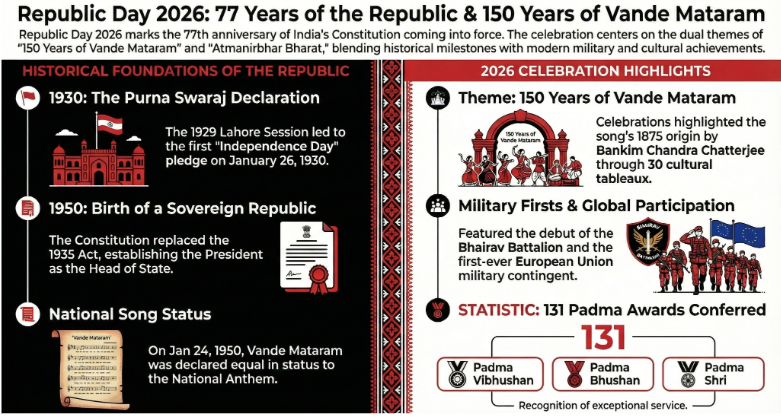
Republic Day 2026 marked the 77th anniversary of the Constitution of India coming into force. The celebration was centered on the theme “150 Years of Vande Mataram,” integrating constitutional values with cultural expression and public participation. Key highlights included the parade debut of the Bhairav Battalion, the first-ever participation of a European Union military contingent in an event of this nature outside Europe, and the display of 30 tableaux representing various states and ministries. The occasion also served as a platform for national recognition, with the conferral of 131 Padma Awards and numerous gallantry and service medals to armed forces and civil services personnel.
Historical Significance of Republic Day
The celebration of Republic Day on January 26th is rooted in specific historical milestones that transitioned India from a colonial entity to a sovereign republic.
The Purna Swaraj Resolution (1929-1930): During the Lahore Session of the Indian National Congress in December 1929, presided over by Jawaharlal Nehru, the "Purna Swaraj" (Complete Independence) resolution was passed. Consequently, January 26, 1930, was observed as Purna Swaraj Day, where Indians pledged to fight for complete self-rule. This date remained a symbol of resistance until 1947.
Constitutional Transition:
The Constituent Assembly first met in December 1946.
Post-independence (August 15, 1947), India remained a British Dominion under King George VI until the Constitution was enacted.
The Constitution was formally adopted on November 26, 1949.
January 26, 1950, was chosen as the date the Constitution would come into force to honor the 1930 Purna Swaraj Declaration.
Institutional Changes: Upon the Constitution’s commencement, the Government of India Act, 1935, was replaced. India became a Sovereign Democratic Republic, and the President of India replaced the British Monarch as the Head of State. The 42nd Constitutional Amendment (1976) later added "Socialist" and "Secular" to the Preamble.
77th Republic Day Parade Highlights
The 2026 parade featured 30 tableaux organized under two primary sub-themes: Swatantrata ka Mantra – Vande Mataram and Samriddhi ka Mantra – Atmanirbhar Bharat.
Military and Security Developments
Bhairav Battalion: A newly raised specialized assault infantry unit made its parade debut.
International Participation: A military contingent from the European Union participated, marking a historic first for the EU outside of Europe.
Tri-Services Display: Under the theme “Operation Sindoor – Victory Through Jointness,” the Department of Military Affairs showcased integrated strength including Rafale jets (with SCALP missiles), BrahMos cruise missiles, the S-400 air defense system, and HAROP loitering munitions.
Notable Tableaux and Cultural Representations
Entity | Focus Area | Key Features |
West Bengal | National Song | Honored Bankim Chandra Chatterjee and freedom fighters like Subhas Chandra Bose and Khudiram Bose. |
Gujarat | Revolutionary History | Tributed Madam Bhikaji Cama and the evolution of the Indian flag (1906–1947). |
Assam | Traditional Craft | Highlighted Asharikandi village and its terracotta craft tradition. |
Kerala | Modernization | Featured the Kochi Water Metro and achievements in 100% Digital Literacy. |
Maharashtra | Unity Movements | Showcased Ganeshotsav as a social movement initiated by Lokmanya Tilak. |
Punjab | Spiritual Sacrifice | Honored the 350th year of Sri Guru Tegh Bahadur Sahib Ji's martyrdom (Hind Di Chadar). |
Uttar Pradesh | Regional Heritage | Blended Bundelkhand’s cultural heritage with modern development. |
National Honors and Awards
The 2026 Republic Day served as a major occasion for recognizing civilian and military excellence.
Civilian and Service Awards
Padma Awards: A total of 131 awards were conferred:
5 Padma Vibhushan
13 Padma Bhushan
113 Padma Shri
Gallantry and Police Medals: 982 personnel from Police, Fire Services, Home Guard, and Civil Defence received medals. The President’s Medal for Gallantry was awarded for exceptional courage, while the Medal for Meritorious Service (MSM) recognized dedication to duty.
Jeevan Raksha Padak Series: Awarded for saving lives, categorized into Sarvottam (conspicuous courage in extreme danger), Uttam (courage in great danger), and Jeevan Raksha Padak (courage during grave injury).
Armed Forces Decorations
The President conferred 301 defense decorations and 70 gallantry medals.
Gallantry Medals: Included the Ashok Chakra, Kirti Chakra, and Shaurya Chakra.
Distinguished Service: Awards included the Param Vishisht Seva Medal (exceptional order) and the Uttam Yudh Seva Medal (distinguished service during war).
Coast Guard: Recognition included the President's Tatrakshak Medal (PTM) and Tatrakshak Medal (TM).
Theme Analysis: 150 Years of Vande Mataram
The 2026 theme commemorated the sesquicentennial of the composition of Vande Mataram.
Origins and National Status
Composition: Written by Bankim Chandra Chatterjee, it was first published in Bangadarshan in 1875 and later in the novel Anandamath (1882).
Official Recognition: On January 24, 1950, Dr. Rajendra Prasad declared Jana Gana Mana as the National Anthem and Vande Mataram as the National Song, granting them equal honor.
Constitutional Context: While not explicitly named in the Constitution, Article 51A(a) mandates respect for the National Flag and National Anthem.
Role in the Freedom Movement
Political Adoption: First sung at the 1896 Congress session by Rabindranath Tagore. It was officially adopted for all-India occasions at the 1905 Varanasi session.
Mass Mobilization: It became the rallying cry of the Swadeshi and anti-partition movements in 1905. The British government, under Lord Curzon, eventually ordered arrests for singing it.
Intellectual Influence: The English daily Bande Mataram, launched in 1906 by Bipin Chandra Pal and later joined by Sri Aurobindo, used the song's name to propagate ideas of resistance.
Global Impact:
Madam Bhikaji Cama included the words "Vande Mataram" on the first Indian flag unfurled abroad in Germany (1907).
Madan Lal Dhingra’s final words before execution in 1909 were “Bande Mataram.”
Gopal Krishna Gokhale was greeted with the chant in Cape Town in 1912.