
Introduction
National Voters' Day (NVD) 2026 marks the 76th anniversary of the Election Commission of India (ECI), established on January 25, 1950. The 2026 observance, themed "My India, My Vote" with the tagline "Citizen at the Heart of Indian Democracy," underscores a strategic shift toward citizen-centric electoral processes. This document synthesizes the historical milestones, major technological reforms, and recent digital initiatives undertaken by the ECI to ensure transparent, inclusive, and efficient elections. Key takeaways include the launch of ECINET, a unified digital interface; the success of the Special Intensive Revision (SIR) 2025; and the adoption of the Delhi Declaration 2026, which establishes five pillars for global electoral integrity.
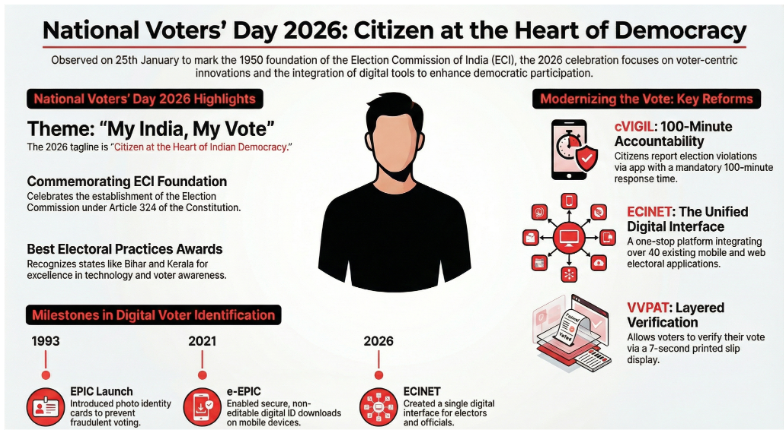
Overview of National Voters' Day 2026
National Voters’ Day is observed annually on January 25 to celebrate democracy and maximize voter enrollment, particularly among young citizens. The 2026 celebrations were presided over by the President of India.
Core Theme and Significance
Theme: "My India, My Vote."
Tagline: "Citizen at the Heart of Indian Democracy."
Objective: To highlight the ECI’s commitment to designing electoral processes that prioritize voter convenience and participation.
Outreach: Focuses on young and new voters through nationwide awareness activities to bridge the "participation gap."
Recognition and Publications
The President presented the Best Electoral Practices Awards to recognize excellence in election management, technology use, and voter awareness.
Award Category | Recognized Regions/States |
Best Electoral Practices | Bihar, Kerala, Tamil Nadu, Odisha, Gujarat, Meghalaya, Mizoram, Uttar Pradesh, Jharkhand, and Delhi |
Two significant publications were released during the event:
"2025: A Year of Initiatives and Innovations": Documenting recent ECI advancements.
"Chunav Ka Parv, Bihar Ka Garv": Showcasing electoral management success in Bihar.
Major Electoral Reforms and Technological Milestones
Since its inception under Article 324 of the Indian Constitution, the ECI has introduced several reforms to safeguard the integrity of the vote and modernize the electoral framework.
Identification and Authentication
EPIC (1993): The Electors Photo Identity Card was introduced to prevent impersonation.
e-EPIC (2021): A secure, non-editable digital version of the identity card, allowing for easier mobile access and portability.
NERPAP (2015): The National Electoral Roll Purification and Authentication Programme linked EPIC data with Aadhaar to eliminate duplicate entries and ensure a "clean" electoral roll.
Voting Technology
Electronic Voting Machines (EVMs): Formally introduced on a large scale in 1998, EVMs eliminated "invalid votes," reduced counting time from days to hours, and promoted environmental sustainability by saving paper.
VVPAT (2013): The Voter Verifiable Paper Audit Trail provides a physical verification layer, allowing voters to see a printed slip of their vote for seven seconds through a glass window.
Accountability and Enforcement
cVIGIL App (2018): A mobile application that empowers citizens to report Model Code of Conduct (MCC) violations via geo-tagged photos or videos. The ECI mandates a response and investigation within 100 minutes.
ERO-NET (2018): A multi-language digital system (14 languages, 11 scripts) for real-time form processing, allowing voters to track applications and preventing dual registration.
Accessibility and Voter Education
The ECI has launched targeted programs to ensure that no citizen is excluded from the democratic process.
SVEEP (2009): Systematic Voters' Education and Electoral Participation is the flagship program for voter education. It uses street plays, social media, and campus ambassadors to combat urban apathy and youth disengagement.
Accessible Elections (2018): Designated as the "Year of Accessible Elections," this initiative introduced Braille-enabled EPICs for visually impaired voters and provided free transport and auxiliary polling stations for Persons with Disabilities (PwDs).
Recent Initiatives (2025–2026)
Special Intensive Revision (SIR) 2025
A comprehensive cleanup of the electoral roll was conducted across 12 States/UTs.
Scope: Covered over 51 crore electors.
Outcome: Removal of deceased voters and duplicate entries to ensure the roll's accuracy before upcoming cycles.
ECINET 2026
Launched as a "one-stop" interface, ECINET integrates more than 40 existing ECI mobile and web applications. It serves a diverse range of stakeholders, including:
Electors
Election Officials
Political Parties
Civil Society
International Cooperation: The Delhi Declaration 2026
India has positioned itself as a leader in global electoral management by hosting the India International Conference on Democracy and Election Management (IICDEM) 2026. This conference led to the adoption of the Delhi Declaration 2026, which is built upon five pillars:
Clean Electoral Rolls: Ensuring the accuracy of voter databases.
Free and Fair Elections: Maintaining the fundamental integrity of the vote.
Research and Publications: Advancing the study of democratic innovations.
Technology Use: Sharing India’s digital platforms (such as ECINET) with international partners.
Capacity Building: Training and professional development through the India International Institute of Democracy and Election Management (IIIDEM).