
Introduction
National Girl Child Day is an annual observance held on January 24 to reaffirm the national commitment to eradicating gender discrimination and fostering the holistic development of girls in India. Initiated in 2008 by the Ministry of Women and Child Development (MWCD), the day serves as a strategic platform to advocate for girls' rights across several critical domains, including education, health, nutrition, and safety.
The 2026 briefing highlights significant progress in gender-related metrics, most notably the improvement in the Sex Ratio at Birth (SRB), which rose from approximately 918 in 2014-15 to 930 in 2023-24. Key legislative and financial interventions, such as the Sukanya Samriddhi Yojana (with over 4.2 crore accounts) and the Prohibition of Child Marriage Act, continue to underpin the government’s efforts to ensure long-term security and social equity for the girl child.
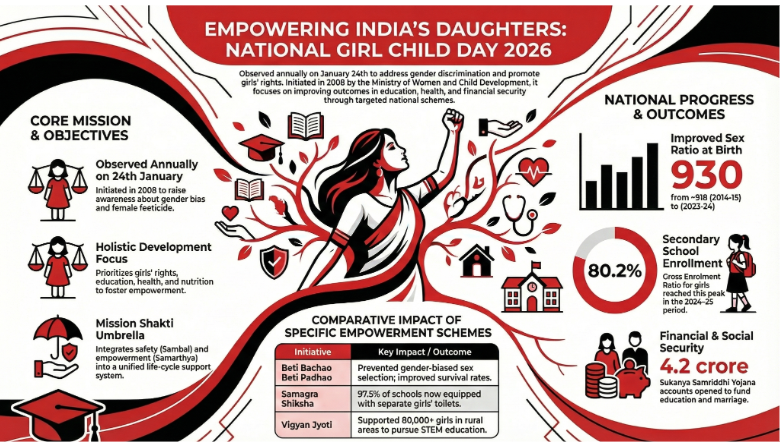 Overview of National Girl Child Day
The primary mission of National Girl Child Day is to raise awareness regarding gender bias and to foster an environment where girls can thrive as empowered citizens. The initiative focuses on:
Addressing Systemic Issues: Combating female feoticide, child marriage, and gender-based discrimination.
Promoting Essential Rights: Ensuring access to quality education, health services, and adequate nutrition.
Equal Opportunity: Advocating for the removal of barriers that prevent girls from achieving their full potential.
Strategic Initiatives and Developmental Outcomes
The government has implemented a multi-tiered framework of schemes designed to support the girl child through various life stages, from birth through secondary education and vocational skilling.
Government Schemes and Impact Analysis
Initiative | Key Features | Outcomes and Impact |
Beti Bachao Beti Padhao (BBBP) | Launched in 2015; focuses on preventing gender-biased sex selection and promoting education. | SRB improved from ~918 (2014-15) to 930 (2023-24); increased secondary education enrollment. |
Mission Shakti | Umbrella scheme (2022) featuring two sub-schemes: Sambal (safety/security) and Samarthya (empowerment). | Provides life-cycle support and ensures convergence of BBBP, One Stop Centres, and PMMVY. |
Samagra Shiksha | Integrated school education scheme (Pre-school to Class XII) focusing on bridging gender gaps. | Girls' Gross Enrolment Ratio (GER) at the secondary level reached 80.2% (2024–25); 97.5% of schools now have separate girls' toilets. |
Sukanya Samriddhi Yojana (SSY) | Financial savings scheme for education and marriage expenses. | Over 4.2 crore accounts opened as of Nov 2024, enhancing financial inclusion. |
Vigyan Jyoti (DST) | Encourages girls in Classes IX-XII (particularly in rural areas) to pursue STEM fields. | Supported 80,000+ meritorious girls across 300 districts in 35 States/UTs. |
Scheme for Adolescent Girls (SAG) | Targets girls aged 14-18 in Aspirational and North Eastern districts; provides nutrition and skilling. | 24.08 lakh+ girls registered on Poshan Tracker (Dec 2024); provides 600 kcal/day and 18-20g protein for 300 days. |
Health and Nutrition Framework
The Scheme for Adolescent Girls (SAG) specifically addresses the nutritional needs of vulnerable populations in Aspirational districts and North Eastern States. The scheme provides a robust nutritional package consisting of:
Energy Intake: 600 kcal per day.
Protein: 18-20g per day.
Micronutrients: Provision of Iron-Folic Acid and regular health check-ups.
Duration: Support is provided for 300 days a year to ensure sustained physical development.
Protection and Legislative Measures
The legal framework for the protection of the girl child is anchored by the Prohibition of Child Marriage Act, 2006, and the subsequent Bal Vivah Mukt Bharat campaign.
National Goal: The campaign aims to achieve a child-marriage-free India by 2030.
Short-term Targets: A target reduction of 10% in the prevalence of child marriage is set for 2026.
Safety Integration: Under the Mission Shakti umbrella, the Sambal sub-scheme is dedicated specifically to the safety and security of women and girls.
Conclusion
The data for 2026 reflects a consistent upward trajectory in the empowerment of the girl child in India. Through the convergence of financial security (SSY), improved educational infrastructure (Samagra Shiksha), and targeted nutritional support (SAG), the government aims to sustain the improvements seen in the Sex Ratio at Birth and secondary school enrollment. The continued focus on STEM education via Vigyan Jyoti and the rigorous pursuit of a child-marriage-free status by 2030 remain central to the national developmental agenda.