
Introduction
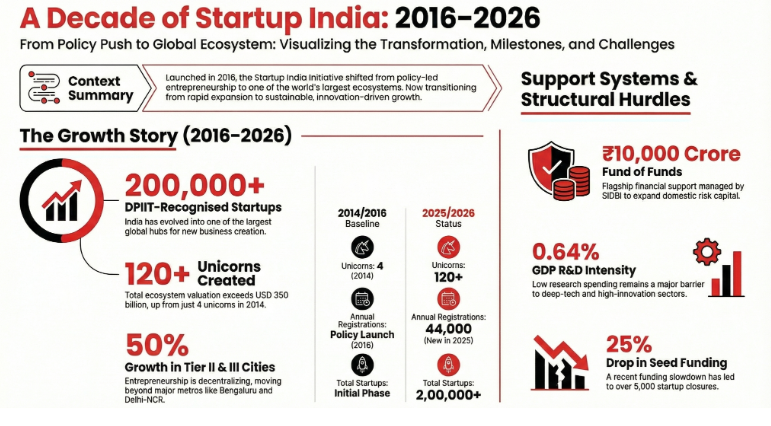
Since its launch on January 16, 2016, the Startup India Initiative has catalyzed a fundamental transformation in the national economy, transitioning from a policy-led push for entrepreneurship to one of the world's largest startup ecosystems. As of late 2025, the ecosystem encompasses over 2 lakh DPIIT-recognized startups and more than 120 unicorns with a combined valuation exceeding USD 350 billion. A significant hallmark of this decade is the decentralization of innovation, with nearly 50% of new startups emerging from Tier II and Tier III cities.
However, the ecosystem faces critical structural challenges that necessitate a shift from rapid expansion to sustainable, innovation-driven growth. These include low R&D intensity (0.64% of GDP), a heavy reliance on foreign risk capital, and a market bias toward consumer-centric services over deep-tech innovation. Strengthening the ecosystem's future will require deepening domestic capital markets, improving infrastructure beyond metropolitan hubs, and fostering closer industry-academia linkages to achieve the vision of Viksit Bharat 2047.
Overview of the Startup India Initiative
The Startup India Initiative was established to shift the national economic paradigm from "job-seeking" to "job-creating." Implemented by a dedicated team under the Department for Promotion of Industry and Internal Trade (DPIIT), the initiative focuses on four key objectives:
Nurturing Innovation: Creating environments to scale innovative products.
Promoting Entrepreneurship: Reducing regulatory burdens across the founder's journey.
Enabling Investment: Facilitating access to necessary funding and capital.
Driving Economic Growth: Generating large-scale employment opportunities.
Core Support Pillars and Funding Schemes
The government has implemented several financial and structural pillars to support the ecosystem:
Scheme/Platform | Description | Scale/Corpus |
Fund of Funds for Startups (FFS) | Managed by SIDBI; invests in SEBI-registered Alternative Investment Funds (AIFs) that fund startups. | ₹10,000 crore |
Startup India Seed Fund (SISFS) | Provides assistance for early-stage requirements like proof of concept and prototyping. | ₹945 crore |
Credit Guarantee Scheme (CGSS) | Enables collateral-free loans through eligible financial institutions. | Operationalized by NCGTC |
Startup India Hub | A single-window digital platform for founders, mentors, and investors. | National reach |
MAARG Portal | Focused on mentorship, advisory, assistance, and resilience. | Digital platform |
States’ Startup Ranking | Evaluates States/UTs on startup-friendly policies to promote competitive federalism. | Framework-based |
Growth and Decentralization Metrics
The initiative has reached significant milestones as of December 2025:
Volume of Startups: Over 2 lakh DPIIT-recognized entities exist globally. In 2025 alone, approximately 44,000 new startups registered—the highest annual addition since 2016.
Unicorn Evolution: India’s unicorn count rose from 4 in 2014 to over 120 by 2025.
Geographic Shifts: While Bengaluru, Mumbai, and Delhi-NCR remain leading hubs, nearly 50% of startups now originate from Tier II and Tier III cities, indicating a deepening decentralization of entrepreneurship.
Complementary Ecosystem Support Programs
Beyond the primary Startup India Initiative, various ministries have launched specialized schemes to foster technology and rural entrepreneurship:
Atal Innovation Mission (AIM 2.0): Includes "Deeptech Reactor" for long-gestation innovations and "Atal Sectoral Innovation Launchpads" (ASIL) for government procurement from startups.
MeitY Initiatives: Includes GENESIS, focused on scaling technology startups in Tier II/III cities, and TIDE 2.0, which supports emerging technologies like AI, blockchain, and clean tech.
NIDHI (Dept. of Science & Technology): Focuses on converting ideas into scalable startups through incubators.
MSME & Rural Programs: The ASPIRE Scheme promotes entrepreneurship in underserved areas, while the Prime Minister’s Employment Generation Programme (PMEGP) provides margin money subsidies (up to 35% in rural areas) for micro-enterprise creation.
Critical Structural Challenges
Despite the quantitative success of the ecosystem, several qualitative and structural barriers persist:
1. Innovation and R&D Deficits
Low R&D Intensity: India’s R&D expenditure remains stagnant at approximately 0.64% of GDP.
Basic vs. Applied Research: There is a heavy emphasis on basic research rather than commercially viable, applied innovation.
Deep-Tech Lag: Most startups focus on consumer-facing services (fintech, food delivery) rather than high-technology sectors like semiconductors, EVs, or advanced AI.
2. Economic and Demand Constraints
Segmented Demand Structure: Startup models often reflect India's uneven wealth distribution. Capital is largely provided by the wealthy, while the middle-income group acts as a price-sensitive consumer base. The poor supply labor but remain largely unmonetizable as consumers.
Consumer-Centric Bias: The structure of the economy drives startups toward scalable consumer models rather than breakthrough technological innovation.
3. Financial and Market Volatility
Funding Slowdown: The ecosystem saw over 5,000 closures recently due to funding shortages. In 2024, seed funding fell by 25%.
Dependency on Foreign Capital: A lack of domestic risk capital leaves startups vulnerable to global financial volatility.
Exit Challenges: High valuations and profitability concerns have led to underperforming IPOs, making investors more cautious.
4. Infrastructure Gaps
High operational costs and inadequate logistics, unreliable power, and poor internet connectivity continue to hinder scalability in Tier II, Tier III, and rural regions.
Strategic Recommendations for Future Scaling
To ensure the ecosystem contributes to the goal of a USD 7.3 trillion economy by 2030, the following measures are identified:
Diversifying Risk Capital: Enabling domestic institutional investors—such as pension funds, insurance companies, and sovereign funds—to invest in deep-tech and long-gestation sectors.
Mission-Mode Funding: Utilizing outcome-based grants through initiatives like the IndiaAI Mission, India Semiconductor Mission, and National Quantum Mission to support high-risk innovation.
Industry-Academia Integration: Facilitating structured collaborations between startups and premier institutions like ISRO, DRDO, and the IITs for applied research.
Regulatory Simplification: Implementing predictable tax policies, faster Intellectual Property Rights (IPR) processing, and stronger exit mechanisms for investors.
Sustainability Focus: Encouraging green innovation in electric mobility and climate technologies aligned with Mission LiFE.
Infrastructure Development: Prioritizing digital and physical connectivity in non-metropolitan regions to reduce the "cost of doing business" for regional startups.