Jal Seva Aankalan – Assessing Rural Drinking Water Services
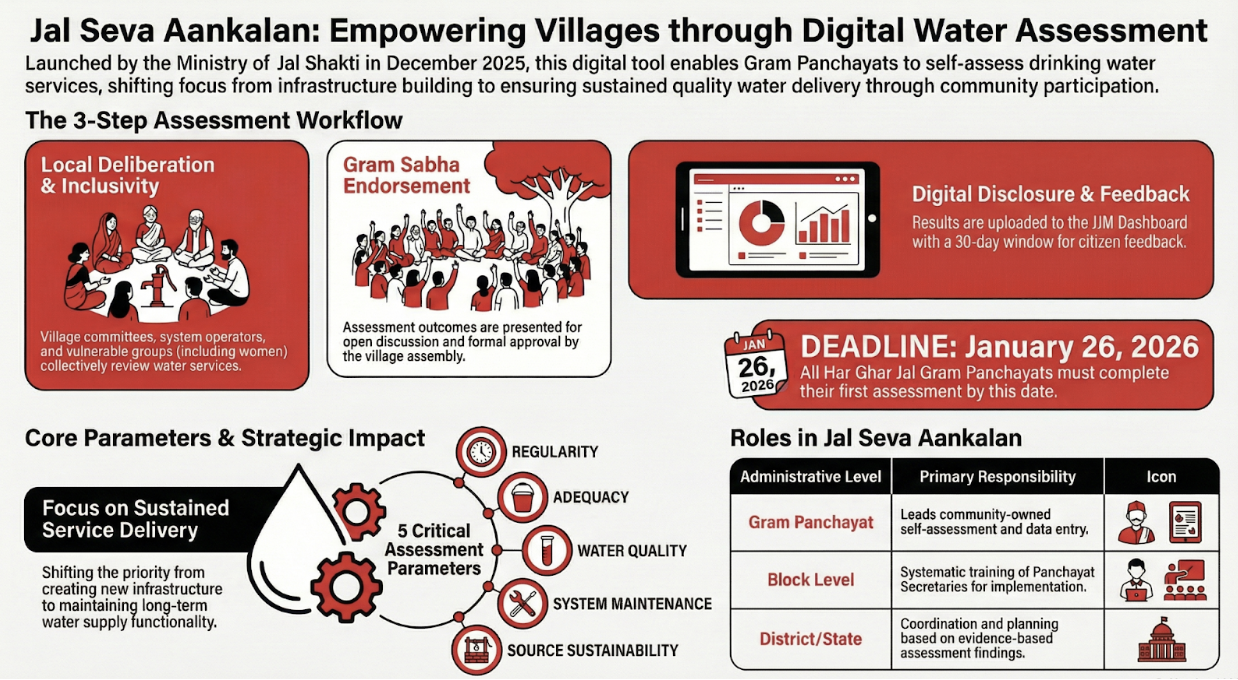
In December 2025, the Ministry of Jal Shakti (MoJS) launched Jal Seva Aankalan, a digital self-assessment tool designed to monitor the functionality of drinking water services in rural India. Developed by the Department of Drinking Water and Sanitation (DDWS) and integrated into the Jal Jeevan Mission (JJM) portal, the tool marks a strategic pivot from infrastructure construction to the long-term sustainability of water service delivery. By placing Gram Panchayats (GPs) and local communities at the center of the evaluation process, the initiative aims to institutionalize community stewardship, enhance transparency, and ensure that "Har Ghar Jal" (HCJ) villages maintain a consistent, high-quality water supply. All HGJ Gram Panchayats are mandated to complete this assessment by January 26, 2026.
Strategic Shift: From Infrastructure to Service Delivery
The launch of Jal Seva Aankalan represents a fundamental evolution in the management of rural water resources.
Community-Led Monitoring: The initiative transitions monitoring responsibilities from expensive, infrequent third-party surveys to a community-owned self-assessment model.
Sustainability Focus: The primary objective is to shift the administrative focus from the creation of water infrastructure to the sustained delivery of services.
Digital Integration: The tool is hosted on the JJM portal, ensuring that assessment data is digitized and integrated with national governance platforms.
The Assessment Process and Transparency Measures
The Jal Seva Aankalan follows a structured, bottom-up methodology to ensure accuracy and inclusive representation:
1. Village-Level Deliberations
The process begins with structured discussions involving:
Members of the Village Water & Sanitation Committee (VWSC).
The Panchayat Secretary.
Water system operators.
A diverse cross-section of water users, with a specific emphasis on including women and vulnerable groups.
2. Formal Endorsement
Findings from these discussions are presented to the Gram Sabha. This forum provides an opportunity for open discussion and requires formal endorsement before the assessment can proceed.
3. Digital Publication and Feedback
Once approved, the data is uploaded to the JJM Panchayat Dashboard and cross-published on:
eGramSwaraj
Meri Panchayat Application
A 30-day window is established for citizens to provide feedback. The report is only finalized after this public review period, ensuring high levels of accountability.
Key Service Parameters
The Jal Seva Aankalan evaluates five critical dimensions of water service functionality:
Parameter | Focus Area |
Quantity & Regularity | Assessment of the adequacy and regularity of the daily water supply. |
Water Quality | Verification of whether the drinking water meets safety standards. |
Operations & Maintenance (O&M) | Review of the functionality and upkeep of existing water systems. |
Source Sustainability | Evaluation of the long-term viability of the water source. |
Institutional Management | Assessment of village-level management and institutional arrangements. |
Implementation Framework and Timeline
The Ministry of Jal Shakti has defined specific roles for various levels of local government to ensure the success of the initiative:
District Level: Zila Panchayats (ZPs) are responsible for planning, coordination, and facilitating the assessment process across their jurisdictions.
Block Level: Authorities are tasked with the systematic training of Panchayat Secretaries to ensure accurate data entry and effective tool implementation.
Completion Deadline: All Har Ghar Jal Gram Panchayats are required to finalize their assessments by January 26, 2026.
Expected Outcomes
The implementation of Jal Seva Aankalan is expected to yield several strategic benefits:
Challenge Identification: Early detection of operational, quality-related, and sustainability issues.
Evidence-Based Planning: Providing District Collectors, CEOs of Zila Panchayats, and State Level authorities with granular data to inform corrective actions and future planning.
Enhanced Stewardship: Reinforcing the role of the community as the primary owners and managers of their water supply systems.
Institutional Transparency: Making service performance data publicly available to foster trust and accountability.
The Jal Jeevan Mission (JJM)
Jal Seva Aankalan serves as a critical monitoring component of the broader Jal Jeevan Mission.
Mission Goal: Launched on August 15, 2019, the JJM aims to provide 55 liters of water per person per day to every rural household through Functional Household Tap Connections (FHTC).
Core Pillars: The mission is built on four pillars: Political Will, People’s Participation, Stakeholder Collaboration, and Optimal Resource Use.
Governance: The mission is implemented by the DDWS under the Ministry of Jal Shakti.
Leadership of the Ministry of Jal Shakti
Union Minister: C. R. Patil (Constituency: Navsari, Gujarat).
Ministers of State:
V. Somanna (Constituency: Tumakuru, Karnataka).
Raj Bhushan Choudhary (Constituency: Muzaffarpur, Bihar).