
Introduction
The Transformative Change Assessment report, released by the Intergovernmental Science-Policy Platform on Biodiversity and Ecosystem Services (IPBES), underscores that mitigating biodiversity loss requires a fundamental, system-wide reorganization of society. The central thesis of the report is that governance is the primary lever for driving this systemic change. Key takeaways include:
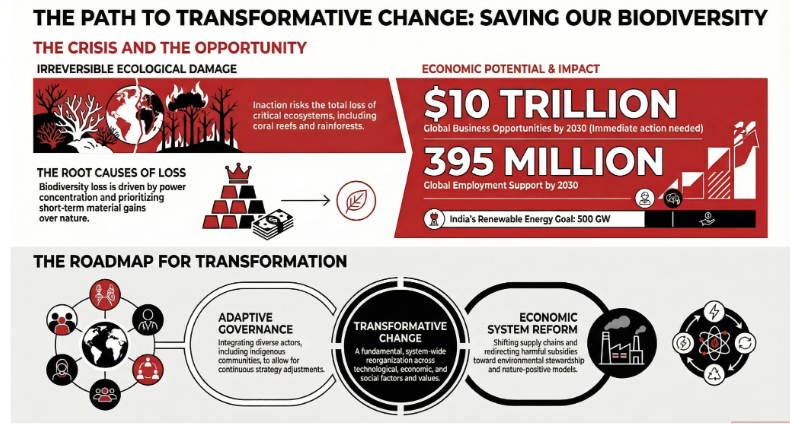
Urgency of Action: Failure to act immediately risks irreversible ecological damage, specifically to rainforests and coral reefs.
Economic Opportunity: Shifting toward nature-positive industries could generate USD 10 trillion in business opportunities and support 395 million jobs globally by 2030.
Root Cause Identification: Biodiversity loss is driven by a disconnection between humans and nature, the concentration of power and wealth, and a prioritization of short-term material gains over long-term sustainability.
Strategic Framework: Transformation must be pursued through five core strategies: conservation and regeneration, sectoral systemic change, economic reform, adaptive governance, and a fundamental shift in societal values.
Defining Transformative Change
Transformative change is defined as a system-wide reorganization across technological, economic, and social factors. This process involves shifting paradigms, goals, and values to ensure the conservation and sustainable use of biodiversity while achieving a high quality of life and sustainable development.
Root Causes of Biodiversity Loss
The report identifies several systemic issues that drive ecological degradation:
Anthropocentric Domination: A mindset of domination over nature and other people.
Human-Nature Disconnection: A widening gap in how societies perceive their relationship with the natural world.
Short-termism: Prioritizing immediate economic and material gains at the expense of long-term environmental stability.
Power Dynamics: The concentration of wealth and power that often sidelines sustainability in favor of extractive practices.
Strategies for Global Transformation
The assessment outlines five key strategies necessary to reverse biodiversity loss and foster a sustainable future:
1. Conserve and Regenerate
Focus on areas of biocultural diversity, which integrates environmental restoration with cultural values. An example of this strategy is community-driven forest management, which leverages local knowledge for ecological preservation.
2. Systematic Change in Key Sectors
Targeted interventions are required in industries that serve as primary drivers of biodiversity loss, specifically:
Agriculture
Fisheries
Infrastructure development
3. Transformation of Economic Systems
Move toward nature-positive economies by:
Reforming or eliminating harmful subsidies that encourage environmental degradation.
Promoting sustainable business models that account for natural capital.
4. Adaptive Governance
Build governance systems that are flexible and inclusive. Key features include:
Inclusivity: Integrating diverse actors, particularly Indigenous communities, into the decision-making process.
Policy Centrality: Making biodiversity a core concern across all policy areas.
Agility: Allowing for the continuous adjustment of strategies based on new information and changing environmental conditions.
5. Shifting Views and Values
Promote the recognition of human-nature interconnectedness through education, experiential activities, and the integration of diverse knowledge systems.
Actionable Pathways for Implementation
To achieve transformative change, the report suggests five practical implementation steps:
Action Category | Description |
Carbon-Neutrality | Making carbon-neutral actions the norm for individuals, businesses, and governments while supporting legitimate climate-friendly offsets. |
Earth-Positive Choices | Influencing supply chains and policies to make it affordable and easy for citizens to contribute positively to the environment. |
Subsidy Reform | Redirecting financial incentives away from resource-extractive industries toward environmental stewardship. |
Precautionary Decision-Making | Addressing environmental threats proactively, even in the absence of definitive proof, through inclusive and cross-sectoral planning. |
Legal Strengthening | Advocating for stronger environmental laws and consistent enforcement to protect nature globally. |
National Implementation: The Case of India
India has launched several initiatives that align with the goals of transformative change and the Sustainable Development Goals (SDGs).
Key Policy Initiatives
National Biodiversity Action Plan (NBAP): Focused on conservation and sustainable use.
Mission LiFE (Lifestyle for Environment): Encouraging individual and collective action for sustainability.
Renewable Energy Targets: Aiming to generate 500 GW from non-fossil sources by 2030 under the leadership of the International Solar Alliance.
Urban and Environmental Programs: Includes the Smart Cities Mission, Green India Mission, Atal Mission for Rejuvenation and Urban Transformation (AMRUT), and Swachh Bharat Abhiyan.
Socio-Economic Interventions: Programs such as Pradhan Mantri Ujjwala Yojana (PMUY) and Faster Adoption and Manufacturing of Hybrid and Electric Vehicles (FAME).
About IPBES
The Intergovernmental Science-Policy Platform on Biodiversity and Ecosystem Services (IPBES) is an independent intergovernmental body established in 2012.
Membership: Nearly 150 member governments, including India.
Function: Provides scientific assessments on biodiversity and ecosystems to inform policy, offering tools and methods for sustainable use and protection.
Structure: While not a United Nations body, the United Nations Environment Programme (UNEP) provides its secretariat services.
Headquarters: Bonn, Germany.