Introduction
On January 7, 2026, India marked a significant diplomatic milestone by participating in its first-ever engagement with the Weimar Triangle, a regional grouping comprising France, Germany, and Poland. Represented by the External Affairs Minister (EAM), India sought to deepen its cooperation with European powers amidst a volatile global landscape. The dialogue focused on critical strategic areas, including India–European Union (EU) relations, the Indo-Pacific, and the conflict in Ukraine. This engagement signals India's intent to utilize smaller, specialized group formats to supplement its broader bilateral and multilateral partnerships within Europe.
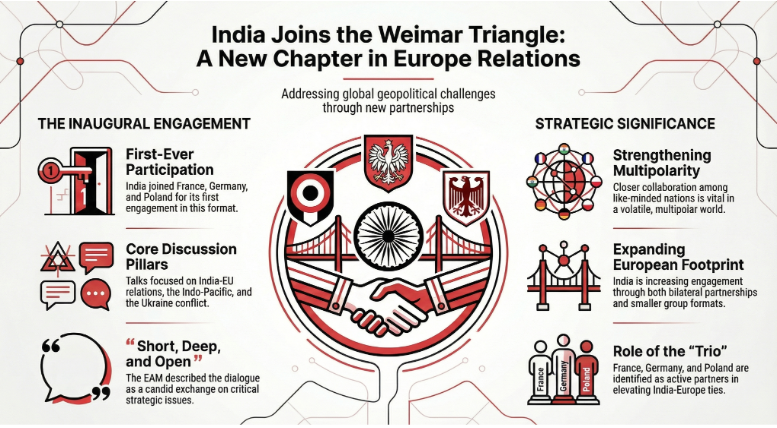
Overview of the Inaugural Engagement
The meeting represented the first instance of India engaging with the Weimar Triangle format. This diplomatic outreach is a component of India’s broader strategy to expand its footprint in Europe through multiple channels.
Participants: Senior leaders from France, Germany, and Poland met with India’s External Affairs Minister.
Nature of the Dialogue: The EAM characterized the discussions as "short but deep and open," indicating a level of candidness and high-level strategic exchange.
Strategic Modality: The engagement is viewed as a natural progression of India’s expanding ties with Europe, acting as a bridge between India's interactions with Brussels (EU headquarters) and its individual bilateral partnerships.
Key Discussion Areas and Strategic Focus
The dialogue centered on three primary pillars of mutual concern, reflecting the shared interests of India and the Weimar Triangle nations:
1. India–European Union Relations
A primary objective of the meeting was to explore ways to elevate India–Europe relations. The EAM expressed confidence that the three Weimar nations France, Germany, and Poland would serve as active catalysts in advancing these ties to a higher strategic level.
2. The Indo-Pacific Region
Recognizing the shifting global gravity toward the Indo-Pacific, the participants discussed regional developments. This alignment suggests a shared recognition of the Indo-Pacific as a critical theater for international security and economic stability.
3. The Conflict in Ukraine
The ongoing conflict in Ukraine was a central point of discussion, highlighting the strategic challenges currently facing Europe and the necessity of coordinated international responses to such crises.
Geopolitical Context and Rationale
The engagement with the Weimar Triangle is framed within a broader context of global instability and shifting power dynamics.
Global Geopolitical Churn: The discussions occurred against a backdrop of significant global uncertainty and strategic challenges within Europe.
The Multipolar Order: The EAM emphasized that the emergence of a multipolar world order necessitates closer collaboration among "like-minded nations."
Volatility and Uncertainty: The current international environment, characterized by volatility, provides a strong rationale for India to seek diverse and flexible diplomatic formats to secure its interests and promote regional stability.
Supplementary Developments (January 2026)
In addition to the Weimar Triangle dialogue, the following developments highlight India's current national and international priorities:
Category | Development |
Legal & Digital | Implementation of India's first fully paperless court system; launch of the PANKHUDI digital portal. |
Media & Culture | Prasar Bharati launched 'Creator's Corner'; celebration of World Hindi Day. |
Economy | United Nations projects strong economic growth for India. |
Defense & Tech | DRDO successfully conducted tests of a Scramjet Engine. |
International Cooperation | India and Fiji engaged in discussions regarding agricultural cooperation. |