Introduction
In January 2026, India and the European Union (EU) concluded negotiations for a comprehensive Free Trade Agreement (FTA), signaling a transformative shift in the economic and strategic landscape between the world’s second and fourth-largest economies. This agreement creates a "zone of trust" between two democratic blocs that together represent 25% of global GDP and one-third of global trade.
Key takeaways include:
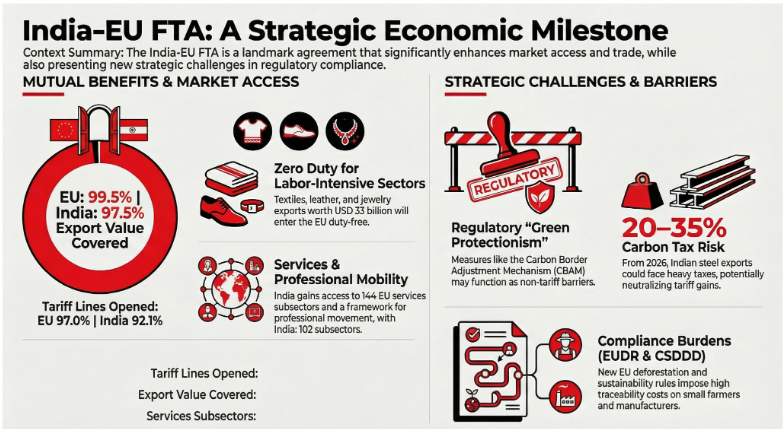
Unprecedented Market Access: The EU will open 97% of its tariff lines, providing zero-duty access for Indian labor-intensive exports worth approximately USD 33 billion.
Services and Mobility: India gained access to 144 EU service subsectors and a framework for professional mobility, while opening 102 subsectors to EU firms.
Regulatory Hurdles: The primary challenges to the FTA’s success are the EU’s stringent environmental and labor regulations—such as the Carbon Border Adjustment Mechanism (CBAM) and the EU Deforestation Regulation (EUDR)—which Indian stakeholders view as non-tariff barriers.
Strategic Diversification: The FTA advances the "China-plus-one" strategy, positioning India as a trusted manufacturing and services alternative for the EU in sensitive sectors like AI, semiconductors, and green technology.
Analysis of Key FTA Commitments
The agreement is built on reciprocal but calibrated concessions designed to balance market access with the protection of sensitive domestic industries.
European Union Commitments
The EU has offered India some of the deepest preferential market access arrangements in its history:
Tariff Elimination: The EU committed to opening 97% of its tariff lines, covering 99.5% of India’s exports by value.
Labor-Intensive Sectors: Key sectors currently facing duties of 4–26%—including textiles, apparel, leather, footwear, gems and jewellery, and marine products—will enter the EU at zero duty.
Professional Mobility: A clear framework was established for the temporary movement of professionals, including intra-corporate transferees and independent professionals, with provisions for dependents and future social security arrangements.
Agricultural Access: India secured preferential access for agricultural and processed food exports, aimed at boosting farmer incomes and rural livelihoods.
India’s Commitments
India’s approach focused on calibrated liberalization to protect vulnerable sectors:
Tariff Lines: India committed to market access on 92.1% of its tariff lines, covering 97.5% of EU exports.
Protected Sectors: Critical agricultural sectors, including dairy, cereals, poultry, and soymeal, remain protected.
Gradual Liberalization: Tariffs on automobiles, wines, and spirits will be reduced gradually to shield domestic MSMEs and farmers.
Intellectual Property (IPR): India reaffirmed TRIPS-compliant protection while safeguarding its generic pharmaceutical industry and public interest.
Feature | EU Commitment | India Commitment |
Tariff Lines Opened | 97% | 92.1% |
Export Value Covered | 99.5% | 97.5% |
Services Subsectors | 144 subsectors | 102 subsectors |
Key Protections | Regulatory standards (SPS/TBT) | Dairy, poultry, cereals, MSMEs |
Strategic and Geoeconomic Significance
The FTA extends beyond mere trade, serving as a pillar for deeper strategic integration.
Geoeconomic Diversification
The agreement facilitates the China-plus-one strategy, establishing India as a reliable partner in global supply chains. By creating a rules-based economic bloc, India and the EU seek to insulate sensitive sectors—such as defense manufacturing, semiconductors, and green technologies—from the weaponization of trade through sanctions or export controls.
The "Brussels Effect" and Global Competitiveness
The FTA acts as a "standards upgrade" engine. To access the EU market, Indian manufacturers must adhere to stringent Sanitary and Phytosanitary (SPS) measures and technical standards. This overhaul is expected to make Indian goods more competitive in other high-standard markets, such as the United States and Japan.
Green and Digital Modernization
The agreement focuses on the digital economy through secure data flows and AI-driven development. It also aligns with the India-Middle East-Europe Economic Corridor (IMEC) to reduce logistical costs and build resilient supply chains.
Critical Challenges and Regulatory Concerns
Despite the breakthrough, significant friction points remain, primarily regarding the EU’s regulatory framework and existing trade asymmetries.
Non-Tariff Barriers (NTBs) as "Green Protectionism"
Indian exporters face a "regulatory onslaught" from the EU that could negate tariff gains:
Carbon Border Adjustment Mechanism (CBAM): Starting in 2026, Indian exports of steel, aluminium, and chemicals could face tax equivalents of 20–35%.
EU Deforestation Regulation (EUDR): This requires geotagging and traceability for commodities like coffee and rubber to prove they were not produced on deforested land. This represents a heavy compliance burden for smallholders.
Corporate Sustainability Due Diligence (CSDDD): Effective in 2027, this requires auditing value chains for human rights and environmental risks, which Indian firms fear may expose sensitive supplier data.
Market Access Asymmetries
There is a notable imbalance in the starting positions of both parties:
Pre-existing Low Tariffs: Over 75% of India’s exports to the EU already attract less than 1% tariff. Thus, India’s relative gain in goods is smaller than the EU’s, as India’s average tariffs (10–12%) are significantly higher than the EU’s (3–4%).
Competition: India must compete with countries like Bangladesh and Vietnam, which already enjoy zero-duty access to the EU through other schemes.
Institutional Foundation of India-EU Relations
The FTA is the latest evolution in a relationship that has matured since 1962:
Strategic Partnership: Institutionalized in 2004, the relationship is guided by the "India–EU Strategic Partnership: A Roadmap to 2025."
Trade and Technology Council (TTC): Established in 2022, this serves as a key mechanism for coordinating on high-tech and strategic trade issues.
Economic Scale: The EU is India’s largest goods trading partner (USD 135 billion in FY 2023–24), with EU investments in India exceeding USD 117 billion.
Security Cooperation: Collaboration includes joint naval exercises (Operation Atalanta) and India’s associate membership in CERN.
Roadmap for Strengthening Economic Relations
To ensure the FTA’s sustainability, the following measures are identified as essential:
Address Asymmetries: India must aggressively leverage its gains in services and professional mobility to offset the disparity in goods tariffs.
Dispute Prevention: Establish a "Rapid Response Forum" to allow senior-level intervention in emerging non-tariff barrier disputes (e.g., EU regulations or India’s Quality Control Orders).
Equitable Carve-outs: India should seek exemptions or extended transition periods for regulations like CBAM and EUDR, similar to parity granted to other major powers like the US.
Strategic Synergy: Deepen collaboration through the Indo-Pacific Oceans Initiative (IPOI) and the IMEC to ensure the partnership remains resilient against geopolitical shifts.
Conclusion
The India-EU FTA represents a strategic milestone that moves the relationship beyond simple commerce into a deep geopolitical alliance. While it offers massive potential for market expansion and industrial modernization, its long-term success depends on the ability of both parties to navigate complex regulatory standards and ensure that the partnership remains mutually beneficial.