Introduction
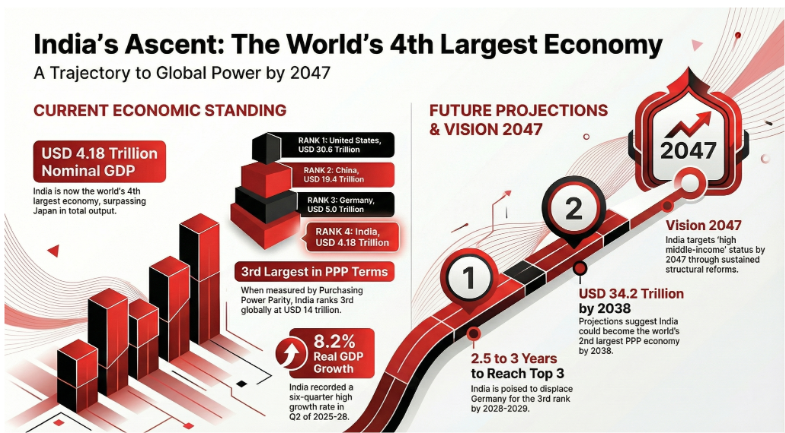
The Government of India has announced that the nation has officially surpassed Japan to become the world’s fourth-largest economy, with a nominal GDP of USD 4.18 trillion. Characterized as the fastest-growing major economy globally, India maintains a robust growth momentum, recording an 8.2% real GDP growth in the second quarter of the 2025-26 fiscal year. In terms of Purchasing Power Parity (PPP), India already holds the third rank globally at USD 14 trillion. Projections from international financial institutions suggest that India will displace Germany to become the third-largest economy by approximately 2028-2029. The nation’s long-term objective, "Vision 2047," seeks to achieve high middle-income status through sustained structural reforms and economic resilience.
Current Global Economic Standings
India’s transition to the fourth-largest economy marks a significant milestone in global shifted dynamics. The current hierarchy of the world’s leading economies by nominal GDP is as follows:
Rank | Country | GDP (Nominal) |
1 | United States | USD 30.6 Trillion |
2 | China | USD 19.4 Trillion |
3 | Germany | USD 5.0 Trillion |
4 | India | USD 4.18 Trillion |
Purchasing Power Parity (PPP) Analysis
While India ranks fourth in nominal terms, its economic influence is even more pronounced when adjusted for Purchasing Power Parity.
Current Standing: India is the 3rd largest economy in PPP terms at USD 14 trillion, trailing only China (USD 33 trillion) and the United States (USD 25 trillion).
Future PPP Projections: The International Monetary Fund (IMF) projects India's PPP GDP will reach USD 20.7 trillion by 2030. By 2038, India is expected to potentially become the world’s second-largest PPP economy with a GDP of USD 34.2 trillion.
Growth Trajectory and Institutional Forecasts
India’s economic expansion is underpinned by a "six-quarter high" in real GDP growth, reaching 8.2% in Q2 of 2025-26. This performance reflects a resilient domestic economy capable of navigating global trade uncertainties.
Projections for Near-Term Expansion
Displacing Germany: India is poised to overtake Germany as the world’s third-largest economy within the next 2.5 to 3 years.
2030 Milestone: The nominal GDP is projected to reach USD 7.3 trillion by 2030.
International Institution Forecasts
Major global financial entities and rating agencies have provided optimistic growth forecasts for India:
Asian Development Bank (ADB): Elevated its 2025 growth forecast to 7.2%.
International Monetary Fund (IMF): Raised its 2025 forecast to 6.6%.
World Bank: Projects a 6.5% growth rate for 2026.
Moody’s: Identifies India as the likely fastest-growing economy within the G20.
Macroeconomic Indicators and Stability
The sustained growth of the Indian economy is supported by several positive internal macroeconomic factors:
Inflation and Employment: The economy is currently benefiting from low inflation levels and declining unemployment rates.
Domestic Demand: Strong urban demand and consistent credit flow provide the necessary support for continued expansion.
Resilience: The 8.2% growth rate in the most recent quarter demonstrates an ability to withstand external shocks and international trade volatility.
Long-Term Strategic Goals: Vision 2047
The government has outlined a definitive roadmap for the next two decades, termed "Vision 2047." The core components of this strategic plan include:
Status Objective: Achieving "high middle-income" status by the year 2047.
Strategic Pillars: The vision is anchored in three primary areas:
Structural Reforms: Continued modernization of economic frameworks.
Economic Resilience: Building internal capacity to handle global fluctuations.
Social Progress: Ensuring economic growth translates into broader social development.