Introduction
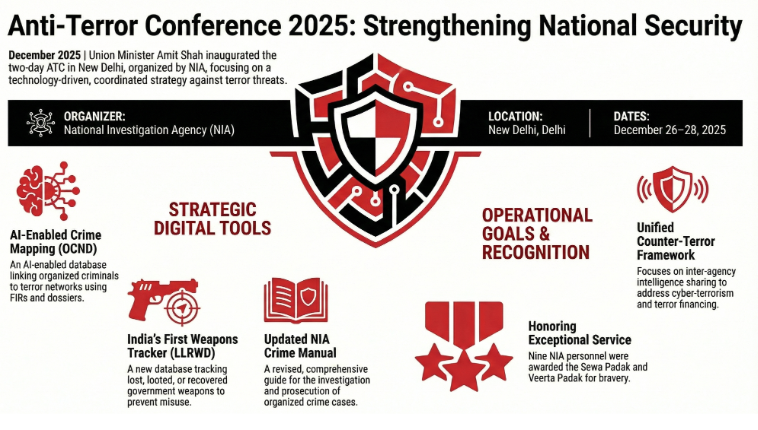
The Anti-Terror Conference (ATC) 2025, held in New Delhi from December 26 to 28, 2025, served as a high-level platform for refining India’s national security strategy. Inaugurated by Union Minister Amit Shah, the conference was organized by the National Investigation Agency (NIA) under the Ministry of Home Affairs (MHA). The primary objective of the summit was to establish a uniform, technology-driven counter-terror framework through enhanced inter-agency coordination and intelligence sharing.
Key outcomes of the conference included the launch of three major digital tools: the Updated NIA Crime Manual, the Artificial Intelligence (AI)-enabled Organized Crime Network Database (OCND), and the Lost, Looted and Recovered Weapons Database (LLRWD). Furthermore, the event recognized the exceptional service of nine NIA personnel, reinforcing the government’s commitment to incentivizing excellence in national security operations.
Conference Overview and Participation
The ATC 2025 brought together a diverse range of stakeholders from the security and legal sectors to address the evolving landscape of global and domestic threats.
Inauguration and Leadership: The event was inaugurated by Union Minister Amit Shah (Ministry of Home Affairs and Ministry of Cooperation). Key dignitaries in attendance included Ministers of State (MoS) Nityanand Rai and Bandi Sanjay Kumar.
Organizing Body: The National Investigation Agency (NIA).
Participants: The two-day conference saw participation from:
Central agencies: Intelligence Bureau (IB) and Central Armed Police Forces (CRPF).
State-level entities: State Police Anti-Terror Squads (ATS).
Subject matter experts: Forensic specialists, prosecutors, and technology professionals.
Strategic Objectives and Framework
The conference was centered on charting a coordinated strategy to combat terrorism and organized crime. The discussions focused on several critical pillars:
Inter-Agency Coordination: Enhancing the flow of information and intelligence between state and central agencies to eliminate silos.
Emerging Threat Mitigation: Addressing modern security challenges, specifically cyber-terrorism and terror financing.
Capacity Building: Strengthening the capabilities of the domestic security apparatus in the fields of investigation, prosecution, and forensic analysis.
Standardization: Developing a uniform counter-terror framework across all Indian states and territories to ensure a consistent and effective response to threats.
Technological Integration: New Digital Tools
A central feature of the ATC 2025 was the unveiling of advanced digital tools designed to modernize investigative processes and track criminal activity through data-driven insights.
Anti-Terror Digital Tool Descriptions
Tool Name | Primary Function | Key Features |
Updated NIA Crime Manual | Procedural Guide | A revised comprehensive guide for the investigation and prosecution of terrorism and organized crime cases. |
Organized Crime Network Database (OCND) | Intelligence Mapping | An AI-enabled national database used to map organized criminals and their connections to terror networks. It utilizes FIRs, charge-sheets, and dossiers. |
Lost, Looted and Recovered Weapons Database (LLRWD) | Asset Tracking | India's first-ever weapons database. It tracks government weapons that are lost, stolen, looted, or recovered from state and central forces (CAPFs). |
The LLRWD, prepared specifically by the NIA, is intended to prevent the misuse of government-issued arms by criminals or terrorist organizations.
Recognition of Excellence: NIA Personnel Awards
To honor dedication to national security, Union Minister Amit Shah presented awards to nine NIA personnel during the conference.
Sewa Padak: Awarded to personnel demonstrating outstanding dedication, commitment, and meritorious service in law enforcement and national security.
Veerta Padak: Awarded for acts of courage, bravery, and valor during high-risk investigations and critical counter-terror operations.
Institutional Leadership Context
The conference operated under the aegis of the Ministry of Home Affairs (MHA). The current leadership structure is as follows:
Union Minister: Amit Shah (Constituency: Gandhinagar, Gujarat).
Ministers of State (MoS):
Nityanand Rai (Constituency: Ujiarpur, Bihar).
Bandi Sanjay Kumar (Constituency: Karimnagar, Telangana).