Introduction
The partnership between India and Germany has reached a critical juncture, marking 75 years of diplomatic relations and 25 years of a formal strategic partnership. Recent diplomatic engagements have revitalized this relationship, shifting focus toward deep-seated cooperation in defence industrialization, critical technology, and climate action.
Key takeaways include:
Economic Integration: Bilateral trade surpassed USD 50 billion in 2024, representing more than 25% of India’s total trade with the European Union.
Defence Pivot: A transition from buyer-seller dynamics to a joint roadmap for co-development and co-production, alongside Germany's increased participation in Indo-Pacific military exercises.
Green Development: Germany has committed €1 billion annually through 2030 to support India's climate goals under the Green and Sustainable Development Partnership (GSDP).
Strategic Divergence: Challenges remain regarding differing stances on the Russia-Ukraine conflict and varying perceptions of China, alongside slow progress on the India–EU Free Trade Agreement (FTA).
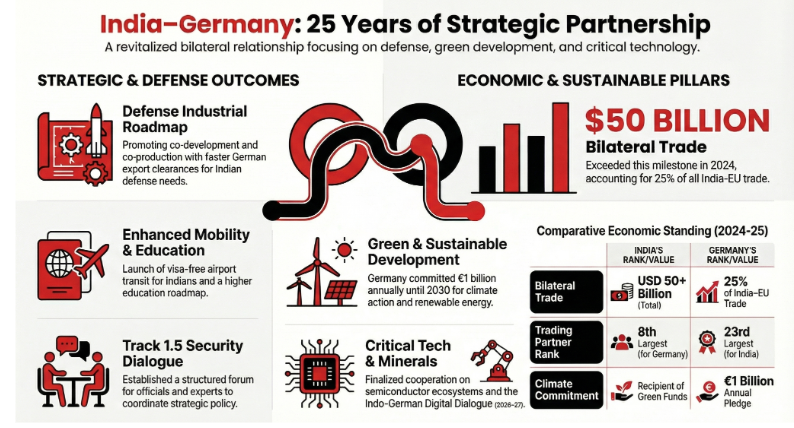
Strategic Outcomes of Recent Diplomatic Engagements
The recent visit of the German Chancellor to India has resulted in several high-impact agreements designed to enhance mobility, security, and technological resilience.
Defence and Security Cooperation
Defence Industrial Roadmap: Both nations agreed to a roadmap for defence co-development and technology partnerships. Germany has committed to accelerating export clearances for India.
Military Engagement: Germany will participate in major Indian exercises, including MILAN, the Indian Ocean Naval Symposium, and Tarang Shakti.
Track 1.5 Dialogue: The establishment of a Foreign Policy and Security Dialogue to facilitate structured communication between government officials and non-governmental experts.
Counter-terrorism: Joint condemnation of cross-border terrorism and a commitment to deepen intelligence sharing and legal cooperation via the newly ratified Mutual Legal Assistance Treaty.
Technology and Innovation
Critical Ecosystems: Agreements were reached to collaborate on critical minerals and semiconductor supply chains to enhance economic resilience.
Indo-German Digital Dialogue: Finalization of the 2026–27 work plan covering Artificial Intelligence (AI), data governance, telecommunications, and Industry 4.0.
Education and Skilling: Adoption of a higher education roadmap, including invitations for German universities to open Indian campuses and the creation of a Centre of Excellence for Renewable Energy skilling.
Mobility and Regional Connectivity
Visa-free Transit: Indian passport holders are now permitted visa-free airport transit through German facilities.
Indo-Pacific Alignment: Launch of a bilateral dialogue mechanism to support a rules-based regional order and reaffirmation of support for the India–Middle East–Europe Economic Corridor (IMEC).
Core Facets of the Bilateral Relationship
Economic and Commercial Metrics
Germany currently stands as India’s 8th largest trading partner (2024–25), while India is Germany’s 23rd largest. The economic relationship is characterized by:
Trade Volume: Bilateral trade in goods and services exceeded USD 50 billion in 2024.
The "Mittelstand" Factor: The Make in India Mittelstand (MIIM) programme facilitates investment from German small-and-medium-sized enterprises (SMEs) and family-owned businesses into the Indian market.
Development and Climate Action
The Green and Sustainable Development Partnership (GSDP) serves as the primary framework for environmental cooperation:
Financial Commitment: €1 billion per year until 2030.
Focus Areas: Renewable energy, sustainable urban development, forest management, and agriculture.
Triangular Cooperation: Joint implementation of Sustainable Development Goal (SDG) projects in third countries.
Challenges and Strategic Divergences
Despite the positive momentum, several systemic issues constrain the full potential of the partnership:
Category | Description of Challenge |
Geopolitics | Divergence over the Russia-Ukraine conflict; Germany seeks alignment while India maintains strategic autonomy and energy ties with Russia. |
China Policy | Germany views China as a "systemic economic rival," whereas India views China as a "direct security and territorial threat." |
Defence Asymmetry | India’s legacy dependence on Russian equipment and the high cost/conditionalities of German defence exports. |
Trade Framework | Prolonged negotiations regarding the India–EU Free Trade Agreement (FTA) create investment uncertainty. |
Integration | Persistence of language barriers and issues regarding the recognition of professional qualifications for Indian migrants in Germany. |
Strategic Recommendations for Enhanced Cooperation
To deepen the partnership and mitigate existing challenges, the following steps are proposed:
1. Economic and Trade Integration
FTA Conclusion: Prioritize the early finalization of the India–EU Free Trade Agreement to provide a stable regulatory environment.
Supply Chain Diversification: Use the MIIM programme to embed India into EU-centric value chains, reducing collective dependence on China.
2. Global Governance and Multilateralism
UNSC Reform: Continue joint advocacy through the G4 framework for United Nations Security Council reform.
Shared Normative Model: Champion a value-based, non-coercive model of governance that serves as an alternative to both authoritarian revisionism and Western unilateralism.
Expanded Triangular Cooperation: Scale up joint development projects in Africa and Latin America, specifically in healthcare and digital public infrastructure.
3. Digital and Green Transition
Digital Interoperability: Align India’s Digital Public Infrastructure (e.g., UPI, Aadhaar) with EU digital governance frameworks through the Indo-German Digital Dialogue.
Green Hydrogen: Leverage the GSDP to accelerate the transition to green hydrogen and climate-resilient infrastructure.