
Introduction
As of April 2026, the global landscape is characterized by a significant military escalation in the Middle East and a concerted push for industrial self-reliance in India. A full-scale conflict has erupted between a US-led coalition and Iran, aimed at dismantling Iran’s nuclear capabilities and leadership. This has resulted in the reported deaths of Iran’s Supreme Leader and several top security officials, alongside massive retaliatory strikes against regional energy infrastructure and international corporate interests.
Economically, the conflict has triggered a severe energy crisis, with oil prices surging from $79 to $119 per barrel. India is actively managing these risks through aggressive diplomatic intervention, the repatriation of over 375,000 citizens from the Gulf, and a rapid diversification of its oil supply chain. Concurrently, India is accelerating its domestic high-tech manufacturing sector, evidenced by the inauguration of new world-class electronics facilities and a strategic roadmap for semiconductor independence through "Semicon 2.0."
I. Military Escalation and the US-Iran Conflict
The military situation in the Gulf has transitioned into a full-scale war involving high-intensity precision strikes and significant leadership decapitation.
Major Combat Operations
Targeted Decapitation: US and Israeli forces have executed the largest military strikes in history to decimate Iranian leadership. Reported casualties include:
Ali Khamenei: Iran’s Supreme Islamic Leader.
Ali Larijani: Top leader and Security Chief.
Esmail Khatib: Intelligence Minister responsible for internal and external security.
Air Superiority: Approximately 200 USAF and Navy jets are conducting continuous strikes on political and military targets. The US asserts control over Iranian airspace, though Iran continues to launch missile strikes.
Combat Search and Rescue (CSAR): A major operation involving 30 to 40 aircraft successfully rescued a downed USAF F-15E pilot, a Colonel, from Iranian territory.
Ground Operations: While no large-scale "boots on the ground" have been officially reported, Mossad and Israeli Special Forces have reportedly infiltrated Iran for undisclosed secret operations.
Iranian Retaliation and Regional Instability
Infrastructure Attacks: Iran has extended the war to American multi-national corporations, notably attacking an Amazon data center in Bahrain.
Energy and Utility Sabotage: Strikes have hit the Pars gas field and oil infrastructure in neighboring Gulf countries. Gulf states are currently moving to secure critical water desalination plants.
Aviation Disruptions: An Iranian drone strike on Dubai International Airport caused significant flight disruptions. In a friendly fire incident, Kuwaiti forces mistakenly shot down three USAF F-15E Strike Eagle aircraft; all six crew members survived.
II. Global Economic and Energy Impact
The conflict has caused immediate and profound disruptions to global markets and logistics.
Energy Market Volatility
Metric | Status/Value |
Oil Price Increase | Surged from $79 to $119 per barrel |
LNG Supply | India remains 90% dependent on the Gulf for LNG |
Sourcing Diversification | India has increased oil sourcing from 25 to 41 countries |
Logistics and Aviation
Strategic Chokepoints: The Strait of Hormuz remains a critical concern. President Trump has requested warships from the UK, China, and France to secure the lanes, but has received no response.
Aviation Industry Stress: Airlines have introduced fuel surcharges to combat rising oil costs. India's largest carrier, Indigo, faced major disruptions with 4,000 flight cancellations prior to the appointment of new CEO William Walsh.
III. Indian Strategic and Diplomatic Response
India is navigating the crisis with a focus on citizen safety, energy security, and regional mediation.
Diplomatic Initiatives
Mediation: Prime Minister Modi is in contact with world leaders and the Iranian President to urge the cessation of attacks on infrastructure and the reopening of shipping lanes.
Multilateral Engagement: External Affairs Minister Jaishankar is coordinating with European counterparts in Brussels regarding the Gulf War.
Crisis Management
Repatriation: Of the 10 million Indians in the Gulf, 375,000 have returned home, including approximately 1,000 medical students from Iran.
Maritime Safety: Approximately 700 Indians remain stuck on India-flagged ships currently in the Gulf.
Domestic Stability: Petroleum Minister Hardeep Puri has issued assurances regarding the continuity of domestic gas supplies despite global volatility.
IV. Advancements in Domestic Electronics and Semiconductors
While managing the external crisis, India continues to expand its high-tech manufacturing base, specifically in Bengaluru.
Zetwerk Electronics Manufacturing Unit
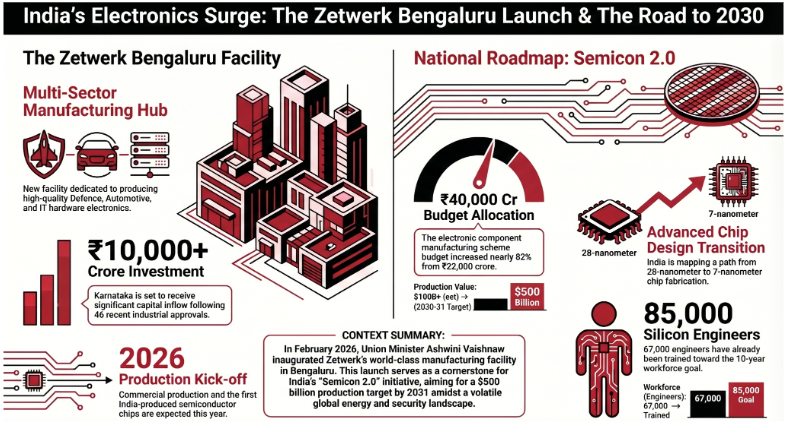
Union Minister Ashwini Vaishnaw recently inaugurated a world-class facility in Bengaluru dedicated to Defence, Automotive, and IT Hardware.
Strategic Investment: Karnataka is expected to receive over ₹10,000 crore in investments.
Government Support: The budget for the electronic component manufacturing scheme has been nearly doubled, rising from ₹22,000 crore to ₹40,000 crore.
Semiconductor Roadmap: "Semicon 2.0"
The government has outlined a transition from 28-nanometer to 7-nanometer chip manufacturing.
Design Capabilities: India is already designing "2-nanometer" chips.
Talent Pipeline: The goal is to train 85,000 silicon engineers within 10 years; 67,000 have already been trained within the first four years.
Ecosystem Development: Efforts are underway to bring major equipment manufacturers to India, including Applied Materials and Lam Research, with ASML targeted as the next major partner.
Production Targets: The Prime Minister has set a total production target of $500 billion by the 2030-2031 financial year.
V. Key Institutional Appointments
Several high-level leadership changes have been recorded across the civil and administrative sectors:
Civil Aviation: Vir Vikram Yadav (IAS 1996) appointed as Director General of Civil Aviation (DGCA).
Indigo Airlines: William Walsh (former IATA head) appointed as CEO following the resignation of Pieter Elbers.
Delhi Administration: Former diplomat Taranjit Singh Sandhu appointed as Lieutenant Governor of Delhi.
BBC: Matt Brittin (former Google executive) named Director General.
Iran National Security: Mohammad Baghel Zolghadr appointed as Secretary of the Supreme National Security Council, succeeding the deceased Ali Larijani.