
Introduction
The relationship between India and Greece has transitioned from a foundation of historical goodwill into a structured, long-term strategic partnership. Following the elevation of ties to a "Strategic Partnership" in August 2023, recent high-level engagements in February 2026 have formalized a shift toward deep defence industrial cooperation and enhanced maritime security.
Key takeaways include:
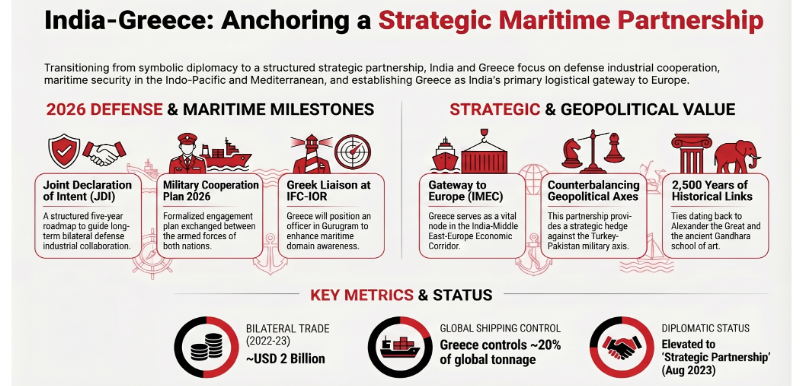
Defence Industrial Integration: The signing of a Joint Declaration of Intent (JDI) establishes a structured five-year roadmap, aligning India’s 'Aatmanirbhar Bharat' initiative with Greece’s 'Agenda 2030' defence reforms.
Maritime Domain Awareness: Greece is increasing its presence in the Indo-Pacific by positioning a Liaison Officer at the Information Fusion Centre-Indian Ocean Region (IFC-IOR) in India.
Strategic Gateway: Greece serves as a critical node in the India-Middle East-Europe Economic Corridor (IMEC), offering India a logistical entry point into the European Union market.
Geopolitical Balancing: The partnership provides a vital counterbalance to the Turkey-Pakistan axis and aligns two maritime powers in maintaining a rules-based order across the Mediterranean and the Indo-Pacific.
Recent Bilateral Developments and Outcomes
- In February 2026, bilateral talks between the Indian Defence Minister and the Greek Minister of National Defence in New Delhi resulted in several landmark agreements designed to move beyond ad-hoc arrangements toward institutionalized cooperation.
- Key Agreements (2026)
Military and Diplomacy: The relationship dates back to 326 BC with Alexander’s reaching of the Hyphasis (Beas River) and his encounter with King Puru. Historical records such as Chanakya’s Arthashastra note the presence of Megasthenes, a Greek ambassador, at the court of Chandragupta Maurya.
Cultural Fusion: The Gandhara school of art is a primary example of the historical blend of Indian and Greek cultural influences.
Kashmir and UNSC: Greece consistently supports India’s stance on Kashmir and its bid for a permanent seat on the UN Security Council.
Cyprus Issue: India supports Greece’s position on Cyprus, advocating for a bi-zonal, bi-communal federation in accordance with international law and UNSC resolutions.
Shipping Dominance: Greek entities control approximately 20% of global merchant shipping tonnage, making them essential logistical partners.
Infrastructure: Greek ports, specifically Piraeus, are identified as potential entry points for Indian goods under the India-Middle East-Europe Economic Corridor (IMEC) framework.
Economic Performance: Bilateral trade remains low at approximately USD 2 billion (2022-23), dominated by primary products like aluminum and mineral fuels rather than high-technology services.
Logistical Deficits: The lack of direct shipping lines between the two nations necessitates trans-shipment, which increases the cost and time of exports.
The "China Factor": The Port of Piraeus, a critical node for IMEC, is majority-owned by COSCO Shipping, a Chinese state-owned enterprise. This introduces a security dilemma regarding India's reliance on infrastructure controlled by a geopolitical rival.
Institutional Gaps: There is currently a lack of regularized high-level mechanisms, such as a "2+2 Dialogue," which hinders consistent policy follow-up and long-term coordination.
Operationalizing IMEC: Accelerating the corridor to bypass Red Sea instabilities and establishing a "Green Maritime Corridor" focused on green hydrogen and decarbonized shipping.
Migration and Mobility: Swiftly implementing the Migration and Mobility Partnership Agreement (MMPA) to address Greece’s labor shortages in agriculture and construction while utilizing India’s surplus skilled workforce.
Minilateralism: Formalizing a "Mediterranean Quad" involving India, Greece, Cyprus, and potentially Israel or France to focus on naval patrols and energy security.
Digital Infrastructure: Utilizing the Blue-Raman submarine cable system to link Indian and European digital infrastructures via Greece, providing a secure alternative to the Suez route.
Agreement | Primary Objective |
Joint Declaration of Intent (JDI) | To strengthen defence industrial cooperation through a five-year roadmap. |
Bilateral Military Cooperation Plan (2026) | Outlining scheduled military engagements and exercises between the two armed forces. |
IFC-IOR Liaison Positioning | The placement of a Greek International Liaison Officer in Gurugram to enhance Maritime Domain Awareness (MDA). |
These developments signal a strategic diversification for India, allowing the nation to expand its defence partnerships beyond traditional suppliers while fostering indigenous industrial growth.
Historical and Diplomatic Foundations
The contemporary partnership is rooted in over 2,500 years of historical and cultural exchange.
Ancient Linkages
Modern Diplomatic Synergy
The two nations maintain a high degree of mutual support regarding core national interests:
Strategic Significance of the Cooperation
1. The European Gateway and IMEC
Greece is uniquely positioned to facilitate India’s economic expansion into Europe.
2. Geopolitical Counterbalancing
Closer ties with Greece allow India to strategically offset the military cooperation between Turkey and Pakistan. By strengthening ties with Greece—Turkey’s traditional rival—India secures a more robust presence in the Eastern Mediterranean.
3. Maritime Security Continuum
Both nations advocate for freedom of navigation and a rules-based international order. This shared interest creates a "security continuum" that links the Arabian Sea, the Aegean Sea, and the broader Indo-Pacific and Mediterranean regions.
Challenges and Constraints
Despite the strategic convergence, several hurdles remain that could limit the depth of the partnership:
Future Roadmap for Enhanced Engagement
To fully realize the potential of the India-Greece Strategic Partnership, several forward-looking initiatives have been identified:
Conclusion
The relationship between India and Greece is currently evolving into a bridge between the Indo-Pacific and Europe. By addressing current economic and logistical gaps, both nations are positioned to leverage their shared maritime identities to secure regional stability and economic growth.