
Introduction
The India-AI Impact Summit 2026, held at Bharat Mandapam in New Delhi, marks a pivotal shift in the global discourse on Artificial Intelligence. Hosted by the Ministry of Electronics and Information Technology (MeitY) under the IndiaAI Mission, the summit transitions the narrative from "AI Safety" and risk-centric regulation to "AI for Development and Impact."
Positioning India as a "bridge power" and the voice of the Global South, the summit emphasizes inclusive growth through the democratization of technology. Key takeaways include the integration of AI into Digital Public Infrastructure (DPI), the establishment of sovereign AI capabilities via the ₹10,371 crore IndiaAI Mission, and the application of AI to solve critical challenges in healthcare, agriculture, and governance. The summit aims for at least 15 tangible deliverables, including India’s entry into the Pax Silica initiative and the expansion of the AI Safety Institute model.
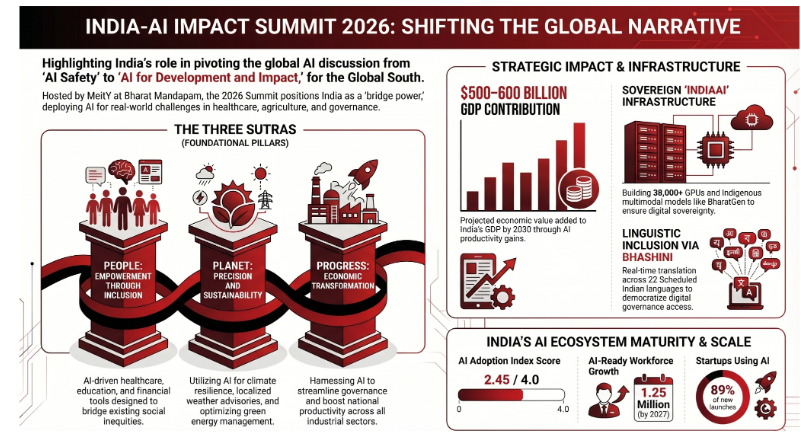
Conceptual Framework: The Philosophy of Inclusive AI
The summit is anchored in the Indian ethos of "Sarvajana Hitaya, Sarvajana Sukhaya" (Welfare for all, happiness for all). This philosophy is operationalized through two distinct frameworks:
The Three Sutras (Pillars)
People: Empowering citizens through healthcare, education, and financial inclusion.
Planet: Utilizing AI for sustainable practices, resource efficiency, and climate resilience.
Progress: Harnessing AI to drive economic growth, modernize governance, and improve public service delivery.
The Seven Chakras (Working Groups)
The summit’s technical and policy discussions are organized into seven thematic working groups:
Health
Agriculture
Safe & Trusted AI
Science
Inclusion
Democratizing AI Resources
Economic Development
The IndiaAI Mission: Pillars of Sovereign Capability
Approved in March 2024 with a budget of ₹10,371 crore, the IndiaAI Mission is the primary vehicle for achieving the vision of "Making AI in India and Making AI Work for India." The mission rests on seven core pillars:
Pillar | Description and Key Data Points |
IndiaAI Compute | Providing affordable access to 38,000+ GPUs. Users can access compute power at up to 40% reduced cost. |
IndiaAI Application Development | Focusing on India-specific challenges in healthcare, agriculture, and cybersecurity through hackathons. |
AIKosh (Dataset Platform) | A national repository hosting 3,000+ datasets and 243 models across 20 sectors. |
IndiaAI Foundation Models | Developing indigenous multimodal Large Language Models (LLMs) like BharatGen and supporting startups like Sarvam AI. |
IndiaAI FutureSkills | Building an AI-ready workforce through fellowships and labs in Tier 2 and Tier 3 cities. |
IndiaAI Startup Financing | Funding and global expansion support for AI startups, including European market access. |
Safe and Trusted AI | Establishing the IndiaAI Safety Institute and projects on bias mitigation and privacy. |
Sectoral Impact: AI for People, Planet, and Progress
1. People: Bridging Social Inequities
AI is being deployed to overcome traditional barriers in essential services:
Healthcare: AI diagnostics are addressing the 1:834 doctor-patient ratio. Tools like Qure.ai provide radiology results in rural areas, while automated blood analysis offers "lab-grade" results in remote clinics.
Education: Platforms like DIKSHA use adaptive learning. The YUVAi program (Youth for Unnati and Vikas with AI) equips students in Classes 8-12 with technical and social skills.
Linguistic Inclusion: The Bhashini initiative enables real-time translation across 22 Scheduled Indian languages. Sarvam Vision, an indigenous model, provides high-accuracy OCR and processing for Indian languages.
2. Planet: Precision and Sustainability
AI serves as a tool for "Climate-Smart" development to meet India’s 2070 Net Zero targets:
Agriculture: AI models analyze satellite and soil data. Kisan E-Mitra (an AI chatbot) helps farmers optimize fertilizer use, while MausamGPT provides conversational weather advisories in regional languages.
Flood Forecasting: The BrahmaSATARK system uses AI-integrated physics modeling for the Brahmaputra and Ganga basins.
Energy: AI integrates with smart grids to manage the intermittency of renewable energy sources like solar and wind.
3. Progress: Economic and Governance Transformation
AI is projected to add USD 500–600 billion to India's GDP by 2030.
Governance: AI is integrated into Digital Public Infrastructure (Aadhaar, UPI, DigiLocker). MuleHunter.AI is used to identify fraudulent "mule accounts" in banking, and AI automates the translation of court judgments to improve legal accessibility.
Digital Sovereignty: Initiatives like BharatGen ensure that AI models are culturally representative and that national data remains within borders.
India’s Strategic Role in the Global AI Landscape
The India-AI Impact Summit 2026 establishes India as a leader in "Applied AI," shifting the focus from theoretical regulation to practical deployment.
Strategic Diplomacy and "AI Commons"
India advocates for the "AI Commons" model, which seeks to make compute power, datasets, and models accessible to developing nations. This prevents a monopoly by a few tech giants and offers a blueprint for emerging economies. By hosting this summit, India acts as a bridge between the technology-owning West and the technology-needing Global South.
Key International Outcomes
Pax Silica Initiative: India's entry into this US-led initiative aims to build a resilient global electronics and semiconductor supply chain.
Multistakeholder Governance: Preference for collaborative frameworks over formal treaty bodies for AI ethics.
Global Expansion of Safety Models: Strengthening the AI Safety Institute model to promote collaborative research and standards.
State of the Indian AI Ecosystem (2025-2026)
The summit highlights the rapid maturation of India's technology sector:
Workforce: Over 6 million people are employed in the tech and AI ecosystem, with the AI talent pool expected to reach 12.5 lakh by 2027.
Training: MeitY’s FutureSkills PRIME program has seen 18.56 lakh registrations and 3.37 lakh course completions.
Startups: India hosts 1.8 lakh startups; approximately 89% of new startups launched in the last year integrated AI into their products.
Enterprise Adoption: India scores 2.45/4 on the NASSCOM AI Adoption Index. 87% of enterprises are actively using AI, with the industrial, automotive, retail, and banking sectors contributing 60% of AI's total value.
Maturity: 26% of Indian companies have achieved AI maturity at scale according to Boston Consulting Group.