
Introduction
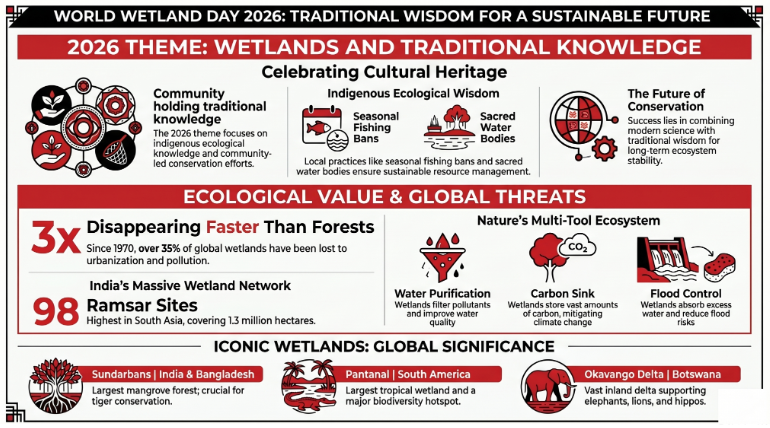
World Wetlands Day 2026, observed on February 2, serves as a critical global platform to advocate for the protection and restoration of wetland ecosystems. The 2026 theme, "Wetlands and Traditional Knowledge: Celebrating Cultural Heritage," emphasizes the integration of indigenous ecological wisdom with modern science to achieve sustainable conservation. Despite their immense value as biodiversity hotspots and carbon sinks, wetlands are disappearing three times faster than forests, with over 35% lost since 1970. This briefing outlines the historical evolution of the Ramsar Convention, the current status of global and Indian wetlands, and the multifaceted threats necessitating urgent community and legislative action.
Conceptual Overview: Defining Wetlands
Wetlands are characterized as land areas where water covers the soil either permanently or seasonally. These ecosystems serve as natural buffers against environmental disasters and support millions of species and human communities. Key categories of wetlands include:
Inland Systems: Lakes, rivers, floodplains, marshes, swamps, and peatlands.
Coastal Systems: Mangroves and coastal lagoons.
Historical Development and the Ramsar Convention
The observance of World Wetlands Day commemorates the adoption of the Ramsar Convention on Wetlands in 1971. This international treaty was established to promote the conservation and sustainable use of these vital ecosystems.
Timeline of Key Milestones
Year | Event |
1971 | Adoption of the Ramsar Convention in Ramsar, Iran (February 2). |
1996 | The 19th Meeting of the Ramsar Convention's Standing Committee established February 2 as an annual celebration. |
1997 | The first global celebration of World Wetlands Day. |
2001 | Introduction of the Ramsar Wetland Conservation Awards. |
2015 | United Nations acknowledgment of the day as a global awareness event. |
2021 | 50th anniversary of the Ramsar Convention. |
2022 | United Nations General Assembly officially adopted a resolution recognizing February 2 as World Wetlands Day. |
The 2026 Theme: Wetlands and Traditional Knowledge
The 2026 theme focuses on the intersection of cultural heritage and environmental stewardship. It advocates for a conservation model that merges "modern science + traditional wisdom."
Core Pillars of the 2026 Theme
Indigenous Ecological Knowledge: Utilizing long-term local understanding of ecosystem cycles.
Community-Led Conservation: Empowering local populations to manage resources through traditional practices such as seasonal fishing bans and the protection of sacred water bodies.
Cultural and Spiritual Links: Recognizing the deep-seated religious and historical connections communities maintain with local wetlands.
Sustainable Management: Adopting low-cost, long-term sustainability models derived from traditional harvesting techniques.
Global Importance and Iconic Ecosystems
Wetlands are among the most productive ecosystems on Earth, providing essential environmental, economic, and social services.
Environmental Functions
Biodiversity Hotspots: Habitats for migratory birds, amphibians, and various aquatic species.
Climate Mitigation: Functioning as carbon sinks to reduce greenhouse gas emissions.
Water Purification: Natural filtration systems that remove pollutants from water bodies.
Disaster Mitigation: Acting as buffers for flood control and preventing soil erosion.
Iconic Global Wetlands
Wetland | Location | Significance |
Sundarbans | India & Bangladesh | Largest mangrove forest; vital for tiger conservation and coastal defense. |
Pantanal | Brazil, Bolivia, Paraguay | Largest tropical wetland; high biodiversity hotspot. |
Everglades | USA | Largest tropical wetland in the U.S.; critical for water filtration. |
Okavango Delta | Botswana | Vast inland delta supporting megafauna like elephants and lions. |
Mont-Saint-Michel | France | Supports migratory birds and features historical cultural heritage. |
Kakadu | Australia | UNESCO site with indigenous rock art and high biodiversity. |
Current Threats to Wetland Integrity
Wetlands are currently the most threatened ecosystems in the world. The primary drivers of their decline include:
Conversion and Urbanization: Land transformation for cities and agricultural expansion.
Pollution: Industrial discharge, plastic waste, and chemical runoff.
Resource Over-Extraction: Excessive withdrawal of water for human and industrial use.
Climate Change: Rising sea levels and shifting weather patterns that stress fragile aquatic balances.
Wetland Conservation in India
India maintains one of the largest wetland networks in Asia, characterized by strong cultural and livelihood linkages.
Status and Statistics
Ramsar Sites: India hosts 98 sites, the highest number in South Asia.
Coverage: Over 1.3 million hectares of protected wetland area.
Livelihood Impact: Vital for traditional fishing communities, irrigation, and agriculture.
Regulatory Framework: Wetland Rules, 2017
The Wetland (Conservation and Management) Rules, 2017, provide the legal basis for protection by:
Identifying and officially notifying wetlands for protection.
Restricting harmful industrial and construction activities within wetland boundaries.
Encouraging local community participation in management.
Persistent Challenges in India: Despite legal frameworks, Indian wetlands face threats from weak enforcement, urban encroachment, and pollution.
Strategic Directions for Conservation
Conservation efforts must occur at multiple levels to be effective:
Global Level: Continued implementation of the Ramsar Convention and integration with broader biodiversity and climate treaties.
National Level: Prioritizing wetland mapping, legal protection, and the restoration of degraded sites.
Community Level: Leveraging traditional ecological knowledge and promoting sustainable fishing and farming.
Individual Action: Reducing water wastage, avoiding chemical pollutants, and participating in local conservation drives.