
Introduction
In February 2026, India assumed the Chairmanship of the Indian Ocean Naval Symposium (IONS) during the 9th Conclave of Chiefs held in Visakhapatnam. This transition marks a significant return for India, which initiated the forum in 2008 and served as its inaugural chair. IONS is a voluntary, multilateral maritime forum comprising approximately 25 member nations from the Indian Ocean Region (IOR), alongside various observer countries and maritime partners.
The symposium's primary mission is to foster regional maritime cooperation, maintain peace and stability, and secure sea lanes. Its operational framework relies on strategic dialogues through Conclaves of Chiefs, joint maritime exercises (IMEX), and three specialized working groups focused on Humanitarian Assistance and Disaster Relief (HADR), Maritime Security (MARSEC), and Information Sharing & Interoperability (IS&I). India's reassumption of the chair signals renewed momentum for coordinated regional responses to both traditional and non-traditional maritime threats.
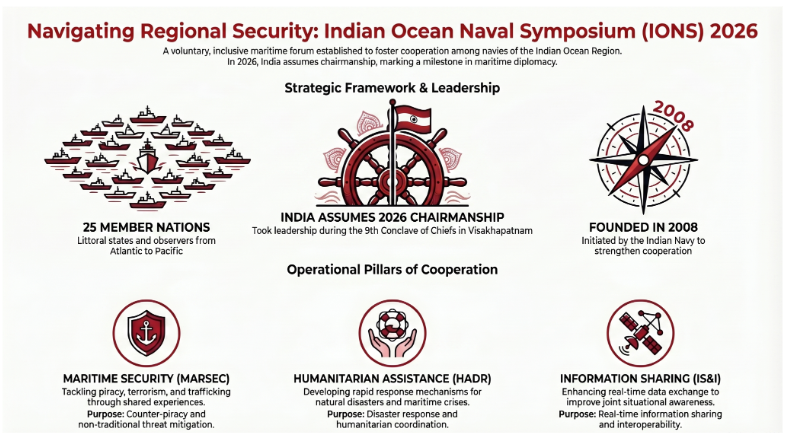
Institutional Overview of IONS
The Indian Ocean Naval Symposium (IONS) serves as an inclusive platform for the navies of littoral states within the Indian Ocean Region. Established to bridge regional gaps in maritime security, its structure is designed to promote professional exchange and collaborative strategy.
Core Objectives
Regional Peace and Stability: Enhancing collaboration to ensure the Indian Ocean remains a secure environment for trade and transit.
Interoperability: Developing compatible procedures and operational understanding between diverse regional navies.
Coordinated Response: Strengthening the ability of member nations to respond collectively to humanitarian crises and security challenges.
Membership and Participation
Member Nations: Approximately 25 countries situated within the Indian Ocean Region.
Observers and Partners: Participation extends beyond the immediate littoral states, involving observer nations and maritime partners with interests spanning from the Atlantic to the Pacific Oceans.
Historical Context and Chairmanship
The 2026 chairmanship represents a cyclical return to India’s leadership of the forum it helped create.
Inception: The forum was established in 2008, initiated by the Indian Navy to strengthen maritime ties among IOR states.
Chronology of Leadership:
India: Inaugural Chair (2008–2010).
Successive Chairs: United Arab Emirates (UAE), South Africa, Australia, Bangladesh, Iran, France, and Thailand.
India: Reassumed Chairmanship in February 2026 at the 9th Conclave of Chiefs in Visakhapatnam.
Key Operational Functions and Frameworks
IONS operates through a multi-tiered approach that combines high-level strategic planning with practical, technical cooperation.
Strategic Dialogue and Exercises
Conclaves of Chiefs of Navies: A high-level platform for naval leaders to engage in strategic dialogue regarding regional challenges and future collaborative strategies.
IONS Maritime Exercises (IMEX): Joint drills and officer interactions designed to improve operational confidence and situational awareness among participating forces.
Specialized Working Groups
The symposium translates its strategic goals into action through three dedicated working groups:
Working Group | Focus Areas |
Humanitarian Assistance and Disaster Relief (HADR) | Developing coordination mechanisms and best practices for rapid response to natural disasters and maritime crises. |
Maritime Security (MARSEC) | Addressing non-traditional threats, including piracy, terrorism, and various forms of trafficking. |
Information Sharing & Interoperability (IS&I) | Enhancing real-time data exchange and establishing compatible procedures for joint operations. |
Institutional and Technical Collaboration
The forum leverages digital systems and professional development to maintain continuous engagement:
Maritime Domain Awareness: Encouraging the sharing of data and coordinated surveillance to monitor activities and ensure safer sea lanes.
Capacity Building: Utilizing training programs, workshops, and digital systems to foster long-term institutional cooperation among member navies.