Introduction
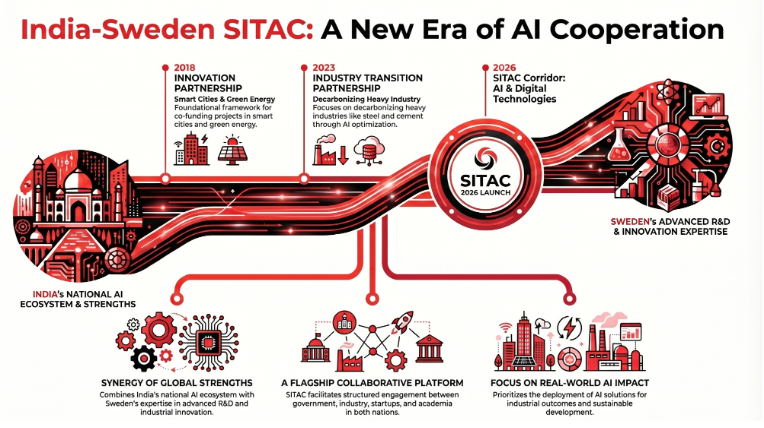
The partnership between India and Sweden has entered a significant new phase with the establishment of the Sweden–India Technology and Artificial Intelligence Corridor (SITAC). Formulated through a Statement of Intent (SoI) between the IndiaAI Mission and Business Sweden during the 2026 India AI Impact Summit, SITAC serves as a flagship platform for structured bilateral cooperation. The initiative seeks to merge India’s burgeoning national AI ecosystem with Sweden’s established leadership in industrial innovation and Research & Development (R&D). By focusing on the practical deployment of AI solutions, the partnership aims to drive economic growth and sustainable development while addressing the inherent risks of emerging technologies.
Overview of the SITAC Partnership
The SITAC agreement represents a formal commitment to deepening digital and technological ties. It is designed to facilitate high-level engagement across multiple sectors of society.
Core Engagement Structure
SITAC is intended to provide a structured framework for collaboration among four key pillars in both nations:
Government Agencies: Coordinating policy and regulatory alignment.
Industry: Integrating AI into industrial processes and commercial applications.
Startups: Providing a gateway for entrepreneurial innovation and market entry.
Academic Institutions: Driving foundational research and talent development.
Strategic Synergy
The partnership is built on the complementary strengths of the two nations:
India’s Contribution: The "IndiaAI Mission" provides a massive national ecosystem focused on expanding access to computing power, large-scale data, and a deep pool of technical talent.
Sweden’s Contribution: Sweden brings expertise in advanced industrial innovation, high-end R&D, and a proven track record in the "responsible implementation" of AI technologies.
Objectives and Real-World Impact
The SITAC partnership is not merely theoretical; it is oriented toward "real-world industrial and societal outcomes." The collaboration focuses on several key areas of development:
Development and Deployment: Moving beyond research to the actual implementation of AI solutions in various sectors.
Economic and Sustainable Growth: Leveraging AI to foster innovation that contributes to economic health and environmental sustainability.
Risk Management: Collaborative efforts to identify and mitigate the risks associated with AI, ensuring responsible technological advancement.
Historical Context: The Foundation of Cooperation
SITAC is the latest evolution in a series of bilateral agreements aimed at technological and industrial advancement. It builds upon two major prior frameworks:
1. Joint Declaration on India-Sweden Innovation Partnership (2018)
This is considered the foundational framework for the bilateral technological relationship. It established the principles of:
Co-funding and Co-creation: Shared financial and intellectual investment in new technologies.
Societal Challenges: Addressing issues in smart cities, green energy, and early-stage AI integration.
2. India–Sweden Industry Transition Partnership (ITP) (2023)
The ITP focuses specifically on the "decarbonization" of heavy industries, which remains a critical component of the bilateral agenda.
Focus Area | Key Technologies & Methods |
Heavy Industries | Focusing specifically on the Steel and Cement sectors. |
Low-Carbon Tech | Implementation of carbon capture and the use of Hydrogen. |
Optimization | Using AI to optimize industrial processes for lower emissions. |
Knowledge Sharing | Joint innovation and pilot projects to test transition strategies. |
Conclusion
The establishment of SITAC marks a transition from general innovation cooperation to a specialized focus on Artificial Intelligence. By aligning India's scale and talent with Sweden's industrial sophistication, the partnership seeks to create a robust corridor for technological exchange that prioritizes practical application and sustainable industrial transition.