
Observed annually on February 20th, the World Day of Social Justice serves as a global platform to advance poverty eradication, gender equality, social inclusion, and decent work. The 2026 observance, themed "Renewed Commitment to Social Development and Social Justice," emphasizes the urgent need to integrate social justice into modern economic, labor, climate, and digital strategies. At the national level in India, the Department of Social Justice & Empowerment utilizes this day to reaffirm constitutional mandates of social, economic, and political justice. Key international drivers include the International Labour Organization (ILO) and the United Nations Department of Economic and Social Affairs (UNDESA), focusing on alignment with Sustainable Development Goals (SDGs) regarding poverty and inequality.
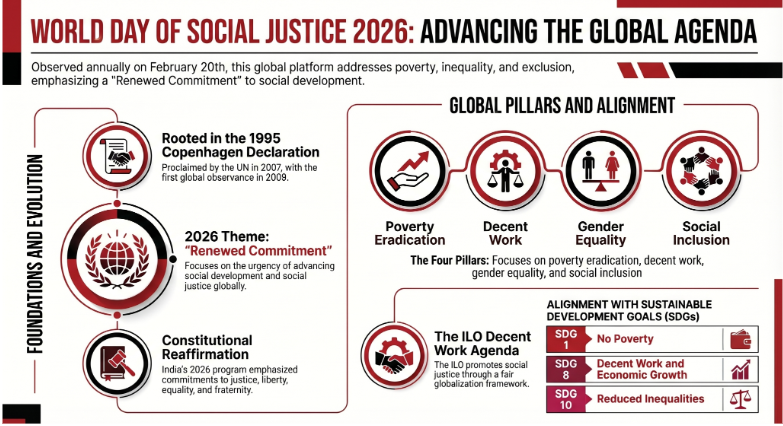 Overview of World Day of Social Justice 2026
The World Day of Social Justice is a United Nations-mandated event designed to highlight the necessity of social justice in achieving and maintaining peace and security within and among nations.
The 2026 Theme
The theme for 2026 is "Renewed Commitment to Social Development and Social Justice." This theme underscores a global urgency to move beyond theoretical frameworks and toward active advancement of social equity in a rapidly changing global landscape.
Core Objectives
The platform focuses on four primary pillars of social development:
Poverty Eradication: Addressing systemic barriers to economic stability.
Decent Work: Promoting labor rights and fair employment opportunities.
Gender Equality: Ensuring equitable access and treatment across all genders.
Social Inclusion: Integrating marginalized populations into the broader social and economic fabric.
Historical and Institutional Framework
The establishment of this day is the result of decades of international policy development focused on fair globalization and social welfare.
Key Historical Milestones
The foundation of the World Day of Social Justice is rooted in several critical international agreements:
Year | Milestone |
1995 | The Copenhagen Declaration sets the groundwork for social development priorities. |
2007 | The United Nations General Assembly (UNGA) officially proclaims the World Day of Social Justice. |
2008 | The ILO unanimously adopts the Declaration on Social Justice for a Fair Globalization. |
2009 | The first official global observance of the day takes place. |
Leading Institutions
Several entities are responsible for the policy integration and advocacy of social justice:
International Labour Organization (ILO): Manages the "Decent Work" agenda.
United Nations Department of Economic and Social Affairs (UNDESA): Focuses on the integration of social policies into broader economic frameworks.
Civil Society Organizations: Play a critical role in advocating for the inclusion of social justice within climate, digital, and economic strategies.
Strategic Alignment with Global and National Goals
Social justice is not viewed as an isolated concept but as a critical component of broader development frameworks.
Sustainable Development Goal (SDG) Alignment
The initiatives highlighted by the World Day of Social Justice directly support the UN 2030 Agenda:
SDG 1 (No Poverty): Direct link to poverty eradication efforts.
SDG 8 (Decent Work and Economic Growth): Alignment with the ILO’s labor agendas.
SDG 10 (Reduced Inequalities): Focus on social inclusion and gender equality.
National Implementation: India
In India, the Department of Social Justice & Empowerment spearheads the observance. The national focus is inextricably linked to the Preamble of the Indian Constitution, reaffirming a commitment to:
Justice: Social, economic, and political.
Liberty: Of thought, expression, belief, faith, and worship.
Equality: Of status and opportunity.
Fraternity: Assuring the dignity of the individual and the unity of the nation.
The department utilizes the 2026 programme to review government policies and interventions related to disability, welfare schemes, and poverty alleviation.
Conclusion
The 2026 observance of the World Day of Social Justice signals a transition toward "renewed commitment." By aligning international labor standards and UN development goals with national constitutional mandates, the day serves as a catalyst for integrating social justice into the core of economic, digital, and environmental policy-making.