
Introduction
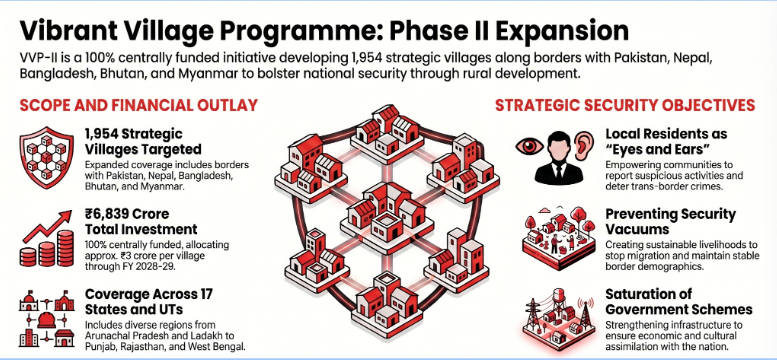
The Second Phase of the Vibrant Village Programme (VVP-II) represents a significant strategic expansion of India’s border development initiatives. Originally launched in 2023 to address villages along the China border, the programme’s second phase cleared in April 2025, now encompasses 1,954 strategic villages along the borders of Pakistan, Nepal, Bangladesh, Bhutan, and Myanmar. With a total financial outlay of Rs 6,839 crore through FY 2028-29, the initiative aims to curb rural-to-urban migration, eliminate security vacuums, and transform border settlements into self-sufficient "growth centres." By saturating government schemes and building trust through culturally sensitive outreach, the Ministry of Home Affairs (MHA) intends to integrate these communities into the national fabric while utilizing local residents as vital intelligence assets for border security.
 ibra
ibra
Strategic Scope and Expansion
The VVP-II marks a pivot from a localized focus on the northern border to a comprehensive national border strategy.
Original Mandate: Launched in 2023, the first phase of VVP was dedicated exclusively to villages bordering China.
Expanded Mandate: VVP-II broadens this scope to include five additional neighboring countries: Pakistan, Nepal, Bangladesh, Bhutan, and Myanmar.
Target Areas: The programme identifies 1,954 strategic villages for targeted intervention.
Financial and Administrative Framework
VVP-II is classified as a Central Sector Scheme, meaning it receives 100% funding from the Central Government.
Feature | Details |
Total Financial Outlay | Rs 6,839 crore |
Implementation Timeline | Until Financial Year (FY) 2028-29 |
Per Village Expenditure | Proposed at Rs 3 crore per village |
Funding Source | 100% Centre funding |
Geographic Coverage
The programme spans 17 states and Union Territories across India’s various international frontiers:
North & West: Jammu and Kashmir, Ladakh, Punjab, Rajasthan, Gujarat.
Himalayan Belt: Himachal Pradesh (implied by context of China border), Uttarakhand, Sikkim, Arunachal Pradesh.
East & Northeast: Uttar Pradesh, Bihar, West Bengal, Assam, Meghalaya, Nagaland, Manipur, Mizoram, Tripura.
Strategic Objectives
The primary mission of VVP-II is to secure India’s borders by stabilizing and empowering the populations residing there.
1. Prevention of Migration and Security Vacuums
The government identifies the migration of border populations to urban areas as a critical security risk. Such migration creates a "security vacuum" and leads to undesirable demographic changes in sensitive areas. By providing sustainable livelihood opportunities, the programme aims to keep these populations in place.
2. Local Intelligence and Policing
A core tenet of the VVP-II is to transform local residents into the "eyes and ears" of the Border Guarding Forces. This collaborative relationship is intended to:
Discourage illicit activities and trans-border crimes.
Increase the reporting of suspicious movements or activities.
Build a frontline of civilian defense and awareness.
3. Trust and Cultural Assimilation
The MHA emphasizes the need for "culturally sensitive" outreach. This strategy focuses on building trust between security agencies and local communities, ensuring that development does not come at the cost of local identity but rather encourages economic and cultural assimilation with the rest of the nation.
Implementation Strategy: The "Growth Centre" Model
To achieve its objectives, the programe moves beyond basic aid toward a model of comprehensive regional development.
Saturation of Schemes: The strategy involves the 100% implementation (saturation) of existing government welfare and development schemes within these villages.
Infrastructure Strengthening: Significant investment is directed toward improving basic infrastructure to elevate the standard of living.
Economic Hubs: Villages are intended to be developed as "growth centers," fostering local economies that can sustain the population without external urban dependence.
Security Agency Collaboration: Active engagement between border security forces and the community to foster mutual reliance and information sharing.