On February 14, 2026, the Government of India announced the first national call for proposals under the ₹2,000 crore BIRAC–RDI Fund. This specialized financing window is a critical component of the broader ₹1 lakh crore Research, Development, and Innovation (RDI) initiative. Managed by the Biotechnology Industry Research Assistance Council (BIRAC), the fund is designed to catalyze high-impact innovations and bridge the "lab-to-industry" gap.
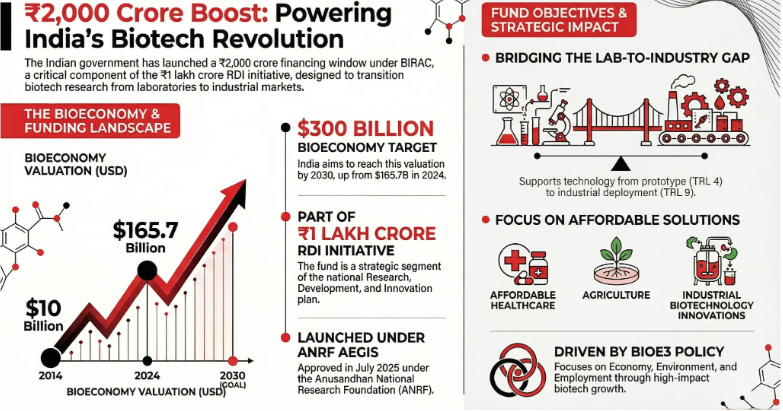
India’s bioeconomy has demonstrated exponential growth, expanding from $10 billion in 2014 to $165.7 billion in 2024, with a strategic target of reaching $300 billion by 2030. The BIRAC–RDI Fund supports this trajectory by providing financial instruments for technologies transitioning from laboratory prototypes to market-ready products, specifically targeting Technology Readiness Levels (TRL) 4 through 9.
Overview of the BIRAC–RDI Fund
The BIRAC–RDI Fund is a specialized financial mechanism established to nurture the biotechnology sector's innovation ecosystem. It operates under the high-level strategic direction of the Anusandhan National Research Foundation (ANRF).
Key Financial Framework
Total Allocation: ₹2,000 crore dedicated to biotechnology.
Parent Initiative: Part of the government's comprehensive ₹1 lakh crore RDI initiative.
Launch Timeline: The broader initiative was approved by the Union Cabinet in July 2025 and officially launched in November 2025 under the Department of Science and Technology.
Fund Manager: Biotechnology Industry Research Assistance Council (BIRAC), a public sector enterprise under the Department of Biotechnology (DBT).
The Indian Bioeconomy: Growth and Projections
The implementation of the BIRAC–RDI Fund coincides with a period of rapid expansion in India’s biotechnology sector. The government aims to position India as a global leader in the field, mirroring the historical growth trajectory of the IT sector.
Year | Bioeconomy Valuation | Status |
2014 | $10 Billion | Historical Baseline |
2024 | $165.7 Billion | Current Standing |
2030 | $300 Billion | Strategic Target |
Institutional and Policy Framework
The fund is supported by a robust institutional architecture designed to coordinate research and innovation across academic, industrial, and governmental spheres.
1. Anusandhan National Research Foundation (ANRF)
Statutory Status: Established under the Anusandhan National Research Foundation Act, 2023.
Role: Replaces the Science and Engineering Research Board (SERB) as the apex body providing strategic direction for scientific research.
Nodal Ministry: Ministry of Science and Technology.
Primary Function: To fund, promote, and coordinate R&D across various sectors to strengthen the national innovation ecosystem.
2. BioE3 Policy
The fund aligns with the BioE3 Policy, which focuses on three pillars:
Economy
Environment
Employment
The policy promotes biotechnology-driven solutions for sustainable industrial growth, bio-manufacturing, bioenergy, and the blue economy.
Strategic Objectives and Funding Mechanisms
The BIRAC–RDI Fund targets specific gaps in the development lifecycle of biotechnological products, ensuring that innovations do not stall at the proof-of-concept stage.
Primary Objectives
Financial Support: Providing capital for early-stage innovations that possess high potential for impact.
Entrepreneurship: Encouraging life sciences startups and Small and Medium Enterprises (SMEs).
Sectoral Focus: Development of affordable solutions in healthcare, agriculture, and industrial biotechnology.
Technical Scope and Instruments
The fund specifically focuses on technologies categorized between TRL 4 and TRL 9, facilitating the scaling of research from laboratory prototypes to industrial deployment. Financial support is rendered through:
Equity investments.
Convertible debt instruments.
Long-term loans.
Significance and Ecosystem Impact
The introduction of the BIRAC–RDI Fund addresses several critical bottlenecks in the Indian biotechnology landscape:
Bridging the Innovation Gap: By focusing on the transition from laboratory research to industrial application, the fund serves as a "Lab-to-Industry" bridge.
Support for Startups and SMEs: It provides the necessary capital for research institutions and startups to move beyond proof-of-concept and enter the market with ready products.
Strategic Growth: The fund is a cornerstone of the national effort to achieve a $300 billion bioeconomy by 2030, ensuring that biotechnology becomes a primary driver of India's economic and sustainable development.
National Policy Alignment: It acts as a complementary force to the BioE3 Policy, fostering biopharmaceuticals, bio-manufacturing, and sustainable innovation.