Introduction
The Union Cabinet has approved the Startup India Fund of Funds 2.0 (FoF 2.0) with a dedicated corpus of ₹10,000 crore. Building upon the foundational success of its predecessor, FFS 1.0, this second phase represents a strategic shift in India’s entrepreneurial policy. While the initial phase focused on building a general venture capital architecture, FoF 2.0 is designed to foster "strategic capability formation" by prioritizing long-term domestic venture capital for deep-tech and high-end manufacturing. Managed by the Small Industries Development Bank of India (SIDBI) under the monitoring of the Department for Promotion of Industry and Internal Trade (DPIIT), the fund aligns with the "Viksit Bharat @ 2047" vision to transform India into a global innovator of complex, high-impact technologies.
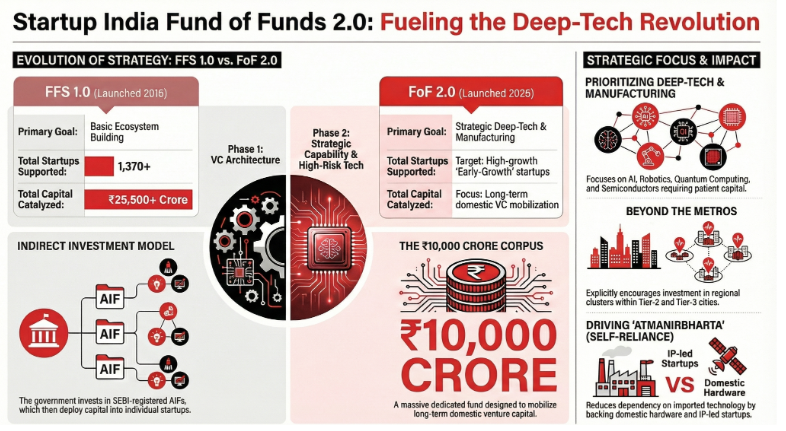
Evolution of the Fund of Funds Framework
The transition from FFS 1.0 to FoF 2.0 marks the maturation of the Indian startup ecosystem from service-based applications toward hardware and intellectual property (IP)-led innovation.
FFS 1.0 (Launched 2016)
Primary Goal: Ecosystem building and establishing basic venture capital architecture.
Performance: Committed its entire ₹10,000 crore corpus to 145 Alternative Investment Funds (AIFs).
Catalytic Impact: Successfully mobilized over ₹25,500 crore of total investment into more than 1,370 startups.
FoF 2.0 (Current Phase)
Primary Goal: Strategic capability formation and high-risk technology development.
Core Focus: Directing capital toward high-gestation sectors that require patient investment.
Vision Alignment: Designed to support the "Viksit Bharat @ 2047" objective of national development.
Operational Mechanism and Key Features
FoF 2.0 does not invest directly in individual startups. Instead, it operates as a financial instrument that strengthens the domestic venture capital base.
The "Fund of Funds" Model
Entity | Role in FoF 2.0 |
DPIIT | Monitoring and oversight of the fund's implementation. |
SIDBI | Operating agency responsible for fund management. |
AIFs | SEBI-registered Alternative Investment Funds that receive capital from FoF 2.0. |
Startups | End-recipients of capital deployed by the AIFs. |
Strategic Priorities
Targeted Segmentation: Prioritization of Deep-Tech (Artificial Intelligence, Robotics, Quantum Computing, Semiconductors) and Innovative Manufacturing.
Early-Growth Safety Net: Reducing failure rates for founders moving from the prototype stage to achieving "product-market fit."
National Reach: Encouraging AIFs to look beyond traditional hubs like Delhi, Bengaluru, and Mumbai to support innovation in Tier-2 and Tier-3 regional clusters.
Support for Niche AIFs: Strengthening the domestic VC base by backing smaller funds that focus specifically on strategic priority sectors.
Significance and Strategic Impact
The implementation of FoF 2.0 is expected to have multi-dimensional effects on the Indian economy and its technological standing.
Self-Reliance (Atmanirbharta): By funding hardware and IP-led startups, India aims to reduce its dependency on imported critical technologies and foster domestic intellectual property.
Counter-Cyclical Stability: The fund provides a stable source of domestic capital, acting as a buffer during "funding winters" when foreign venture capital may be withdrawn from emerging markets.
Economic Resilience: Shifting the narrative from "service-based apps" to "global technology champions" enhances India's long-term global competitiveness.
Job Creation: The focus on deep-tech and manufacturing is intended to drive the creation of high-quality, high-paying technical employment.
Implementation Challenges
Despite its strategic importance, the document identifies several challenges that may impact the success of FoF 2.0:
Gestation Periods: Deep-tech breakthroughs typically require 7–10 years to reach commercialization. The fund must remain "patient" even if initial returns are slow.
Deployment Speed: Success depends on the efficiency of SIDBI in processing AIF applications and the subsequent speed at which AIFs can deploy capital to startups.
Governance and Transparency: There is a critical need for digital dashboards to monitor the geographical and sectoral distribution of funds to ensure balanced growth and accountability.
Conclusion
Startup India Fund of Funds 2.0 represents a pivotal moment in India's industrial and entrepreneurial trajectory. By providing a stable, government-backed source of patient capital, the initiative seeks to ensure India is not merely a consumer of technology but a leading global innovator in high-impact industries.