
Introduction
In early 2026, the Ministry of Railways launched the "52 Reforms in 52 Weeks" initiative, a time-bound program designed to modernize the national transporter through weekly structural changes. Two pivotal reforms within this framework are the Rail Tech Policy and the Railway Claims Tribunal (e-RCT) Digitization.
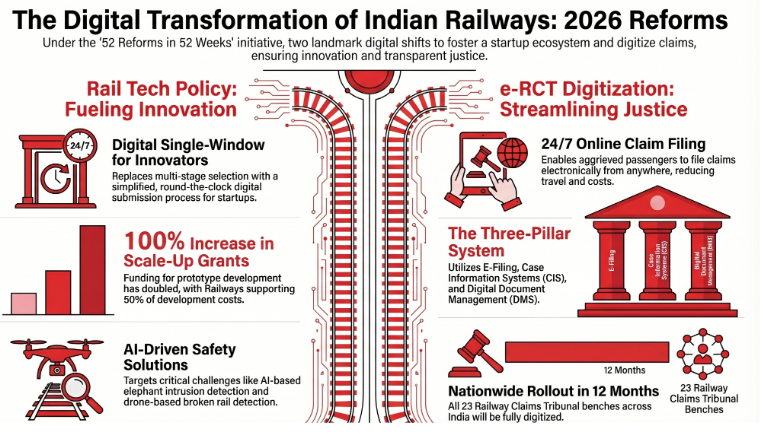
The Rail Tech Policy establishes a digital single-window for innovators and startups, significantly increasing grants and funding for critical technological solutions like AI-based intrusion and fire detection. Simultaneously, the e-RCT digitization project aims to overhaul the judicial process for railway-related claims through a 24/7 online filing system and centralized case tracking. Together, these initiatives seek to enhance operational safety, foster industrial innovation, and provide faster, more transparent access to justice for passengers.
The "52 Reforms in 52 Weeks" Initiative
Launched in 2026, this program represents a commitment by the Indian Railways to implement one major structural reform every week throughout the calendar year.
Core Objective: To achieve a comprehensive and transparent transformation of the railway network.
Strategic Alignment: The initiative aligns with the broader "Reforms Express" vision, building upon modernization efforts established over the previous decade.
Implementation: The program emphasizes time-bound delivery and accountability in railway governance.
The Rail Tech Policy: Driving Innovation
The Rail Tech Policy serves as a high-tech, round-the-clock digital single-window platform designed to integrate modern technology into railway operations.
1. Digital Integration and Access
Rail Tech Portal: A dedicated portal serves as a unified entry point for innovators, startups, industry players, and academic institutions to submit proposals.
Simplified Processing: The policy replaces outdated, multi-stage vendor selection with a streamlined, single-stage digital submission and processing mechanism.
2. Enhanced Financial Support
To encourage high-level research and development, the policy significantly boosts financial assistance:
Grant Increases: The scale-up grant has been increased more than three times, while the maximum grant for prototype development and trials has been doubled.
Development Funding: Indian Railways will support up to 50% of the development funding for viable technological solutions.
3. Key Technological Targets
The policy prioritizes several critical operational and safety challenges through advanced technology:
AI-Based Systems: Implementation of AI for Elephant Intrusion Detection Systems (EIDS), fire detection in coaches, and monitoring coach cleaning.
Autonomous Detection: Utilization of drones for broken rail detection and sensor-based load calculation for parcel vans.
Safety in Adverse Weather: Development of obstruction detection systems for foggy environments.
4. Scalability
Successful innovations are not limited to pilot programs. The policy provides for substantial long-term orders to enable the scaling of viable solutions across the entire national railway network.
Railway Claims Tribunal (e-RCT) Digitization
The Railway Claims Tribunal (RCT) is a quasi-judicial body established under the Railway Claims Tribunal Act, 1987. It adjudicates claims involving accidents (death or injury), loss of goods, and fare refunds. The digitization reform aims to modernize the 23 benches of the RCT located across India.
1. Core Digital Modules
The e-RCT platform is built upon three integrated components:
E-Filing: Provides 24/7 online claim filing with instant acknowledgments sent via SMS and email.
Case Information System (CIS): A centralized database that enables real-time tracking of cases from the initial filing to final disposal.
Document Management System (DMS): A digital repository for pleadings, orders, and judgments featuring digitally signed records for authenticity.
2. Citizen-Centric Benefits
The digitization of the tribunal provides several advantages for aggrieved passengers and litigants:
Jurisdictional Flexibility: Claimants can file electronically from anywhere in India, removing the confusion often associated with jurisdictional boundaries in cross-state travel incidents.
Efficiency and Cost Reduction: The system reduces the need for physical travel, printing, and courier services, leading to significant cost savings for litigants.
Transparency: Real-time updates and online access to orders ensure a more transparent judicial process with fewer adjournments.
3. Implementation and Future Scope
Timeline: All 23 RCT benches are scheduled to be fully digitized within 12 months.
Future Expansion: Success in the RCT model may lead to the extension of this digital framework to other judicial bodies, such as the Central Administrative Tribunal.
Conclusion
The Rail Tech Policy and e-RCT Digitization represent a two-pronged approach to railway reform. By leveraging AI and drone technology to solve operational hazards and utilizing digital platforms to streamline judicial processes, the Ministry of Railways aims to improve both the technical reliability of the network and its accountability to the public.