
National Science Day is observed annually in India on February 28th to commemorate the discovery of the Raman Effect by Sir Chandrasekhara Venkata Raman (CV Raman) in 1928. The 2026 celebration is centered on the theme "Women in Science: Catalyzing Viksit Bharat." This observance serves not only as a tribute to Raman’s groundbreaking contribution to physics which earned him the 1930 Nobel Prize but also as a platform to highlight the evolving role of women in the nation's scientific development. Beyond historical commemoration, the day underscores the enduring practical utility of Raman spectroscopy across diverse fields such as medicine, forensics, and materials science. 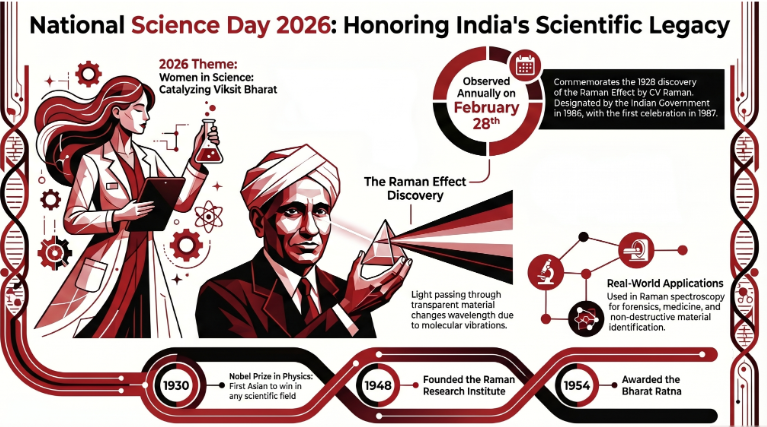
Historical Background and Significance
The Government of India officially designated February 28th as National Science Day in 1986. The primary objective was to honor the legacy of CV Raman and promote scientific temper within the country.
Inaugural Celebration: The first National Science Day was held in 1987.
Purpose: To mark the anniversary of the 1928 discovery of the Raman Effect.
2026 Theme: The current focus, "Women in Science: Catalyzing Viksit Bharat," emphasizes the critical role of female scientists in achieving a developed India.
Profile of Sir Chandrasekhara Venkata Raman (CV Raman)
Sir CV Raman remains one of India’s most influential physicists. His work was pivotal in proving the quantum nature of light and establishing a robust scientific infrastructure in India.
Key Honors and Recognition
Raman’s career was marked by several historic milestones, most notably being the first Asian and first non-White person to receive a Nobel Prize in any scientific field.
Year | Honor / Recognition |
1924 | Elected Fellow of the Royal Society (FRS) |
1929 | Received Knighthood |
1930 | Nobel Prize in Physics |
1954 | Bharat Ratna (India's highest civilian award) |
1957 | Lenin Peace Prize |
Institutional Legacy
Raman was instrumental in creating the foundations for modern Indian scientific research by establishing three enduring institutions:
Indian Journal of Physics (1926): A platform for scientific publication.
Indian Academy of Sciences (1934): A professional body for scientific advancement.
Raman Research Institute (1948): Located in Bengaluru, providing a dedicated space for research.
The Raman Effect: Discovery and Mechanism
Discovered in collaboration with KS Krishnan, the Raman Effect is a fundamental phenomenon in physics concerning the interaction of light and matter.
Definition: The phenomenon occurs when light passes through a transparent material. As it passes, the light undergoes a change in wavelength due to interaction with molecular vibrations.
Scientific Impact: This discovery provided critical evidence for the quantum nature of light.
Raman Spectroscopy: The effect forms the scientific basis for Raman spectroscopy, a non-destructive method used to analyze the molecular structure of materials.
Contemporary Applications of Raman Spectroscopy
The discovery of the Raman Effect continues to drive innovation and safety in various modern sectors. Because the method is non-destructive, it allows for the analysis of materials without altering their state.
Forensics and Law Enforcement: Enables the detection of drugs inside sealed evidence bags without opening them.
Medicine and Biology: Used for clinical analysis and understanding biological structures.
Materials Science and Chemistry: Utilized for non-destructive material identification and molecular analysis.
Environmental Safety: Provides a safe method for the analysis of nuclear waste.